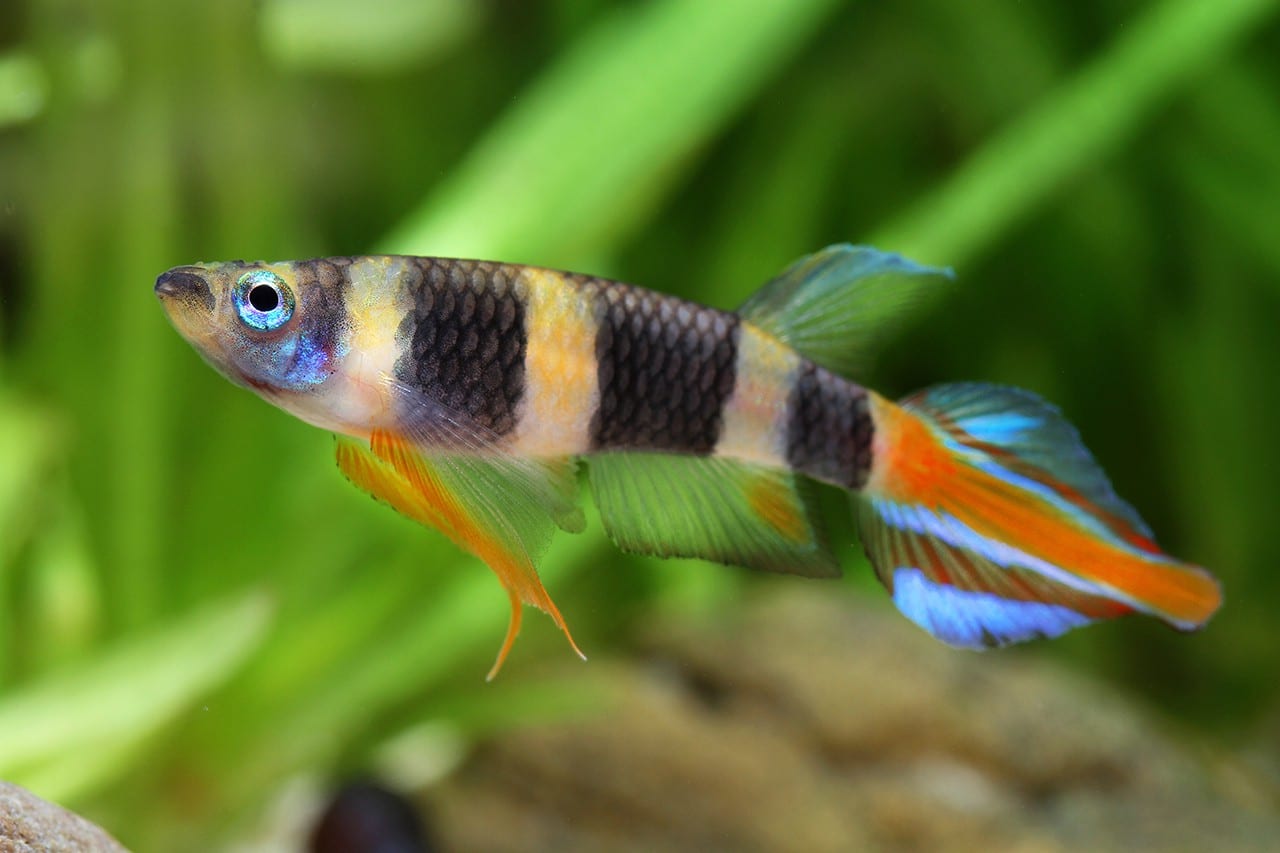
Banded panchax
Epiplatys annulatus
Parameter dashboard
23-26 °C
5.5-7
3.5 cm
3 years
Care guide
The clown killifish, also sold as the rocket killifish or banded panchax, is a tiny surface-dwelling fish from the coastal blackwaters of Guinea, Liberia and Sierra Leone in West Africa. It barely reaches 3.5 cm, with a cream body crossed by dark bands and, on males, a small flag-like tail marked in red and blue. They hang just under the surface with their upturned mouths, looking very much like a row of little rockets, which is where the trade name comes from.
These are micropredators that pick tiny insects, larvae and zooplankton off the surface, so they do best on small live and frozen foods like baby brine shrimp, with dried food only as a supplement. They are generally peaceful but make poor general community fish: anything boisterous will outcompete them, and their mouths are too small for normal flake. Keep them in a quiet species tank or with equally tiny, gentle companions. They are nervous in open space, so floating plants and a dark substrate help them settle and show their color.
Clown killifish want soft, acidic, warm water, roughly 23 to 26°C and a pH on the acid side of neutral, ideally tannin-stained. A tight lid is essential, since surface fish jump. They will spawn readily among fine-leaved floating plants, scattering a few eggs each day rather than in one batch; the fry are tiny and need infusoria-grade food at first, but a planted, predator-free tank will often raise a handful on its own.
Sources
- seriouslyfish.com — https://www.seriouslyfish.com/species/epiplatys-annulatus/
- en.wikipedia.org — https://en.wikipedia.org/wiki/Clown_killi
Further reading on identification and aquarium care.
Tankmate compatibility (sample)
Pairwise screening against other species in the database (prioritizing the same family when data is available).
Review first (8)
Caution or avoid from automated rules — confirm before mixing.
| Species | Assessment | Notes |
|---|---|---|
| Agassiz's dwarf cichlid Apistogramma agassizii Caution | Caution | Fish 2x+ larger may eat smaller tankmates Open pair in Compare → |
| Blue gularis Fundulopanchax sjostedti Caution | Caution | Fish 2x+ larger may eat smaller tankmates Open pair in Compare → |
| Blue lyretail Fundulopanchax gardneri Caution | Caution | close relatives, and one of them is territorial, so both claim the same kind of space Open pair in Compare → |
| Coolie loach Pangio semicincta Caution | Caution | Fish 2x+ larger may eat smaller tankmates Open pair in Compare → |
| Panda Loach Yaoshania pachychilus Caution | Caution | the two share only a narrow band of temperature, so one of them sits at the edge of its range Open pair in Compare → |
| Royal Farlowella Sturisomatichthys festivus Caution | Caution | Fish 2x+ larger may eat smaller tankmates Open pair in Compare → |
| Siamese fighting fish Betta splendens Caution | Caution | Fish 2x+ larger may eat smaller tankmates · one of these species is highly aggressive and is usually best kept on its own Open pair in Compare → |
| Siamese flying fox Crossocheilus oblongus Caution | Caution | Fish 2x+ larger may eat smaller tankmates Open pair in Compare → |
4 species with compatible assessment in this sampleCollapse to hide the list; use “Open pair in Compare” for the full matrix.
| Species | Assessment | Notes |
|---|---|---|
| Daisy's Rice Fish Oryzias woworae Compatible | Compatible | No rule-based conflicts detected for this pair. Open pair in Compare → |
| Dwarf danio Danio nigrofasciatus Compatible | Compatible | No rule-based conflicts detected for this pair. Open pair in Compare → |
| Palespotted corydoras Hoplisoma gossei Compatible | Compatible | No rule-based conflicts detected for this pair. Open pair in Compare → |
| Umbrella cichlid Apistogramma borellii Compatible | Compatible | No rule-based conflicts detected for this pair. Open pair in Compare → |
Same rule engine as Compare. Not a substitute for observation, tank size, or acclimation.
Related species
Was this page useful? Spot anything wrong?