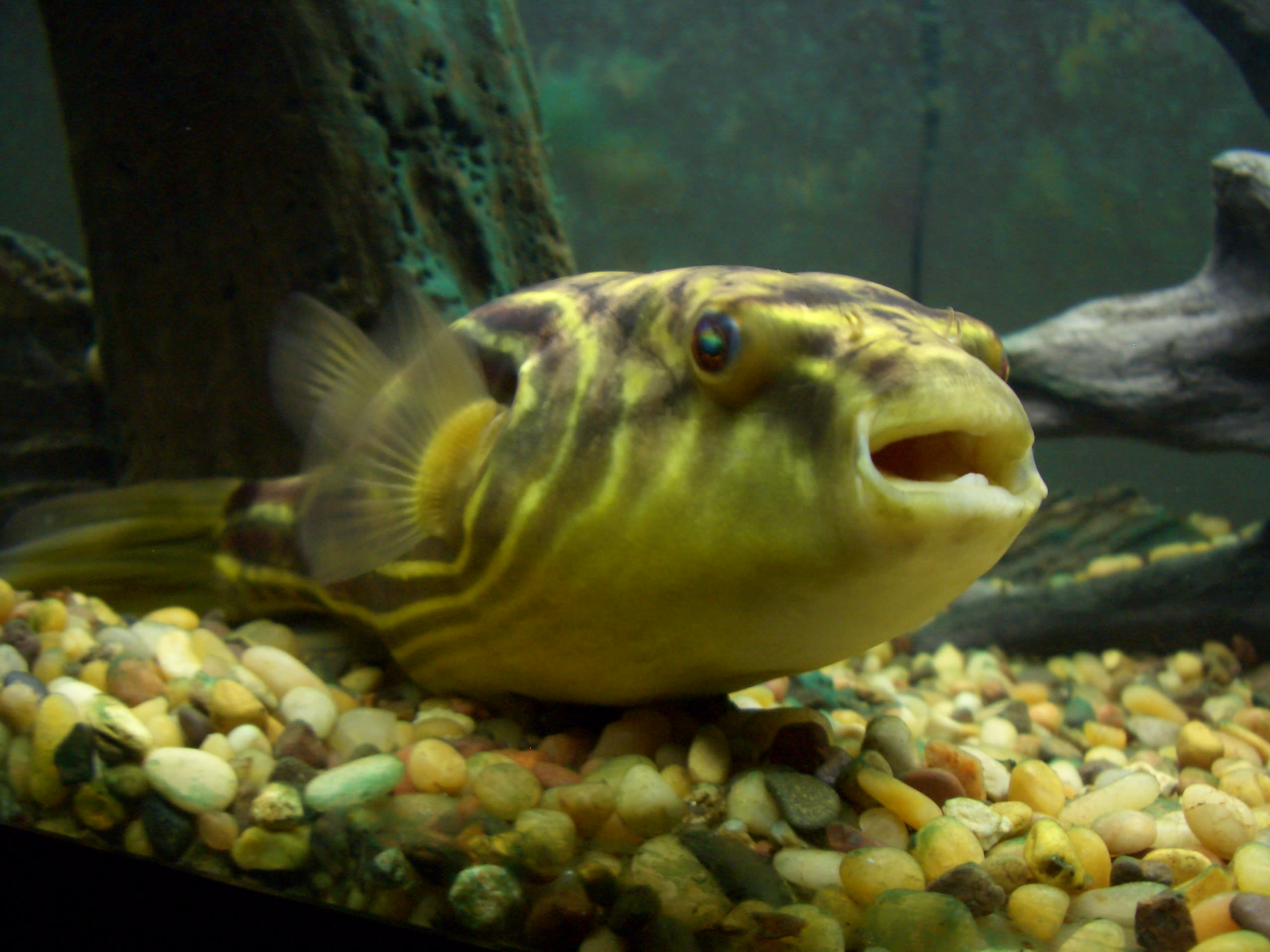
Globe fish
Tetraodon lineatus
Parameter dashboard
24-26 °C
6.5-7.5
43 cm
10 years
Care guide
The Fahaka puffer, also known as the Nile puffer or globe fish, is one of the largest freshwater puffer species and a fascinating but challenging aquarium inhabitant. Native to a wide stretch of Africa from Senegal to Egypt, it inhabits various lakes and rivers, frequenting both open water and sheltered, heavily vegetated areas. This species is a molluscivore in nature, equipped with powerful beak-like teeth that grow continuously and must be kept worn down through regular feeding of snails, unshelled shellfish, crab legs, and mussels. It also accepts worms and other live and frozen foods.
Temperament is the defining consideration with this fish — it is generally aggressive and intolerant, capable of biting chunks from tankmates with its beak-like mouth, and is best maintained alone. Even conspecifics are typically attacked, so group keeping demands an enormous tank and careful management. A single specimen requires a minimum of 450 litres with a sandy substrate, smooth rocks, driftwood, and plenty of open swimming space. Plants may be added but expect bite marks on leaves.
Water parameters should be tropical: 24-26°C, pH 6.5-7.5, with moderate hardness. The Fahaka develops a distinctive personality and will learn to interact with its owner, changing colour according to mood and surroundings. Inflation is often a response to a threat and should not be deliberately provoked. Keep hands clear of its powerful mouth during maintenance.
Sources
- seriouslyfish.com — https://www.seriouslyfish.com/species/tetraodon-lineatus/
- fishbase.se — https://www.fishbase.se/summary/Tetraodon-lineatus.html
Further reading on identification and aquarium care.
Tankmate compatibility (sample)
Pairwise screening against other species in the database (prioritizing the same family when data is available).
Review first (12)
Caution or avoid from automated rules — confirm before mixing.
| Species | Assessment | Notes |
|---|---|---|
| Adolf's catfish Corydoras adolfoi Avoid | Avoid | Fish 2x+ larger may eat smaller tankmates · one of these species is highly aggressive and is usually best kept on its own · one is boisterous and the other a much smaller peaceful fish sharing the same floor, where it can be intimidated and outcompeted at feeding time · Fahaka puffers are best kept alone: they can seriously injure or kill tankmates, including larger fish. Open pair in Compare → |
| Black ruby barb Pethia nigrofasciata Avoid | Avoid | Fish 2x+ larger may eat smaller tankmates · one of these species is highly aggressive and is usually best kept on its own · Fahaka puffers are best kept alone: they can seriously injure or kill tankmates, including larger fish. Open pair in Compare → |
| Celebes rainbowfish Marosatherina ladigesi Avoid | Avoid | Fish 2x+ larger may eat smaller tankmates · one of these species is highly aggressive and is usually best kept on its own · a highly aggressive fish takes long-finned tankmates for rivals and attacks them · Fahaka puffers are best kept alone: they can seriously injure or kill tankmates, including larger fish. Open pair in Compare → |
| Cockatoo cichlid Apistogramma cacatuoides Avoid | Avoid | Fish 2x+ larger may eat smaller tankmates · one of these species is highly aggressive and is usually best kept on its own · one is boisterous and the other a much smaller peaceful fish sharing the same floor, where it can be intimidated and outcompeted at feeding time · Fahaka puffers are best kept alone: they can seriously injure or kill tankmates, including larger fish. Open pair in Compare → |
| Eyespot pufferfish Tetraodon biocellatus Avoid | Avoid | Fish 2x+ larger may eat smaller tankmates · one of these species is highly aggressive and is usually best kept on its own · close relatives, and one of them is territorial, so both claim the same kind of space · Fahaka puffers are best kept alone: they can seriously injure or kill tankmates, including larger fish. Open pair in Compare → |
| Fire eel Mastacembelus erythrotaenia Avoid | Avoid | Fish 2x+ larger may eat smaller tankmates · one of these species is highly aggressive and is usually best kept on its own · a highly aggressive fish takes long-finned tankmates for rivals and attacks them · Fahaka puffers are best kept alone: they can seriously injure or kill tankmates, including larger fish. Open pair in Compare → |
| Glass catfish Kryptopterus vitreolus Avoid | Avoid | Fish 2x+ larger may eat smaller tankmates · one of these species is highly aggressive and is usually best kept on its own · Fahaka puffers are best kept alone: they can seriously injure or kill tankmates, including larger fish. Open pair in Compare → |
| Goldspotted snakehead Channa aurantimaculata Avoid | Avoid | Multiple territorial species in the same swim layer cause stress · one of these species is highly aggressive and is usually best kept on its own · Fahaka puffers are best kept alone: they can seriously injure or kill tankmates, including larger fish. Open pair in Compare → |
| Malabar pufferfish Carinotetraodon travancoricus Avoid | Avoid | Fish 2x+ larger may eat smaller tankmates · Multiple territorial species in the same swim layer cause stress · one of these species is highly aggressive and is usually best kept on its own · close relatives, and one of them is territorial, so both claim the same kind of space · Fahaka puffers are best kept alone: they can seriously injure or kill tankmates, including larger fish. Open pair in Compare → |
| Multies Neolamprologus multifasciatus Avoid | Avoid | Fish 2x+ larger may eat smaller tankmates · Species with non-overlapping pH ranges may not thrive together · one of these species is highly aggressive and is usually best kept on its own · Fahaka puffers are best kept alone: they can seriously injure or kill tankmates, including larger fish. Open pair in Compare → |
| Panda Uaru Uaru fernandezyepezi Avoid | Avoid | Fish 2x+ larger may eat smaller tankmates · Species with non-overlapping temperature ranges cannot coexist · Species with non-overlapping pH ranges may not thrive together · one of these species is highly aggressive and is usually best kept on its own · the two share only a narrow band of temperature, so one of them sits at the edge of its range · Fahaka puffers are best kept alone: they can seriously injure or kill tankmates, including larger fish. Open pair in Compare → |
| Threespot eartheater Satanoperca daemon Avoid | Avoid | Multiple territorial species in the same swim layer cause stress · Species with non-overlapping pH ranges may not thrive together · one of these species is highly aggressive and is usually best kept on its own · Fahaka puffers are best kept alone: they can seriously injure or kill tankmates, including larger fish. Open pair in Compare → |
Same rule engine as Compare. Not a substitute for observation, tank size, or acclimation.
Related species
Was this page useful? Spot anything wrong?