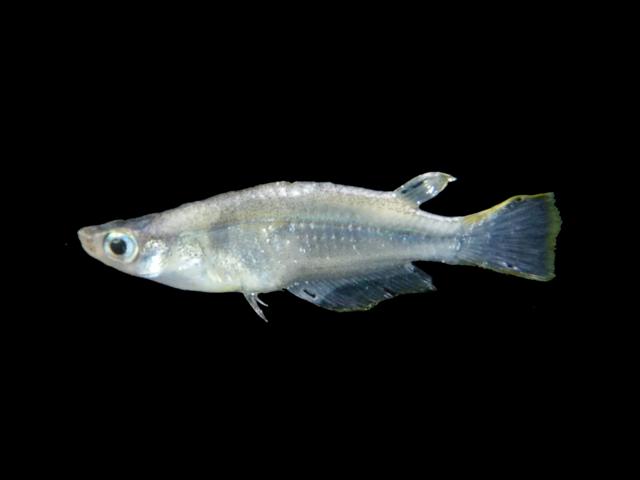
Javanese ricefish
Oryzias javanicus
Parameter dashboard
24-29 °C
7-9
3.5 cm
Care guide
The Javanese ricefish is a small, hardy surface-dwelling species widely distributed throughout Southeast Asia, from Peninsular Thailand and Malaysia through Singapore and Indonesia, including Sumatra, Java, Borneo, Bali, Lombok, and Sulawesi. Its common name derives from its tendency to inhabit rice paddies and shallow coastal waters, and like other members of the family Adrianichthyidae, it is noted for its unusual reproductive strategy — females briefly carry a cluster of fertilised eggs near the vent before depositing them among vegetation. Reaching only about 3.5 cm, these are subtle fish with a semi-translucent body that blends into their natural environment, making them ideal nano-aquarium residents.
Javanese ricefish are particularly interesting for their tolerance of a wide salinity range. In nature they are typically found in coastal brackish streams, mangrove swamps, and pools, though they also occur in freshwater habitats. This adaptability makes them suitable for a variety of aquarium setups, from pure freshwater to low-end brackish. The minimum tank size for a group of six or more is about 40 litres, with a footprint of at least 45 × 30 cm. They thrive in densely planted aquaria with gentle filtration, and a tight-fitting lid is essential as they are known jumpers. Water temperature should be maintained at 24–29°C, with a pH of 7.0–9.0 reflecting their coastal, slightly alkaline natural habitat.
A peaceful shoaling species, the Javanese ricefish does best in groups of six or more where the subtle hierarchy of males displaying to females becomes apparent. They are omnivorous and accept finely crushed flake, micro-pellets, and small live or frozen foods such as brine shrimp nauplii and daphnia. Their small size and peaceful demeanour make them excellent companions for other nano fish like dwarf rasboras, small shrimp, and similarly-sized livebearers. They are one of the easier ricefish to breed in captivity, with the egg cluster on the female clearly visible — eggs can be gently removed to a separate container for rearing.
Sources
- seriouslyfish.com — https://www.seriouslyfish.com/species/oryzias-javanicus/
- fishbase.se — https://www.fishbase.se/summary/Oryzias-javanicus.html
Further reading on identification and aquarium care.
Tankmate compatibility (sample)
Pairwise screening against other species in the database (prioritizing the same family when data is available).
Review first (8)
Caution or avoid from automated rules — confirm before mixing.
| Species | Assessment | Notes |
|---|---|---|
| Bronze corydoras Osteogaster aenea Caution | Caution | Fish 2x+ larger may eat smaller tankmates Open pair in Compare → |
| Chili Rasbora Boraras brigittae Caution | Caution | Species with non-overlapping pH ranges may not thrive together Open pair in Compare → |
| Congo tetra Phenacogrammus interruptus Caution | Caution | Fish 2x+ larger may eat smaller tankmates Open pair in Compare → |
| Red Wolf Fish Erythrinus erythrinus Caution | Caution | Fish 2x+ larger may eat smaller tankmates Open pair in Compare → |
| Ruby barb Pethia padamya Caution | Caution | the two share only a narrow band of temperature, so one of them sits at the edge of its range Open pair in Compare → |
| Siamese fighting fish Betta splendens Caution | Caution | Fish 2x+ larger may eat smaller tankmates · one of these species is highly aggressive and is usually best kept on its own Open pair in Compare → |
| Emerald Dwarf Rasbora Danio erythromicron Avoid | Avoid | Species with non-overlapping temperature ranges cannot coexist · the two share only a narrow band of temperature, so one of them sits at the edge of its range Open pair in Compare → |
| Japanese rice fish Oryzias latipes Avoid | Avoid | Species with non-overlapping temperature ranges cannot coexist · the two share only a narrow band of temperature, so one of them sits at the edge of its range Open pair in Compare → |
4 species with compatible assessment in this sampleCollapse to hide the list; use “Open pair in Compare” for the full matrix.
| Species | Assessment | Notes |
|---|---|---|
| Daisy's Rice Fish Oryzias woworae Compatible | Compatible | No rule-based conflicts detected for this pair. Open pair in Compare → |
| Endlers guppy Poecilia wingei Compatible | Compatible | No rule-based conflicts detected for this pair. Open pair in Compare → |
| Galaxy rasbora Danio margaritatus Compatible | Compatible | No rule-based conflicts detected for this pair. Open pair in Compare → |
| Honey gourami Trichogaster chuna Compatible | Compatible | No rule-based conflicts detected for this pair. Open pair in Compare → |
Same rule engine as Compare. Not a substitute for observation, tank size, or acclimation.
Related species
Was this page useful? Spot anything wrong?