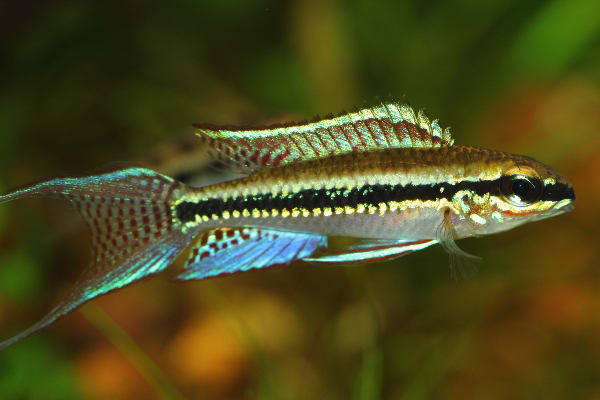
Chessboard cichlid
Dicrossus filamentosus
Parameter dashboard
27-30 °C
4.5-7
10.2 cm
5 years
Care guide
The checkerboard cichlid, also known as the lyretail checkerboard cichlid, is a jewel of the dwarf cichlid world, prized for its intricate checkerboard patterning and elegant finnage. Native to blackwater habitats in Colombia, Venezuela, and the Brazilian Rio Negro, it inhabits soft, acidic waters rich in tannins with dense vegetation and dim lighting. Males reach up to 10 cm (4 inches) with spectacular lyre-shaped tail fins, while females are smaller at around 7.5 cm (3 inches) with rounded tails.
Despite being a cichlid, this species is relatively peaceful and shy, often hugging the bottom among plants and leaf litter. They are best maintained in a well-planted aquarium with dim lighting, plenty of hiding places, and floating plants to diffuse the light. A tank of at least 71 litres is suitable for a pair or small group. They can be combined with other peaceful, similarly-sized fish but will struggle against more aggressive tankmates.
Water conditions are critical: higher temperatures of 27-30°C and very soft, acidic water (pH 4.5-7.0) are required, with RO water nearly mandatory for breeding success. Diet should include quality sinking cichlid pellets, spirulina flakes, and plenty of frozen foods; live Daphnia is excellent for conditioning. The checkerboard cichlid is not the easiest species to find in local fish shops but rewards the dedicated aquarist with unmatched elegance.
Sources
- seriouslyfish.com — https://www.seriouslyfish.com/species/dicrossus-filamentosus/
- fishbase.se — https://www.fishbase.se/summary/Dicrossus-filamentosus.html
Further reading on identification and aquarium care.
Tankmate compatibility (sample)
Pairwise screening against other species in the database (prioritizing the same family when data is available).
Review first (12)
Caution or avoid from automated rules — confirm before mixing.
| Species | Assessment | Notes |
|---|---|---|
| Blue streak hap Labidochromis caeruleus Caution | Caution | Species with non-overlapping pH ranges may not thrive together · the two share only a narrow band of temperature, so one of them sits at the edge of its range · close relatives, and one of them is territorial, so both claim the same kind of space Open pair in Compare → |
| Guayas cichlid Cichlasoma festae Caution | Caution | Fish 2x+ larger may eat smaller tankmates · Species with non-overlapping pH ranges may not thrive together · close relatives, and one of them is territorial, so both claim the same kind of space Open pair in Compare → |
| Oscar Astronotus ocellatus Caution | Caution | Fish 2x+ larger may eat smaller tankmates · the two share only a narrow band of temperature, so one of them sits at the edge of its range · close relatives, and one of them is territorial, so both claim the same kind of space Open pair in Compare → |
| Threespot eartheater Satanoperca daemon Caution | Caution | Fish 2x+ larger may eat smaller tankmates · Multiple territorial species in the same swim layer cause stress · the two share only a narrow band of temperature, so one of them sits at the edge of its range · close relatives, and one of them is territorial, so both claim the same kind of space Open pair in Compare → |
| Venustus Cichlid Nimbochromis venustus Caution | Caution | Fish 2x+ larger may eat smaller tankmates · Species with non-overlapping pH ranges may not thrive together · the two share only a narrow band of temperature, so one of them sits at the edge of its range · close relatives, and one of them is territorial, so both claim the same kind of space Open pair in Compare → |
| Fasciatus Shell Dweller Altolamprologus fasciatus Avoid | Avoid | Species with non-overlapping temperature ranges cannot coexist · Species with non-overlapping pH ranges may not thrive together · the two share only a narrow band of temperature, so one of them sits at the edge of its range · close relatives, and one of them is territorial, so both claim the same kind of space Open pair in Compare → |
| Haitian cichlid Nandopsis haitiensis Avoid | Avoid | Fish 2x+ larger may eat smaller tankmates · Multiple territorial species in the same swim layer cause stress · Species with non-overlapping temperature ranges cannot coexist · Species with non-overlapping pH ranges may not thrive together · the two share only a narrow band of temperature, so one of them sits at the edge of its range · close relatives, and one of them is territorial, so both claim the same kind of space Open pair in Compare → |
| Leleupi Cichlid Neolamprologus leleupi Avoid | Avoid | Species with non-overlapping temperature ranges cannot coexist · Species with non-overlapping pH ranges may not thrive together · the two share only a narrow band of temperature, so one of them sits at the edge of its range · close relatives, and one of them is territorial, so both claim the same kind of space Open pair in Compare → |
| Multies Neolamprologus multifasciatus Avoid | Avoid | Fish 2x+ larger may eat smaller tankmates · Species with non-overlapping temperature ranges cannot coexist · Species with non-overlapping pH ranges may not thrive together · the two share only a narrow band of temperature, so one of them sits at the edge of its range · close relatives, and one of them is territorial, so both claim the same kind of space Open pair in Compare → |
| Princess of Burundi Neolamprologus brichardi Avoid | Avoid | Species with non-overlapping temperature ranges cannot coexist · Species with non-overlapping pH ranges may not thrive together · the two share only a narrow band of temperature, so one of them sits at the edge of its range · close relatives, and one of them is territorial, so both claim the same kind of space Open pair in Compare → |
| Temporaris Shell Dweller Telmatochromis temporalis Avoid | Avoid | Fish 2x+ larger may eat smaller tankmates · Species with non-overlapping temperature ranges cannot coexist · Species with non-overlapping pH ranges may not thrive together · the two share only a narrow band of temperature, so one of them sits at the edge of its range · close relatives, and one of them is territorial, so both claim the same kind of space Open pair in Compare → |
| Umbrella cichlid Apistogramma borellii Avoid | Avoid | Species with non-overlapping temperature ranges cannot coexist · the two share only a narrow band of temperature, so one of them sits at the edge of its range · close relatives, and one of them is territorial, so both claim the same kind of space · one is boisterous and the other a much smaller peaceful fish sharing the same floor, where it can be intimidated and outcompeted at feeding time Open pair in Compare → |
Same rule engine as Compare. Not a substitute for observation, tank size, or acclimation.
Related species
Was this page useful? Spot anything wrong?