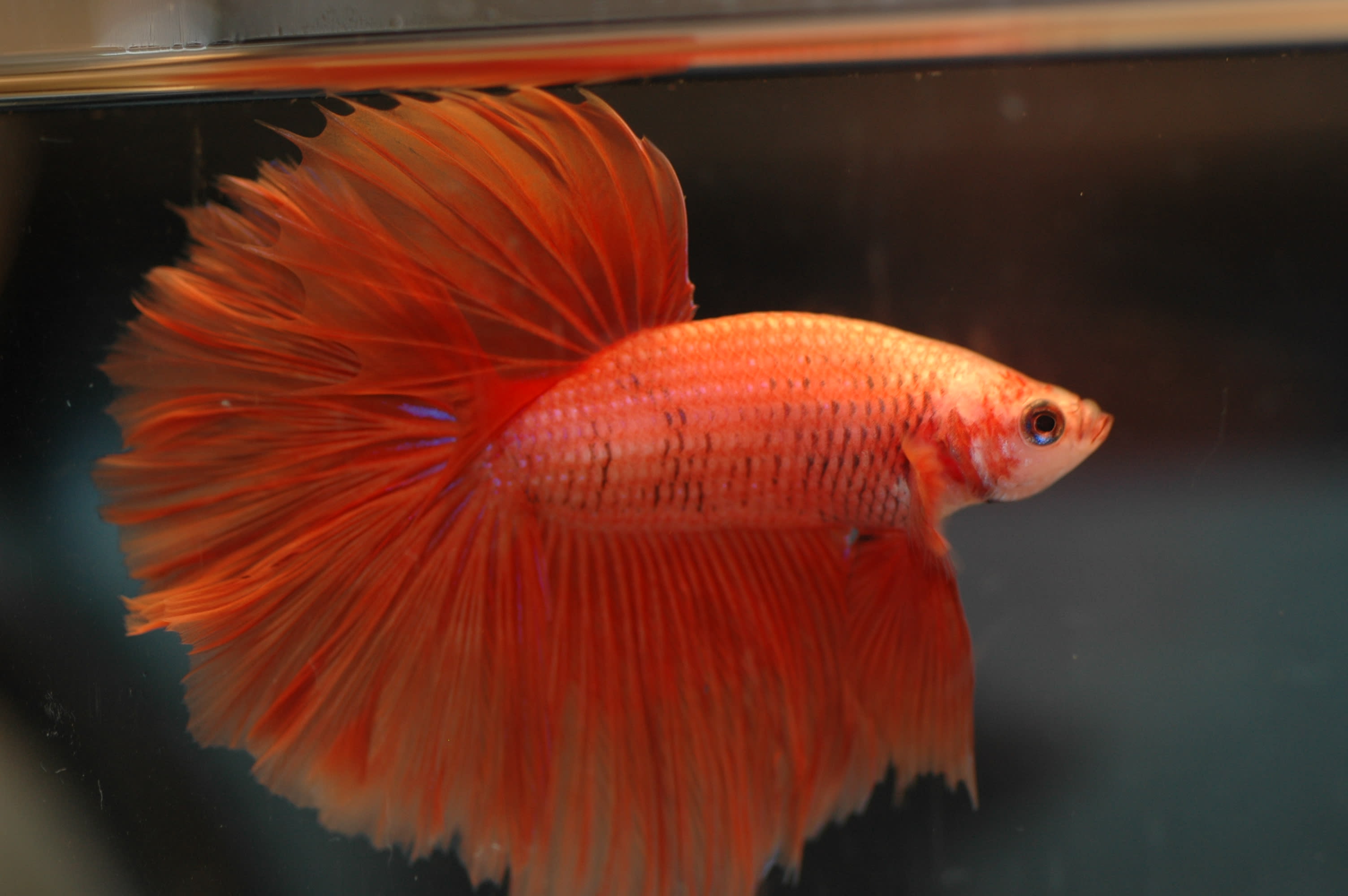
Siamese fighting fish
Betta splendens
Parameter dashboard
22-30 °C
6-8
7 cm
3 years
Care guide
Siamese fighting fish reach about 7 cm standard length. Keep a single male in a mature, heated aquarium with gentle filtration, plants and surface cover. A minimum of 20 litres is the single-fish housing baseline used here; larger aquariums provide more swimming room and easier water stability. This baseline does not cover keeping a pair or adding community fish.
The published species ranges are 22–30 °C and pH 6.0–8.0. Keep conditions stable and avoid exposing fish to cold rooms. Their labyrinth organ permits air breathing, so leave access to the surface and fit a secure lid. Offer a quality betta pellet with small live or frozen invertebrates, and avoid overfeeding.
Males must be kept separately. A male and female are not a routine display pair; breeding introductions require supervision and a way to separate them. Community keeping depends on the individual and needs more space and cover. Avoid fin-nippers, other territorial labyrinth fish and potential prey such as dwarf shrimp; be ready to separate incompatible fish.
Sources
- seriouslyfish.com — https://www.seriouslyfish.com/species/betta-splendens/
- aquariumcoop.com — https://www.aquariumcoop.com/blogs/aquarium/betta-fish-care-guide
- aqueon.com — https://www.aqueon.com/resources/care-guides/betta
Further reading on identification and aquarium care.
Tankmate compatibility (sample)
Pairwise screening against other species in the database (prioritizing the same family when data is available).
Review first (11)
Caution or avoid from automated rules — confirm before mixing.
| Species | Assessment | Notes |
|---|---|---|
| Chocolate gourami Sphaerichthys osphromenoides Caution | Caution | one of these species is highly aggressive and is usually best kept on its own · close relatives, and one of them is territorial, so both claim the same kind of space Open pair in Compare → |
| Dwarf gourami Trichogaster lalius Caution | Caution | Multiple territorial species in the same swim layer cause stress · one of these species is highly aggressive and is usually best kept on its own · close relatives, and one of them is territorial, so both claim the same kind of space Open pair in Compare → |
| Honey gourami Trichogaster chuna Caution | Caution | one of these species is highly aggressive and is usually best kept on its own · close relatives, and one of them is territorial, so both claim the same kind of space Open pair in Compare → |
| Pygmy gourami Trichopsis pumila Caution | Caution | one of these species is highly aggressive and is usually best kept on its own · close relatives, and one of them is territorial, so both claim the same kind of space Open pair in Compare → |
| Alien betta Betta splendens hybrid Avoid | Avoid | one of these species is highly aggressive and is usually best kept on its own · a highly aggressive fish takes long-finned tankmates for rivals and attacks them · close relatives, and one of them is territorial, so both claim the same kind of space Open pair in Compare → |
| Crescent betta Betta imbellis Avoid | Avoid | one of these species is highly aggressive and is usually best kept on its own · a highly aggressive fish takes long-finned tankmates for rivals and attacks them · close relatives, and one of them is territorial, so both claim the same kind of space Open pair in Compare → |
| Galaxy betta Betta splendens Avoid | Avoid | Multiple territorial species in the same swim layer cause stress · one of these species is highly aggressive and is usually best kept on its own · a highly aggressive fish takes long-finned tankmates for rivals and attacks them · close relatives, and one of them is territorial, so both claim the same kind of space Open pair in Compare → |
| Pearl gourami Trichopodus leerii Avoid | Avoid | one of these species is highly aggressive and is usually best kept on its own · a highly aggressive fish takes long-finned tankmates for rivals and attacks them · close relatives, and one of them is territorial, so both claim the same kind of space Open pair in Compare → |
| Snakehead Betta Betta channoides Avoid | Avoid | Multiple territorial species in the same swim layer cause stress · one of these species is highly aggressive and is usually best kept on its own · a highly aggressive fish takes long-finned tankmates for rivals and attacks them · close relatives, and one of them is territorial, so both claim the same kind of space Open pair in Compare → |
| Three spot gourami Trichogaster trichopterus Avoid | Avoid | Fish 2x+ larger may eat smaller tankmates · Multiple territorial species in the same swim layer cause stress · one of these species is highly aggressive and is usually best kept on its own · a highly aggressive fish takes long-finned tankmates for rivals and attacks them · close relatives, and one of them is territorial, so both claim the same kind of space Open pair in Compare → |
| White Seam Betta Betta albimarginata Avoid | Avoid | Fish 2x+ larger may eat smaller tankmates · Multiple territorial species in the same swim layer cause stress · one of these species is highly aggressive and is usually best kept on its own · a highly aggressive fish takes long-finned tankmates for rivals and attacks them · close relatives, and one of them is territorial, so both claim the same kind of space Open pair in Compare → |
Same rule engine as Compare. Not a substitute for observation, tank size, or acclimation.
Related species
Was this page useful? Spot anything wrong?