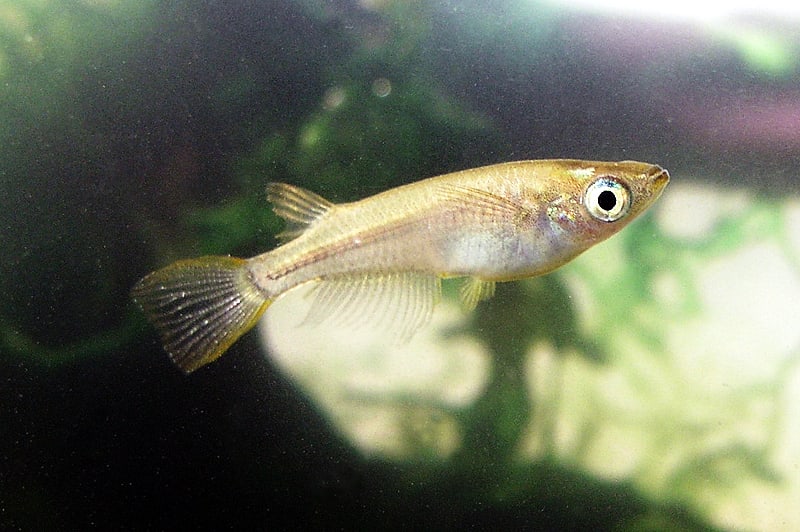
Japanese rice fish
Oryzias latipes
Parameter dashboard
16-22 °C
6.5-8.5
3.6 cm
4 years
Care guide
The Japanese rice fish or medaka (Oryzias latipes) is a small, adaptable adrianichthyid native to East Asia, including Japan, Korea, eastern China, Taiwan, and parts of Southeast Asia. It inhabits a wide variety of shallow, vegetated waters including rice paddies, ponds, oxbows, agricultural canals, and tidal mangrove swamps, where it tolerates both freshwater and brackish conditions. Males reach a maximum standard length of approximately 3.6 cm and are distinguished from females by their elongated, filamentous dorsal and anal fin rays. The medaka has been kept in captivity for centuries, first in Japan and later worldwide, and has also been an important model organism in genetic research. This is a temperate to subtropical species that does best at cooler temperatures between 16 and 22 °C and should not be maintained permanently in heated tropical aquaria, to maintain the recommended cooler conditions. It is a micropredator that feeds on small insects, worms, and crustaceans in nature and accepts quality dried foods supplemented with live and frozen fare in captivity. Peaceful and schooling by nature, it should be kept in groups of at least 8 to 10 specimens in a planted aquarium with base dimensions of at least 45 × 30 cm.
Source
Further reading on identification and aquarium care.
Tankmate compatibility (sample)
Pairwise screening against other species in the database (prioritizing the same family when data is available).
Review first (10)
Caution or avoid from automated rules — confirm before mixing.
| Species | Assessment | Notes |
|---|---|---|
| Bleeding-heart tetra Hyphessobrycon erythrostigma Caution | Caution | the two share only a narrow band of temperature, so one of them sits at the edge of its range Open pair in Compare → |
| Butterfly splitfin Ameca splendens Caution | Caution | Fish 2x+ larger may eat smaller tankmates Open pair in Compare → |
| Giant danio Devario malabaricus Caution | Caution | Fish 2x+ larger may eat smaller tankmates Open pair in Compare → |
| Green terror Andinoacara rivulatus Caution | Caution | Fish 2x+ larger may eat smaller tankmates Open pair in Compare → |
| Agassiz's dwarf cichlid Apistogramma agassizii Avoid | Avoid | Fish 2x+ larger may eat smaller tankmates · Species with non-overlapping temperature ranges cannot coexist · the two share only a narrow band of temperature, so one of them sits at the edge of its range Open pair in Compare → |
| Bolivian Ram Mikrogeophagus altispinosus Avoid | Avoid | Fish 2x+ larger may eat smaller tankmates · Species with non-overlapping temperature ranges cannot coexist · the two share only a narrow band of temperature, so one of them sits at the edge of its range Open pair in Compare → |
| Daisy's Rice Fish Oryzias woworae Avoid | Avoid | Species with non-overlapping temperature ranges cannot coexist · the two share only a narrow band of temperature, so one of them sits at the edge of its range Open pair in Compare → |
| Javanese ricefish Oryzias javanicus Avoid | Avoid | Species with non-overlapping temperature ranges cannot coexist · the two share only a narrow band of temperature, so one of them sits at the edge of its range Open pair in Compare → |
| South American freshwater stingray Potamotrygon motoro Avoid | Avoid | Fish 2x+ larger may eat smaller tankmates · Species with non-overlapping temperature ranges cannot coexist · Species with non-overlapping pH ranges may not thrive together · the two share only a narrow band of temperature, so one of them sits at the edge of its range Open pair in Compare → |
| Whiptail Catfish Loricaria simillima Avoid | Avoid | Fish 2x+ larger may eat smaller tankmates · Species with non-overlapping temperature ranges cannot coexist · the two share only a narrow band of temperature, so one of them sits at the edge of its range Open pair in Compare → |
2 species with compatible assessment in this sampleCollapse to hide the list; use “Open pair in Compare” for the full matrix.
| Species | Assessment | Notes |
|---|---|---|
| Amano Shrimp Caridina multidentata Compatible | Compatible | No rule-based conflicts detected for this pair. Open pair in Compare → |
| Red phantom tetra Hyphessobrycon sweglesi Compatible | Compatible | No rule-based conflicts detected for this pair. Open pair in Compare → |
Same rule engine as Compare. Not a substitute for observation, tank size, or acclimation.
Related species
Was this page useful? Spot anything wrong?