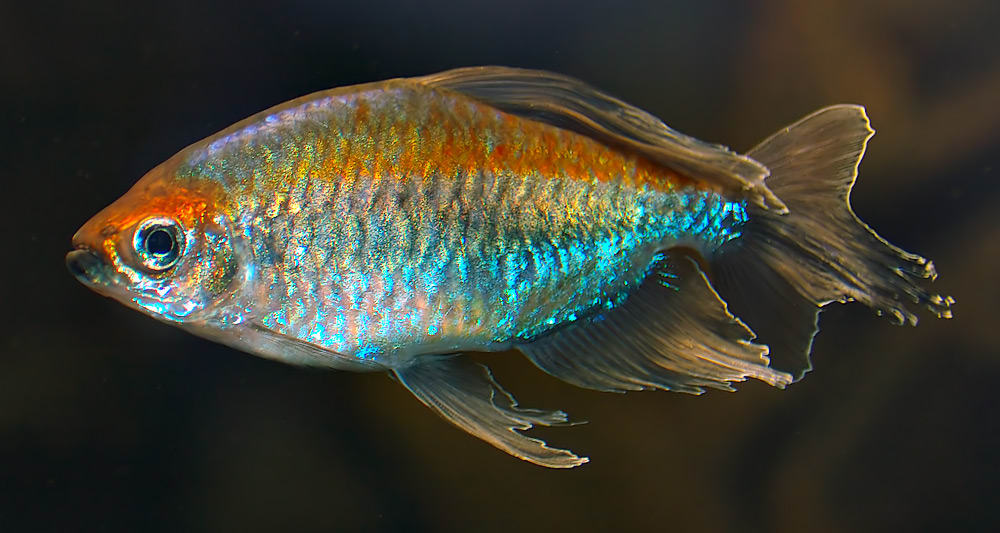
Congo tetra
Phenacogrammus interruptus
Parameter dashboard
23-28 °C
6-7.5
8 cm
5 years
Care guide
The Congo tetra is one of the most majestic of all characins, prized for the iridescent rainbow sheen that sweeps across the flanks of mature males — a shifting blend of blue, green, gold, and red that no photograph quite captures. Endemic to the upper and middle River Congo drainage in the Democratic Republic of Congo, this species inhabits soft, acidic waters shaded by dense rainforest canopy. Males reach about 8 cm in length and develop spectacular flowing fin extensions on the dorsal, caudal, and anal fins that are unique among tetras, while females are smaller at around 6 cm and more modestly coloured. Most fish in the trade are commercially bred in the Far East and Eastern Europe, which has helped reduce pressure on wild populations.
Congo tetras are active, peaceful shoalers that must be kept in groups of six or more, where males constantly display to one another in a shimmering contest that is one of the great sights in the freshwater hobby. A 120-litre tank is the minimum for a group of adults, and the tank should be at least 120 cm long to accommodate their active swimming. They do best in a well-planted setup with plenty of open swimming space, some driftwood branches, and a darker substrate that helps their colours pop. Water conditions should be soft and acidic to neutral: temperature 23–28°C, pH 6.0–7.5, with hardness of 3–18 dH. Good circulation and regular water changes are essential since they are sensitive to deteriorating water quality.
In nature, Congo tetras are omnivores feeding on small worms, insects, crustaceans, and zooplankton. In the aquarium they accept most quality flake and pellet foods without fuss, but live and frozen offerings — bloodworms, brine shrimp, daphnia, and mosquito larvae — should form a significant part of the diet for the fish to exhibit their best colouration and fin development. Ideal tankmates include other medium-sized tetras, rainbowfish, Corydoras catfish, Loricariids, Synodontis, and peaceful cichlids. Avoid fin-nipping species that will destroy the spectacular fins of the males, and avoid boisterous tankmates due to their somewhat shy nature. Congo tetras are egg-scatterers that spawn over fine-leaved plants; the eggs hatch in about six days. Aquarium lifespan estimates are around 5 years with suitable care.
Sources
- seriouslyfish.com — https://www.seriouslyfish.com/species/phenacogrammus-interruptus/
- fishbase.se — https://www.fishbase.se/summary/Phenacogrammus-interruptus.html
Further reading on identification and aquarium care.
Tankmate compatibility (sample)
Pairwise screening against other species in the database (prioritizing the same family when data is available).
Review first (7)
Caution or avoid from automated rules — confirm before mixing.
| Species | Assessment | Notes |
|---|---|---|
| Black Arowana Osteoglossum ferreirai Caution | Caution | Fish 2x+ larger may eat smaller tankmates Open pair in Compare → |
| Boeseman's rainbowfish Melanotaenia boesemani Caution | Caution | the two share only a narrow band of temperature, so one of them sits at the edge of its range Open pair in Compare → |
| Electric blue ram Mikrogeophagus ramirezi Caution | Caution | Fish 2x+ larger may eat smaller tankmates · the two share only a narrow band of temperature, so one of them sits at the edge of its range Open pair in Compare → |
| Glowlight tetra Hemigrammus erythrozonus Caution | Caution | Fish 2x+ larger may eat smaller tankmates Open pair in Compare → |
| Reticulated Sae Crossocheilus reticulatus Caution | Caution | Fish 2x+ larger may eat smaller tankmates · the two share only a narrow band of temperature, so one of them sits at the edge of its range Open pair in Compare → |
| Rosy tetra Hyphessobrycon rosaceus Caution | Caution | Fish 2x+ larger may eat smaller tankmates Open pair in Compare → |
| Threadfin rainbowfish Iriatherina werneri Caution | Caution | Fish 2x+ larger may eat smaller tankmates Open pair in Compare → |
5 species with compatible assessment in this sampleCollapse to hide the list; use “Open pair in Compare” for the full matrix.
| Species | Assessment | Notes |
|---|---|---|
| Amano Shrimp Caridina multidentata Compatible | Compatible | No rule-based conflicts detected for this pair. Open pair in Compare → |
| Blue danio Brachydanio kerri Compatible | Compatible | No rule-based conflicts detected for this pair. Open pair in Compare → |
| Chen Hillstream Loach Pseudogastromyzon cheni Compatible | Compatible | No rule-based conflicts detected for this pair. Open pair in Compare → |
| Leopard corydoras Corydoras julii Compatible | Compatible | No rule-based conflicts detected for this pair. Open pair in Compare → |
| Striped panchax Aplocheilus lineatus Compatible | Compatible | No rule-based conflicts detected for this pair. Open pair in Compare → |
Same rule engine as Compare. Not a substitute for observation, tank size, or acclimation.
Was this page useful? Spot anything wrong?