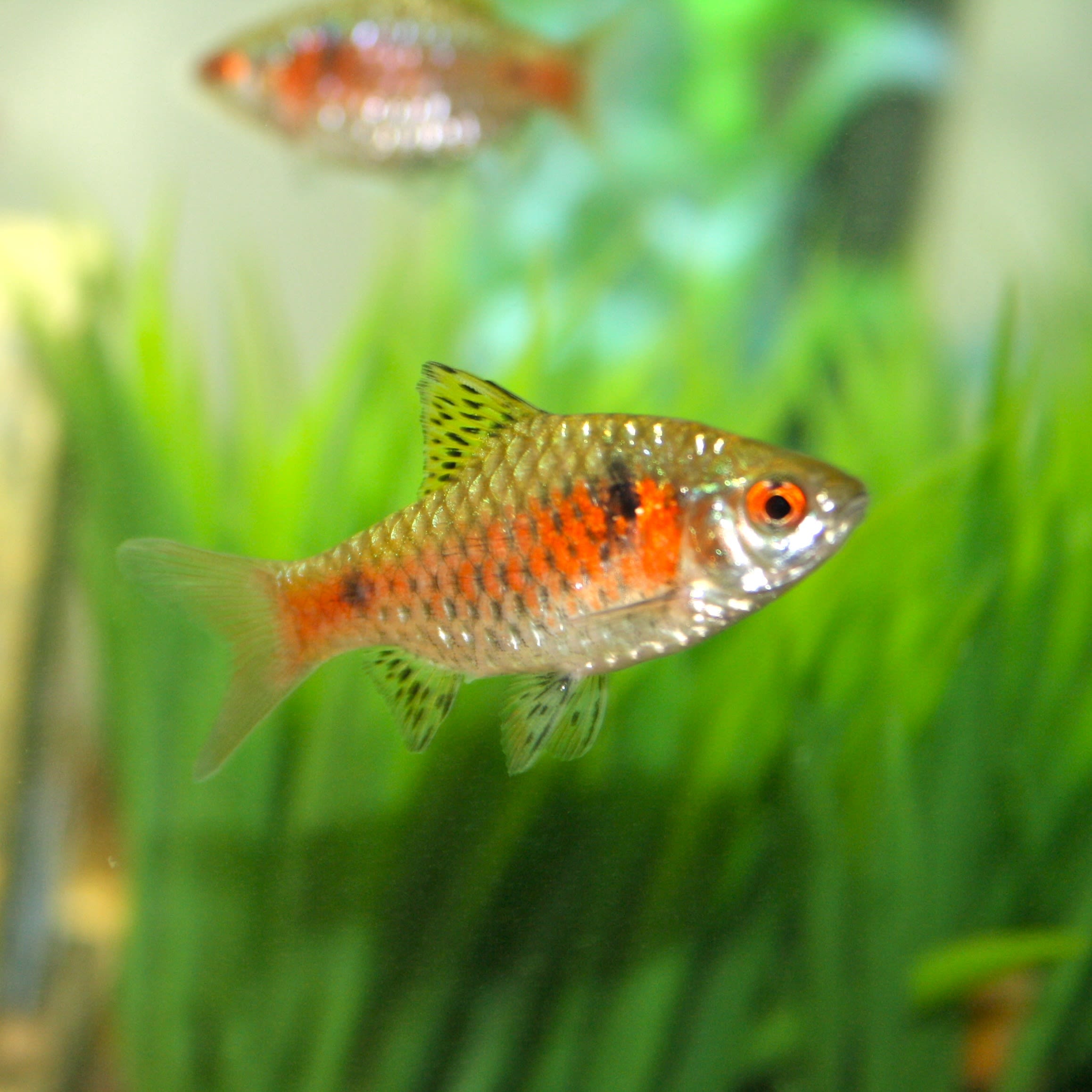
Ruby barb
Pethia padamya
Parameter dashboard
20-25 °C
6.5-7.5
4.6 cm
Care guide
The Odessa Barb (Pethia padamya) is a striking cyprinid endemic to the clear, cool streams of central Myanmar, where it inhabits well-oxygenated waters flowing over limestone in the Mandalay region at elevations around 1,000 meters. Known in the aquarium trade since the 1970s, it first appeared via the Ukrainian port of Odessa — hence its common name — and was long mistaken for an artificially dyed fish due to its intense coloration before wild populations were finally discovered in Myanmar in 2003. Males display a brilliant ruby-red band along the flanks that gives the species its specific epithet (padamya meaning "ruby" in Burmese), complemented by translucent fins edged in black and a dark vertical humeral marking, making them one of the most visually striking small barbs available to aquarists.
Despite their vivid appearance, Odessa Barbs are peaceful community fish that thrive in groups of eight to ten or more, where males compete for hierarchy through displays of intensified color and subtle fin flares. They are best maintained alongside comparably-sized open-water cyprinids such as Danio choprae, Danio albolineatus, and Pethia stoliczkana, as well as benthic loaches from the Ayeyarwady basin. As omnivorous foragers, they accept a wide range of foods but develop their finest colors when offered regular live and frozen fare like bloodworm, Daphnia, and Artemia alongside high-quality dried flakes with plant or algal content. A well-planted aquarium with a dark substrate and floating plants to diffuse light provides the ideal setting for showcasing their striking coloration.
As a cool-water barb from high-altitude streams, the Odessa Barb thrives at temperatures between 20–25°C with neutral to slightly alkaline pH and moderate to hard water. A tank with base dimensions of at least 80 × 30 cm (roughly 80 liters) provides sufficient swimming space for a group. Like most small cyprinids, they are egg-scattering free spawners exhibiting no parental care — when well-conditioned, adults spawn regularly and scatter adhesive eggs among fine-leaved plants or spawning mops. The eggs hatch in 24–48 hours, and fry become free-swimming about a day later. Initial foods should be infusoria-grade, progressing to microworm and Artemia nauplii. Adults will consume eggs given the chance, so a separate breeding tank or protective mesh is recommended for raising fry.
Source
Further reading on identification and aquarium care.
Tankmate compatibility (sample)
Pairwise screening against other species in the database (prioritizing the same family when data is available).
Review first (7)
Caution or avoid from automated rules — confirm before mixing.
| Species | Assessment | Notes |
|---|---|---|
| Denison barb Sahyadria denisonii Caution | Caution | Fish 2x+ larger may eat smaller tankmates Open pair in Compare → |
| Dwarf rasbora Boraras maculatus Caution | Caution | Species with non-overlapping pH ranges may not thrive together Open pair in Compare → |
| Flying fox Epalzeorhynchos kalopterum Caution | Caution | Fish 2x+ larger may eat smaller tankmates Open pair in Compare → |
| Reticulated Sae Crossocheilus reticulatus Caution | Caution | Fish 2x+ larger may eat smaller tankmates Open pair in Compare → |
| Rosy barb Pethia conchonius Caution | Caution | Fish 2x+ larger may eat smaller tankmates Open pair in Compare → |
| Siamese flying fox Crossocheilus oblongus Caution | Caution | Fish 2x+ larger may eat smaller tankmates Open pair in Compare → |
| Three-lined rasbora Rasbora trilineata Caution | Caution | Fish 2x+ larger may eat smaller tankmates Open pair in Compare → |
5 species with compatible assessment in this sampleCollapse to hide the list; use “Open pair in Compare” for the full matrix.
| Species | Assessment | Notes |
|---|---|---|
| Blackline rasbora Rasbora borapetensis Compatible | Compatible | No rule-based conflicts detected for this pair. Open pair in Compare → |
| Cherry barb Puntius titteya Compatible | Compatible | No rule-based conflicts detected for this pair. Open pair in Compare → |
| Chinese barb Barbodes semifasciolatus Compatible | Compatible | No rule-based conflicts detected for this pair. Open pair in Compare → |
| Harlequin rasbora Trigonostigma heteromorpha Compatible | Compatible | No rule-based conflicts detected for this pair. Open pair in Compare → |
| Sawbwa barb Sawbwa resplendens Compatible | Compatible | No rule-based conflicts detected for this pair. Open pair in Compare → |
Same rule engine as Compare. Not a substitute for observation, tank size, or acclimation.
Related species
Was this page useful? Spot anything wrong?