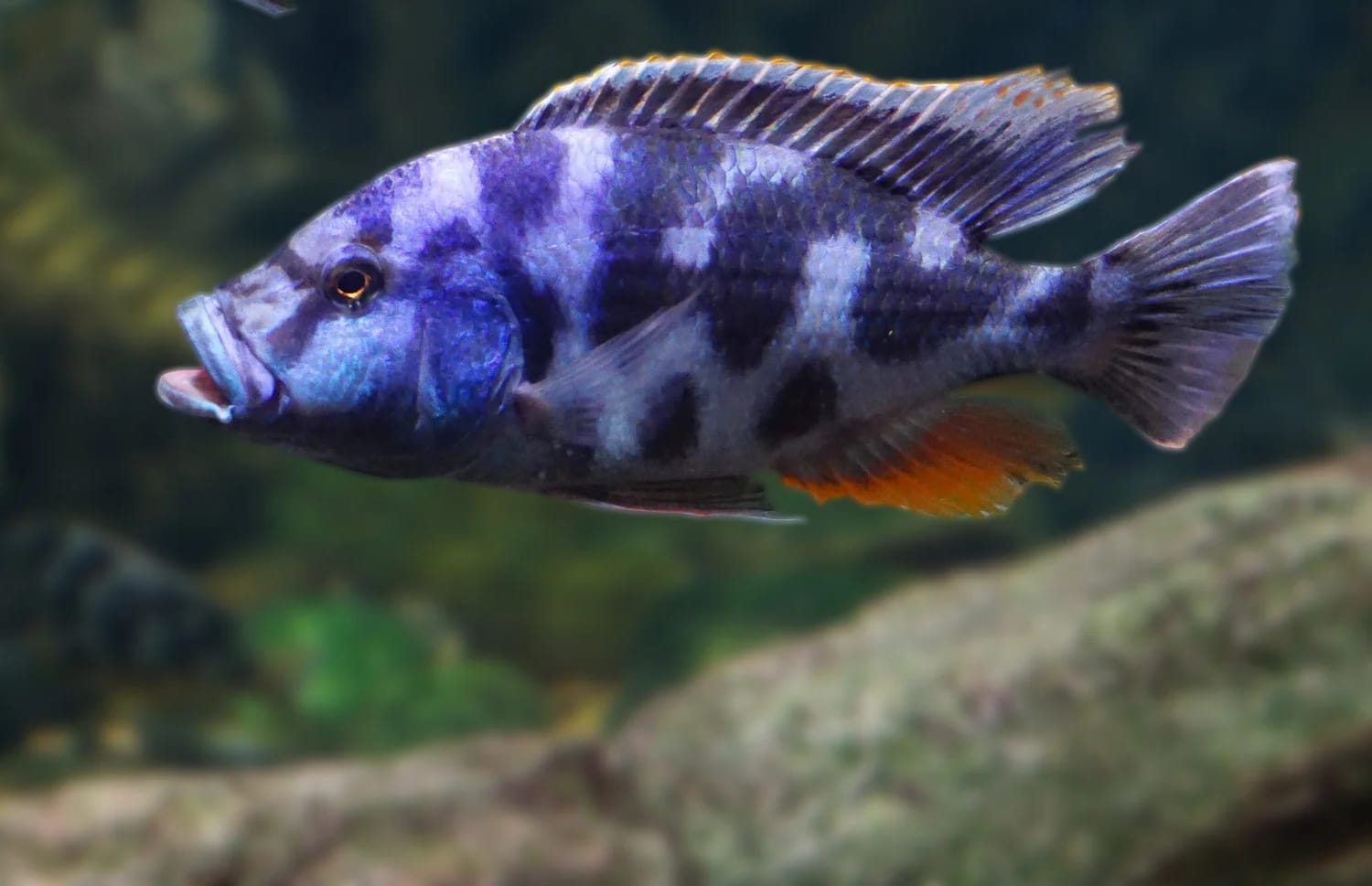
Livingstonii Cichlid
Nimbochromis livingstonii
Parameter dashboard
24-28 °C
7.6-8.8
25 cm
10 years
Care guide
Livingstonii cichlid (Nimbochromis livingstonii) is a large, predatory haplochromine cichlid endemic to Lake Malawi in East Africa, where it is fairly widespread throughout the lake. It inhabits relatively shallow shoreline areas with soft substrates of mud or sand, often thickly vegetated with beds of Vallisneria, though it has also been recorded at depths exceeding 100 metres. Males reach a maximum size of approximately 25 cm and develop more intense blue coloration during the breeding season. This species is famous for a remarkable hunting strategy known as thanatosis or 'playing dead': the fish lies motionless on its side on the substrate, its mottled pattern making it appear as a corpse to unsuspecting smaller fish, which are then ambushed when they approach to investigate. The local name 'Kaligono' translates loosely to 'sleeper' in tribute to this behaviour. In captivity it requires a spacious aquarium with a sandy substrate, piles of rocks forming caves, and open swimming areas. Despite its predatory nature it is generally peaceful with tankmates too large to be considered food, such as Frontosa and other large Rift Lake cichlids. It is an exclusive piscivore in the wild but accepts dead meaty foods in the aquarium, including prawns, lancefish, and whitebait. Breeding is challenging; it is a polygamous maternal mouthbrooder.
Source
Further reading on identification and aquarium care.
Tankmate compatibility (sample)
Pairwise screening against other species in the database (prioritizing the same family when data is available).
Review first (12)
Caution or avoid from automated rules — confirm before mixing.
| Species | Assessment | Notes |
|---|---|---|
| Blue acara Andinoacara pulcher Caution | Caution | Multiple territorial species in the same swim layer cause stress · close relatives, and one of them is territorial, so both claim the same kind of space Open pair in Compare → |
| Bluegray mbuna Melanochromis johannii Caution | Caution | Fish 2x+ larger may eat smaller tankmates · close relatives, and one of them is territorial, so both claim the same kind of space Open pair in Compare → |
| Fasciatus Shell Dweller Altolamprologus fasciatus Caution | Caution | Multiple territorial species in the same swim layer cause stress · close relatives, and one of them is territorial, so both claim the same kind of space Open pair in Compare → |
| Gold severum Heros efasciatus Caution | Caution | Multiple territorial species in the same swim layer cause stress · Species with non-overlapping pH ranges may not thrive together · close relatives, and one of them is territorial, so both claim the same kind of space Open pair in Compare → |
| Haitian cichlid Nandopsis haitiensis Caution | Caution | close relatives, and one of them is territorial, so both claim the same kind of space Open pair in Compare → |
| Jack Dempsey Rocio octofasciata Caution | Caution | close relatives, and one of them is territorial, so both claim the same kind of space Open pair in Compare → |
| Jewelfish Hemichromis bimaculatus Caution | Caution | Species with non-overlapping pH ranges may not thrive together · close relatives, and one of them is territorial, so both claim the same kind of space Open pair in Compare → |
| Mendezs Dwarf Cichlid Apistogramma mendezi Caution | Caution | Fish 2x+ larger may eat smaller tankmates · Species with non-overlapping pH ranges may not thrive together · close relatives, and one of them is territorial, so both claim the same kind of space Open pair in Compare → |
| Panda Uaru Uaru fernandezyepezi Caution | Caution | Multiple territorial species in the same swim layer cause stress · Species with non-overlapping pH ranges may not thrive together · the two share only a narrow band of temperature, so one of them sits at the edge of its range · close relatives, and one of them is territorial, so both claim the same kind of space Open pair in Compare → |
| Pearly calvus Altolamprologus calvus Caution | Caution | close relatives, and one of them is territorial, so both claim the same kind of space Open pair in Compare → |
| Red Spotted Severum Heros efasciatus Caution | Caution | Multiple territorial species in the same swim layer cause stress · Species with non-overlapping pH ranges may not thrive together · close relatives, and one of them is territorial, so both claim the same kind of space Open pair in Compare → |
| Venustus Cichlid Nimbochromis venustus Caution | Caution | Multiple territorial species in the same swim layer cause stress · close relatives, and one of them is territorial, so both claim the same kind of space Open pair in Compare → |
Same rule engine as Compare. Not a substitute for observation, tank size, or acclimation.
Related species
Was this page useful? Spot anything wrong?