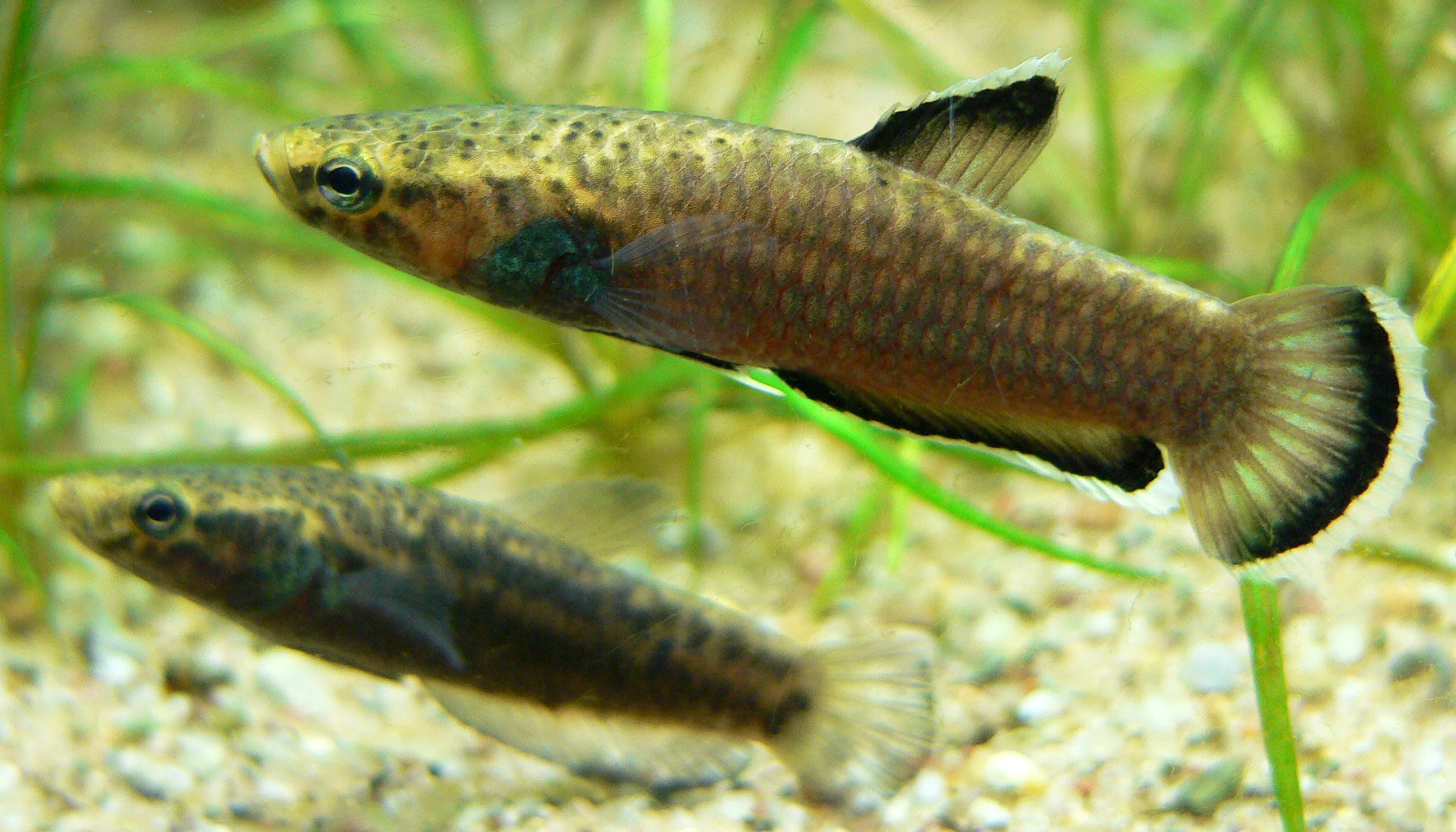
White Seam Betta
Betta albimarginata
Parameter dashboard
23-28 °C
4-6.5
3 cm
3 years
Care guide
The white seam betta (Betta albimarginata) is a small, exquisitely marked mouthbrooding betta species endemic to the Sebuku River drainage in East Kalimantan, Indonesian Borneo. It inhabits very shallow forest streams (depth ~5–10 cm) with moderate flow, where it lives among marginal plant roots and leaf litter. Described scientifically by Kottelat and Ng in 1994, it belongs to the B. albimarginata group, characterised by 9–12 anal-fin spines, far more than any other Betta species. Its common name derives from the broad white distal band on the fins, contrasting with a dark submarginal band and plain red inner portion.
Males reach 25–30 mm (1–1.2 in) in standard length and are more colourful with a broader head shape than females. A pair or small group can be housed in an aquarium with base dimensions of 45 × 30 cm (approximately 41 L / 11 gal). Despite its small size, this species is not recommended for the standard community aquarium due to its specialised water requirements and retiring disposition. It is best maintained alone or with very small, peaceful species that share its need for soft, acidic water. The aquarium should be dimly lit with driftwood, dried leaf litter, and floating vegetation, with gentle filtration via an air-powered sponge filter.
As a paternal mouthbrooder, the male incubates eggs in his mouth for 10–21 days before releasing fully-formed, free-swimming fry. Brood sizes are small, with even 10 eggs considered a good number. In the aquarium, the diet should consist primarily of small live and frozen foods such as Daphnia, Artemia, and bloodworm, supplemented by dried foods once recognised as edible. Water conditions must be acidic with negligible hardness: temperature 23–28°C, pH 4.0–6.5, and hardness 18–90 ppm. A reverse osmosis unit is typically necessary to achieve these parameters. The labyrinth organ allows this species to breathe atmospheric air, and access to a warm, humid air layer above the water surface is essential.
Sources
- seriouslyfish.com — https://www.seriouslyfish.com/species/betta-albimarginata/
- fishbase.se — https://www.fishbase.se/summary/Betta-albimarginata.html
Further reading on identification and aquarium care.
Tankmate compatibility (sample)
Pairwise screening against other species in the database (prioritizing the same family when data is available).
Review first (11)
Caution or avoid from automated rules — confirm before mixing.
| Species | Assessment | Notes |
|---|---|---|
| Alien betta Betta splendens hybrid Caution | Caution | Fish 2x+ larger may eat smaller tankmates · close relatives, and one of them is territorial, so both claim the same kind of space Open pair in Compare → |
| Chocolate gourami Sphaerichthys osphromenoides Caution | Caution | close relatives, and one of them is territorial, so both claim the same kind of space Open pair in Compare → |
| Crescent betta Betta imbellis Caution | Caution | Fish 2x+ larger may eat smaller tankmates · close relatives, and one of them is territorial, so both claim the same kind of space Open pair in Compare → |
| Dwarf gourami Trichogaster lalius Caution | Caution | Fish 2x+ larger may eat smaller tankmates · Multiple territorial species in the same swim layer cause stress · close relatives, and one of them is territorial, so both claim the same kind of space Open pair in Compare → |
| Honey gourami Trichogaster chuna Caution | Caution | close relatives, and one of them is territorial, so both claim the same kind of space Open pair in Compare → |
| Pearl gourami Trichopodus leerii Caution | Caution | Fish 2x+ larger may eat smaller tankmates · close relatives, and one of them is territorial, so both claim the same kind of space Open pair in Compare → |
| Pygmy gourami Trichopsis pumila Caution | Caution | close relatives, and one of them is territorial, so both claim the same kind of space Open pair in Compare → |
| Snakehead Betta Betta channoides Caution | Caution | Multiple territorial species in the same swim layer cause stress · close relatives, and one of them is territorial, so both claim the same kind of space Open pair in Compare → |
| Three spot gourami Trichogaster trichopterus Caution | Caution | Fish 2x+ larger may eat smaller tankmates · Multiple territorial species in the same swim layer cause stress · close relatives, and one of them is territorial, so both claim the same kind of space Open pair in Compare → |
| Galaxy betta Betta splendens Avoid | Avoid | Fish 2x+ larger may eat smaller tankmates · Multiple territorial species in the same swim layer cause stress · one of these species is highly aggressive and is usually best kept on its own · a highly aggressive fish takes long-finned tankmates for rivals and attacks them · close relatives, and one of them is territorial, so both claim the same kind of space Open pair in Compare → |
| Siamese fighting fish Betta splendens Avoid | Avoid | Fish 2x+ larger may eat smaller tankmates · Multiple territorial species in the same swim layer cause stress · one of these species is highly aggressive and is usually best kept on its own · a highly aggressive fish takes long-finned tankmates for rivals and attacks them · close relatives, and one of them is territorial, so both claim the same kind of space Open pair in Compare → |
Same rule engine as Compare. Not a substitute for observation, tank size, or acclimation.
Related species
Was this page useful? Spot anything wrong?