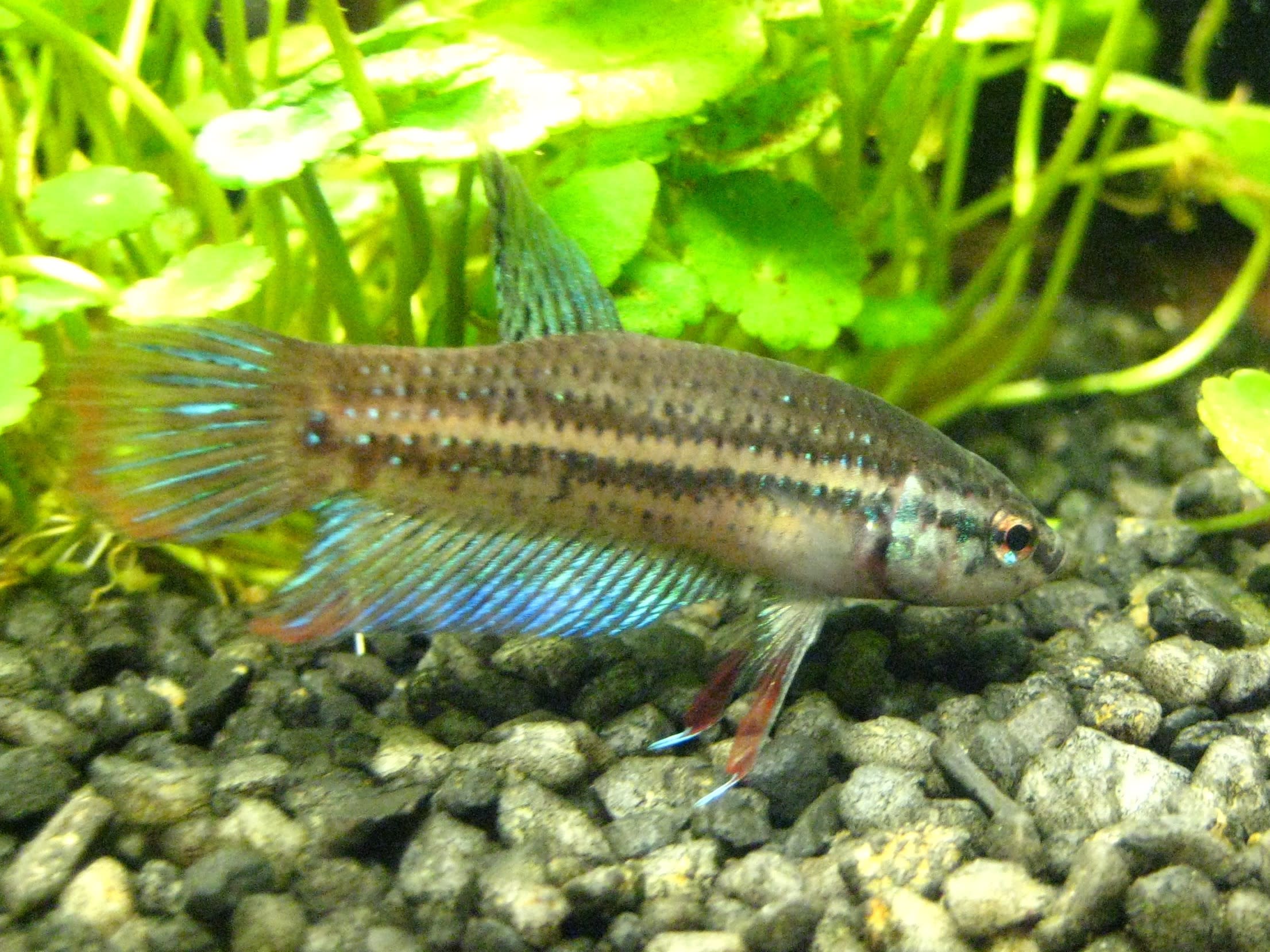
Crescent betta
Betta imbellis
Parameter dashboard
20-28 °C
5-7.5
6 cm
3 years
Care guide
The crescent betta, also known as the peaceful betta, is a beautiful labyrinth fish from southern Thailand, Peninsular Malaysia, and northern Sumatra. Its specific name imbellis means 'peaceful' in Latin, reflecting its notably less aggressive temperament compared to the common Siamese fighting fish (Betta splendens). Males display striking iridescent blue-green scales with vivid red or orange fins marked by pale crescent-shaped bands, while females are more subdued in colouration. Adults reach a modest 5-6 cm.
Unlike its more famous relative, the crescent betta can be maintained in mixed-sex groups in a well-planted aquarium, but monitor male aggression and provide a way to separate fish. A pair requires a tank of at least 40 litres with dense planting, surface cover from floating plants, and shaded areas created by driftwood and leaf litter. This species is a bubble-nester and requires calm water surface access to build its nest. Water movement should be minimal, as the species originates from sluggish pools and rice paddies.
Water parameters are 20-28°C, pH 5.0-7.5, with soft water preferred. As a carnivore, its diet should include quality dried foods supplemented with live or frozen Daphnia, Artemia, and bloodworm. Take care not to overfeed, as bettas are prone to obesity. The species is a prolific breeder: the male constructs a bubble nest, courts the female, and tends the eggs and fry until they are free-swimming. Its peaceful nature, manageable size, and stunning colours make it an excellent choice for the nano-aquarium enthusiast.
Sources
- seriouslyfish.com — https://www.seriouslyfish.com/species/betta-imbellis/
- fishbase.de — https://www.fishbase.de/summary/Betta-imbellis.html
Further reading on identification and aquarium care.
Tankmate compatibility (sample)
Pairwise screening against other species in the database (prioritizing the same family when data is available).
Review first (11)
Caution or avoid from automated rules — confirm before mixing.
| Species | Assessment | Notes |
|---|---|---|
| Alien betta Betta splendens hybrid Caution | Caution | close relatives, and one of them is territorial, so both claim the same kind of space Open pair in Compare → |
| Chocolate gourami Sphaerichthys osphromenoides Caution | Caution | close relatives, and one of them is territorial, so both claim the same kind of space Open pair in Compare → |
| Dwarf gourami Trichogaster lalius Caution | Caution | close relatives, and one of them is territorial, so both claim the same kind of space Open pair in Compare → |
| Honey gourami Trichogaster chuna Caution | Caution | close relatives, and one of them is territorial, so both claim the same kind of space Open pair in Compare → |
| Pearl gourami Trichopodus leerii Caution | Caution | Fish 2x+ larger may eat smaller tankmates · close relatives, and one of them is territorial, so both claim the same kind of space Open pair in Compare → |
| Pygmy gourami Trichopsis pumila Caution | Caution | close relatives, and one of them is territorial, so both claim the same kind of space Open pair in Compare → |
| Snakehead Betta Betta channoides Caution | Caution | close relatives, and one of them is territorial, so both claim the same kind of space Open pair in Compare → |
| Three spot gourami Trichogaster trichopterus Caution | Caution | Fish 2x+ larger may eat smaller tankmates · close relatives, and one of them is territorial, so both claim the same kind of space Open pair in Compare → |
| White Seam Betta Betta albimarginata Caution | Caution | Fish 2x+ larger may eat smaller tankmates · close relatives, and one of them is territorial, so both claim the same kind of space Open pair in Compare → |
| Galaxy betta Betta splendens Avoid | Avoid | one of these species is highly aggressive and is usually best kept on its own · a highly aggressive fish takes long-finned tankmates for rivals and attacks them · close relatives, and one of them is territorial, so both claim the same kind of space Open pair in Compare → |
| Siamese fighting fish Betta splendens Avoid | Avoid | one of these species is highly aggressive and is usually best kept on its own · a highly aggressive fish takes long-finned tankmates for rivals and attacks them · close relatives, and one of them is territorial, so both claim the same kind of space Open pair in Compare → |
Same rule engine as Compare. Not a substitute for observation, tank size, or acclimation.
Related species
Was this page useful? Spot anything wrong?