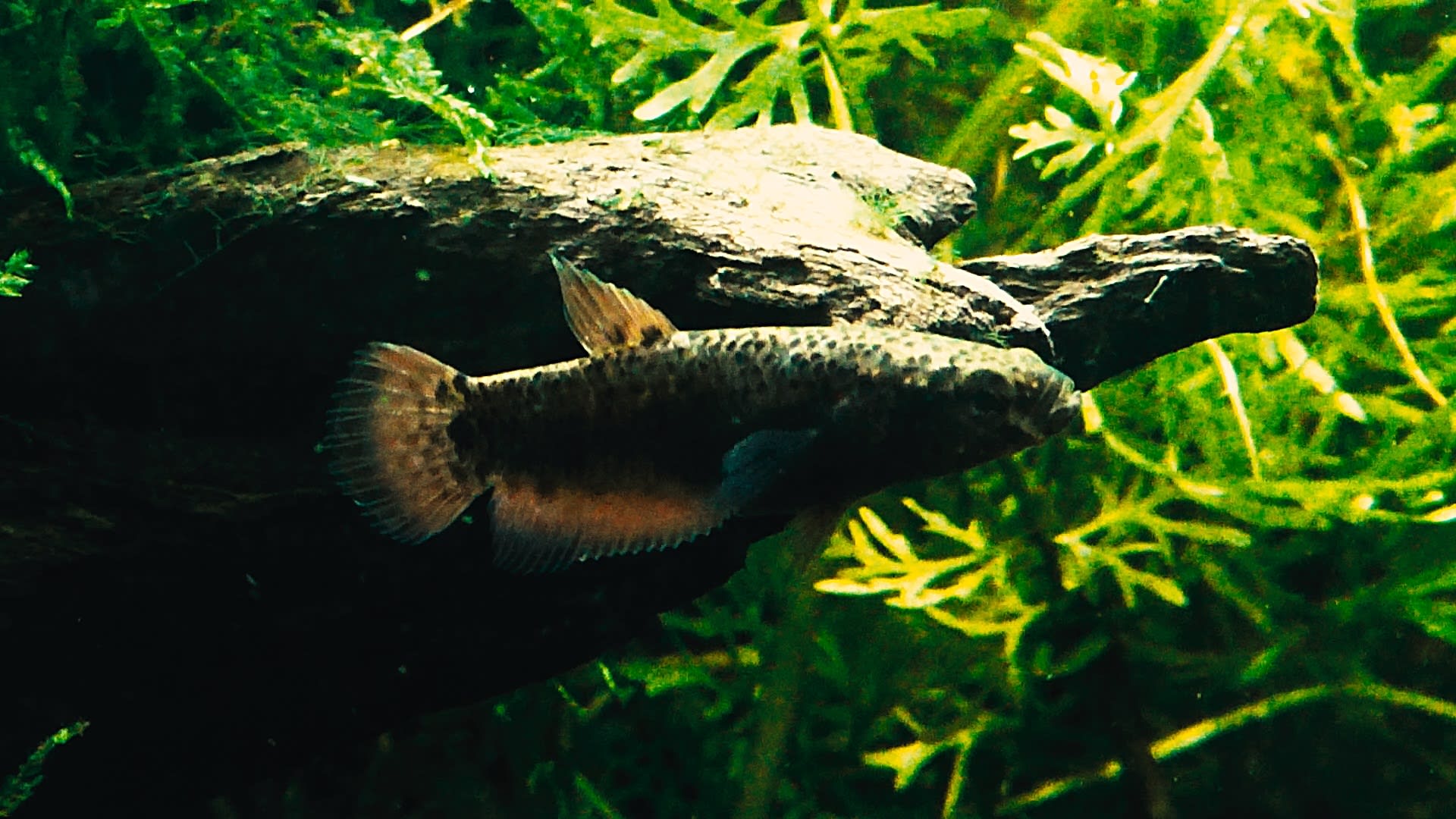
Snakehead Betta
Betta channoides
Parameter dashboard
23-30 °C
4-6.5
4 cm
3 years
Care guide
Betta channoides, commonly known as the Snakehead Betta, is a small paternal mouthbrooding labyrinth fish native to blackwater environments in eastern Borneo, Indonesia. Adults reach a standard length of 3.5–4.0 cm and are best maintained in a species-only or carefully selected community tank with a base of at least 45 × 30 cm. The species requires soft, acidic water with a pH of 4.0–6.5, temperatures of 23–30 °C, and negligible carbonate hardness. The aquarium should be furnished with driftwood roots, dried leaf litter, and dim lighting to replicate its natural habitat of shallow forest streams. Floating vegetation and shade-providing plants such as Microsorum or Cryptocoryne are beneficial. Filtration should be gentle, with an air-powered sponge filter preferred. As a labyrinth fish, it requires access to a layer of humid air above the water surface, and the tank must be well-covered to prevent jumping. Its diet consists primarily of small live and frozen foods such as Daphnia, Artemia, and bloodworm, though dried foods may be accepted once the fish recognize them as edible. Betta channoides can be maintained singly, as a pair, or in a small group, where it displays interesting behavioural interactions. It is not recommended for a standard community setup, as larger or more vigorous tankmates may intimidate it. Compatible species include very small, peaceful cyprinids and loaches from similar blackwater habitats. Males are more colourful with a broader head shape than females. The species is a paternal mouthbrooder with a small brood size; even 10 eggs is considered a good number, and the incubation period lasts 10–21 days.
Source
Further reading on identification and aquarium care.
Tankmate compatibility (sample)
Pairwise screening against other species in the database (prioritizing the same family when data is available).
Review first (11)
Caution or avoid from automated rules — confirm before mixing.
| Species | Assessment | Notes |
|---|---|---|
| Alien betta Betta splendens hybrid Caution | Caution | close relatives, and one of them is territorial, so both claim the same kind of space Open pair in Compare → |
| Chocolate gourami Sphaerichthys osphromenoides Caution | Caution | close relatives, and one of them is territorial, so both claim the same kind of space Open pair in Compare → |
| Crescent betta Betta imbellis Caution | Caution | close relatives, and one of them is territorial, so both claim the same kind of space Open pair in Compare → |
| Dwarf gourami Trichogaster lalius Caution | Caution | Fish 2x+ larger may eat smaller tankmates · Multiple territorial species in the same swim layer cause stress · close relatives, and one of them is territorial, so both claim the same kind of space Open pair in Compare → |
| Honey gourami Trichogaster chuna Caution | Caution | close relatives, and one of them is territorial, so both claim the same kind of space Open pair in Compare → |
| Pearl gourami Trichopodus leerii Caution | Caution | Fish 2x+ larger may eat smaller tankmates · close relatives, and one of them is territorial, so both claim the same kind of space Open pair in Compare → |
| Pygmy gourami Trichopsis pumila Caution | Caution | close relatives, and one of them is territorial, so both claim the same kind of space Open pair in Compare → |
| Three spot gourami Trichogaster trichopterus Caution | Caution | Fish 2x+ larger may eat smaller tankmates · Multiple territorial species in the same swim layer cause stress · close relatives, and one of them is territorial, so both claim the same kind of space Open pair in Compare → |
| White Seam Betta Betta albimarginata Caution | Caution | Multiple territorial species in the same swim layer cause stress · close relatives, and one of them is territorial, so both claim the same kind of space Open pair in Compare → |
| Galaxy betta Betta splendens Avoid | Avoid | Multiple territorial species in the same swim layer cause stress · one of these species is highly aggressive and is usually best kept on its own · a highly aggressive fish takes long-finned tankmates for rivals and attacks them · close relatives, and one of them is territorial, so both claim the same kind of space Open pair in Compare → |
| Siamese fighting fish Betta splendens Avoid | Avoid | Multiple territorial species in the same swim layer cause stress · one of these species is highly aggressive and is usually best kept on its own · a highly aggressive fish takes long-finned tankmates for rivals and attacks them · close relatives, and one of them is territorial, so both claim the same kind of space Open pair in Compare → |
Same rule engine as Compare. Not a substitute for observation, tank size, or acclimation.
Related species
Was this page useful? Spot anything wrong?