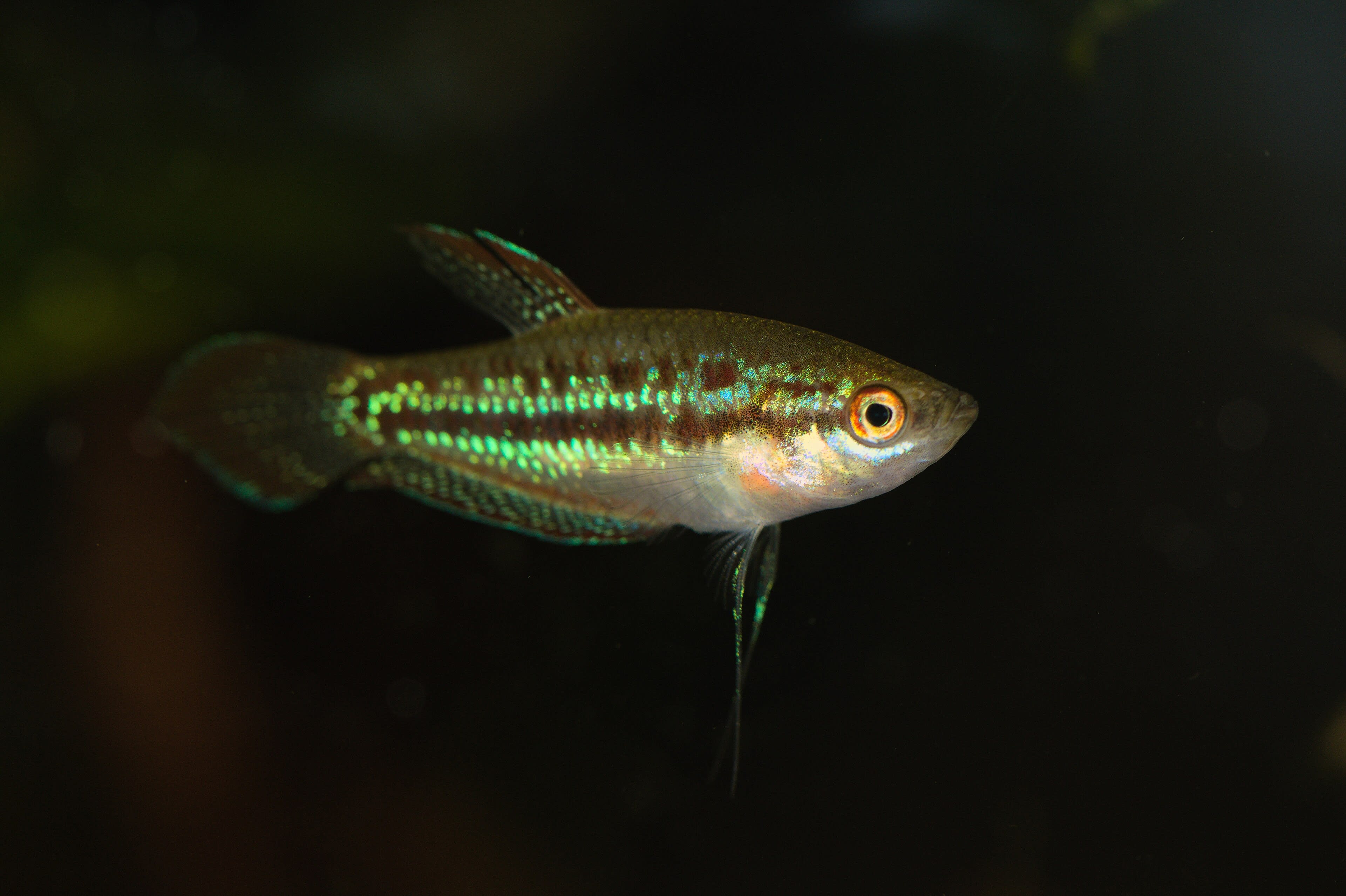
Pygmy gourami
Trichopsis pumila
Parameter dashboard
22-28 °C
5-7.5
4 cm
4 years
Care guide
The sparkling gourami is a true dwarf among labyrinth fish, reaching just 35–40 mm, and lives up to its common name with a constellation of iridescent blue-green and red spots scattered across its body and fins. When the light catches them right, these tiny spots sparkle brilliantly against a warm brown or olive background. Native to the sluggish lowland waters of Southeast Asia — including the lower Mekong basin in Laos, Vietnam, Cambodia, Thailand, and the Malay Peninsula — this species is found in still to slow-moving habitats such as swamp forests, peat swamps, floodplains, paddy fields, and roadside ditches. Like all members of the family Osphronemidae, it possesses a labyrinth organ that allows it to breathe atmospheric air.
Sparkling gouramis are best kept in a well-planted, shady aquarium that mimics their blackwater natural habitat. The tank should include plenty of floating plants or tropical lilies to diffuse the light, driftwood, leaf litter, and a dark substrate. Strong water movement must be avoided — an air-powered sponge filter set to a gentle turnover is adequate. A 40-litre tank can house a small pair or trio, with a footprint of at least 45 × 30 cm. Water temperature should be 22–28°C with a pH of 5.0–7.5 and hardness of 18–215 ppm. The aquarium must be well-covered and not filled to the top, as they require access to the warm, humid air layer above the water and are excellent jumpers.
These are exceptionally peaceful, timid fish that do best in a species-only tank or alongside other tiny, non-aggressive inhabitants such as dwarf rasboras, small shrimp, or pygmy cories. They should never be housed with large or boisterous species. Males produce an audible croaking or grunting sound during courtship — one of the few fish that can vocalise audibly through air. The diet should consist of small live and frozen foods: daphnia, brine shrimp, micro-worms, and finely crushed flake. They are bubble-nest builders: the male builds a nest under a broad leaf, courts the female, and tends the eggs and fry with great care. The fry are tiny and require infusoria as a first food. Aquarium lifespan estimates are around 4 years with suitable care. Very small shrimp and shrimplets may be eaten, so avoid this combination when shrimp breeding is a priority.
Sources
- seriouslyfish.com — https://www.seriouslyfish.com/species/trichopsis-pumila/
- fishbase.se — https://www.fishbase.se/summary/Trichopsis-pumila.html
Further reading on identification and aquarium care.
Tankmate compatibility (sample)
Pairwise screening against other species in the database (prioritizing the same family when data is available).
Review first (9)
Caution or avoid from automated rules — confirm before mixing.
| Species | Assessment | Notes |
|---|---|---|
| Alien betta Betta splendens hybrid Caution | Caution | close relatives, and one of them is territorial, so both claim the same kind of space Open pair in Compare → |
| Crescent betta Betta imbellis Caution | Caution | close relatives, and one of them is territorial, so both claim the same kind of space Open pair in Compare → |
| Dwarf gourami Trichogaster lalius Caution | Caution | Fish 2x+ larger may eat smaller tankmates · close relatives, and one of them is territorial, so both claim the same kind of space Open pair in Compare → |
| Galaxy betta Betta splendens Caution | Caution | one of these species is highly aggressive and is usually best kept on its own · close relatives, and one of them is territorial, so both claim the same kind of space Open pair in Compare → |
| Pearl gourami Trichopodus leerii Caution | Caution | Fish 2x+ larger may eat smaller tankmates Open pair in Compare → |
| Siamese fighting fish Betta splendens Caution | Caution | one of these species is highly aggressive and is usually best kept on its own · close relatives, and one of them is territorial, so both claim the same kind of space Open pair in Compare → |
| Snakehead Betta Betta channoides Caution | Caution | close relatives, and one of them is territorial, so both claim the same kind of space Open pair in Compare → |
| Three spot gourami Trichogaster trichopterus Caution | Caution | Fish 2x+ larger may eat smaller tankmates · close relatives, and one of them is territorial, so both claim the same kind of space Open pair in Compare → |
| White Seam Betta Betta albimarginata Caution | Caution | close relatives, and one of them is territorial, so both claim the same kind of space Open pair in Compare → |
2 species with compatible assessment in this sampleCollapse to hide the list; use “Open pair in Compare” for the full matrix.
| Species | Assessment | Notes |
|---|---|---|
| Chocolate gourami Sphaerichthys osphromenoides Compatible | Compatible | No rule-based conflicts detected for this pair. Open pair in Compare → |
| Honey gourami Trichogaster chuna Compatible | Compatible | No rule-based conflicts detected for this pair. Open pair in Compare → |
Same rule engine as Compare. Not a substitute for observation, tank size, or acclimation.
Related species
Was this page useful? Spot anything wrong?