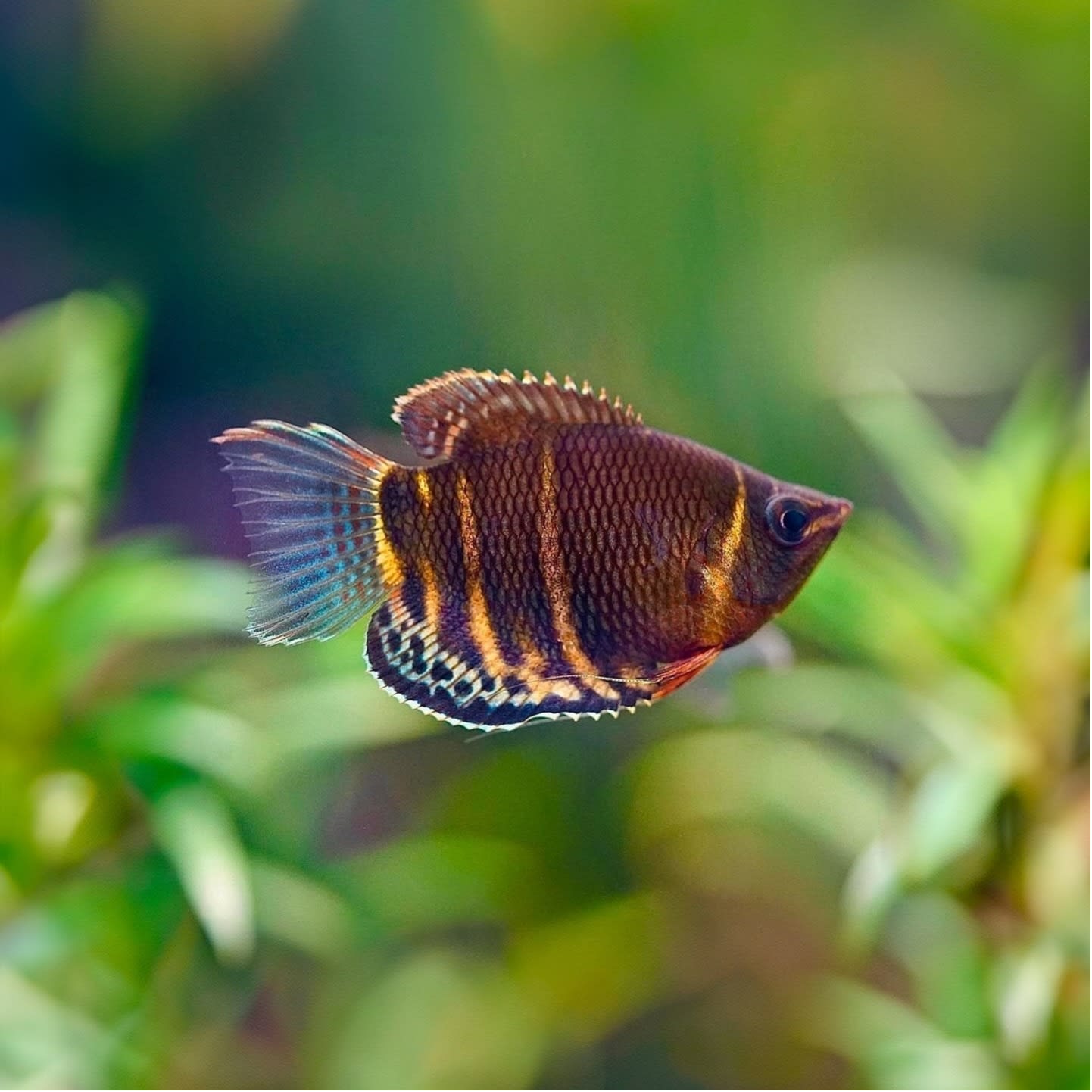
Chocolate gourami
Sphaerichthys osphromenoides
Parameter dashboard
26-31 °C
4-6.5
5 cm
4 years
Care guide
The chocolate gourami (Sphaerichthys osphromenoides) is a uniquely fascinating anabantoid native to blackwater peat swamps and associated streams of the Malay Peninsula, Sumatra, and Borneo. Its deep chocolate-brown body is crossed by several thin, golden-yellow vertical bars, creating a subtle but elegant colour pattern unlike any other labyrinth fish. It reaches a standard length of 4–5 cm and is distinguished within the genus by having 9–10 dorsal fin rays and a reduced or absent light bar anterior to the dorsal fin. The species is also remarkable among anabantoids for its unusual reproductive strategy: it is a maternal mouthbrooder — one of only two Sphaerichthys species in which the female broods the eggs and fry in her mouth for 7–20 days before releasing fully-formed, free-swimming juveniles.
Chocolate gouramis are slow-moving and timid, requiring carefully selected tankmates. They are easily intimidated and outcompeted for food by larger or more boisterous species. Small, peaceful cyprinids such as Danionella, Microdevario, Trigonostigma, and smaller Rasboras make excellent companions, as do Pangio loaches. Though not schooling in the traditional sense, they are gregarious and should be maintained in groups of at least 6 individuals; groups develop noticeable social hierarchies and display more natural behaviour when kept in numbers. In nature they are chiefly micropredators feeding on small aquatic crustaceans, worms, insect larvae, and zooplankton. In the aquarium they can be picky and may initially refuse dried foods, so a consistent offering of small live and frozen fare such as Artemia nauplii, Daphnia, and grindal worm is essential.
An aquarium with base dimensions of at least 60 × 30 cm (roughly 54 litres) is suitable for a small group. The most important requirement is soft, acidic water mimicking blackwater conditions: a sandy substrate, plenty of driftwood roots and branches creating shaded caves, and dried leaf litter (beech, oak, or Ketapang almond) to stain the water with tannins. Filtration should be gentle, and large water changes avoided — weekly changes of 10–15% are adequate. Recommended water parameters include a temperature of 26–31°C, pH 4.0–6.5, and hardness near zero (0–54 ppm) for wild specimens, though tank-raised individuals are more adaptable. The aquarium must have a tightly-fitting cover as the labyrinth organ requires access to warm, humid air above the water surface.
Source
Further reading on identification and aquarium care.
Tankmate compatibility (sample)
Pairwise screening against other species in the database (prioritizing the same family when data is available).
Review first (10)
Caution or avoid from automated rules — confirm before mixing.
| Species | Assessment | Notes |
|---|---|---|
| Alien betta Betta splendens hybrid Caution | Caution | close relatives, and one of them is territorial, so both claim the same kind of space Open pair in Compare → |
| Crescent betta Betta imbellis Caution | Caution | close relatives, and one of them is territorial, so both claim the same kind of space Open pair in Compare → |
| Dwarf gourami Trichogaster lalius Caution | Caution | the two share only a narrow band of temperature, so one of them sits at the edge of its range · close relatives, and one of them is territorial, so both claim the same kind of space Open pair in Compare → |
| Galaxy betta Betta splendens Caution | Caution | one of these species is highly aggressive and is usually best kept on its own · close relatives, and one of them is territorial, so both claim the same kind of space Open pair in Compare → |
| Honey gourami Trichogaster chuna Caution | Caution | the two share only a narrow band of temperature, so one of them sits at the edge of its range Open pair in Compare → |
| Pearl gourami Trichopodus leerii Caution | Caution | Fish 2x+ larger may eat smaller tankmates Open pair in Compare → |
| Siamese fighting fish Betta splendens Caution | Caution | one of these species is highly aggressive and is usually best kept on its own · close relatives, and one of them is territorial, so both claim the same kind of space Open pair in Compare → |
| Snakehead Betta Betta channoides Caution | Caution | close relatives, and one of them is territorial, so both claim the same kind of space Open pair in Compare → |
| Three spot gourami Trichogaster trichopterus Caution | Caution | Fish 2x+ larger may eat smaller tankmates · close relatives, and one of them is territorial, so both claim the same kind of space Open pair in Compare → |
| White Seam Betta Betta albimarginata Caution | Caution | close relatives, and one of them is territorial, so both claim the same kind of space Open pair in Compare → |
1 species with compatible assessment in this sampleCollapse to hide the list; use “Open pair in Compare” for the full matrix.
| Species | Assessment | Notes |
|---|---|---|
| Pygmy gourami Trichopsis pumila Compatible | Compatible | No rule-based conflicts detected for this pair. Open pair in Compare → |
Same rule engine as Compare. Not a substitute for observation, tank size, or acclimation.
Related species
Was this page useful? Spot anything wrong?