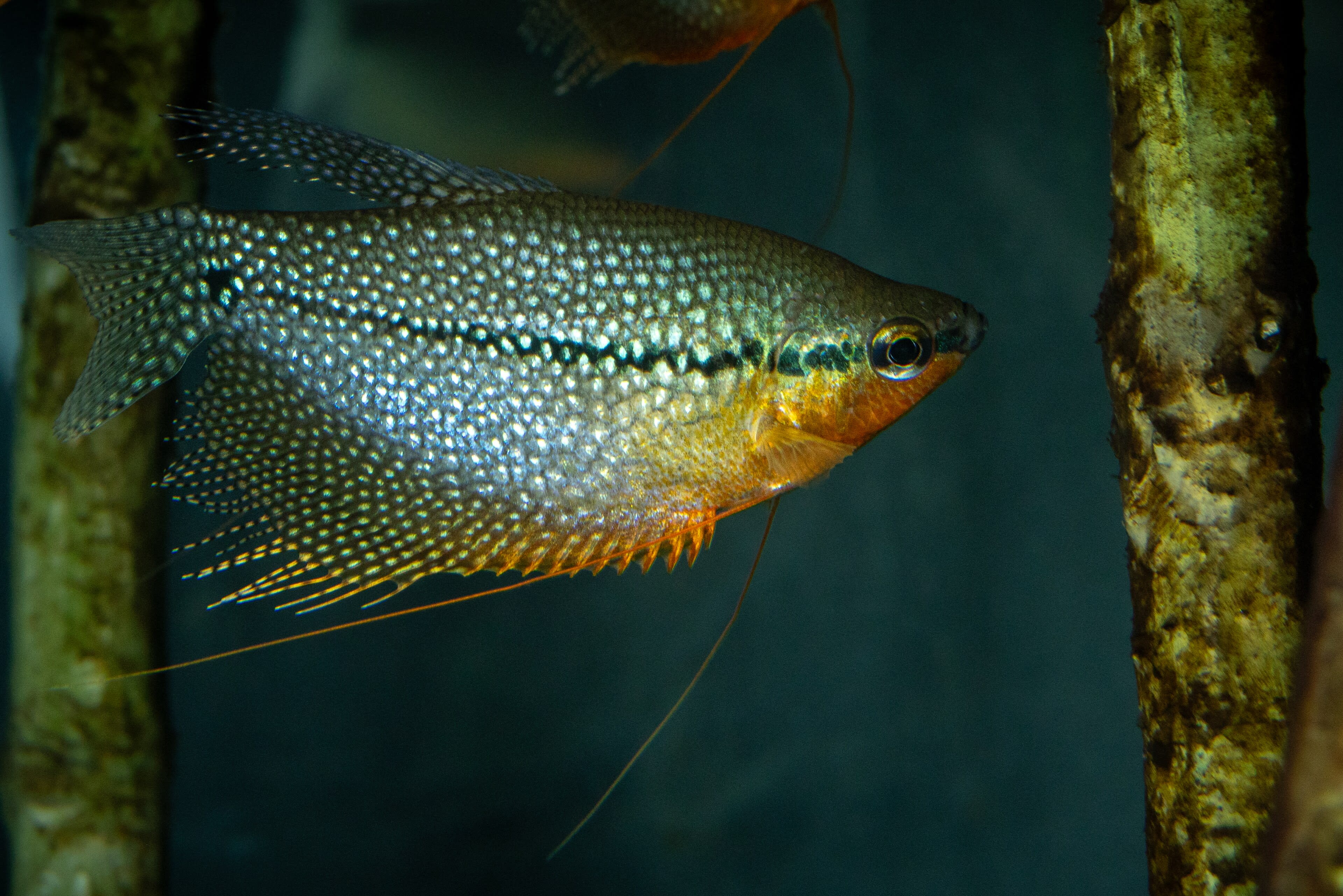
Pearl gourami
Trichopodus leerii
Parameter dashboard
23.9-30 °C
5.5-8
12 cm
Care guide
The pearl gourami (Trichopodus leerii) is a stunning labyrinth fish native to the lowland swamps of Thailand, Malaysia, and the Indonesian islands of Sumatra and Borneo, where it inhabits slow-moving, often acidic waters rich in vegetation. Reaching up to 12 cm (4.7 in) in length, it displays an elongated, laterally compressed body covered in a characteristic pearl-like pattern of iridescent spots against a brownish-silver background, with a dark horizontal stripe running from the snout through the eye to the tail fin. Males develop vibrant orange-red throat and chest coloration during breeding and possess elongated dorsal and anal fin rays, while females remain plainer and rounder-bodied.
Pearl gouramis rank among the most peaceful members of the gourami family and thrive in well-planted community aquariums of at least 100 L (26 gal) with floating vegetation, shaded areas, and open swimming zones. As labyrinth fish they require access to the water surface without strong surface disturbance. Water conditions should be maintained at 24-30C (75-86F), pH 5.5-8.0, and general hardness 2-30 dH. They accept a wide variety of foods including quality flakes, slow-sinking pellets, frozen bloodworms and brine shrimp, and live insects.
Males are territorial toward one another and may be persistent with females during courtship, so ample cover and tank space are essential. Pearl gouramis are bubble-nest builders: the male constructs a large nest among floating plants, courts the female beneath it, and wraps his body around hers in the traditional anabantoid embrace to fertilize the eggs. A single spawning produces 200-300 eggs, which the male guards until hatching at 20-30 hours, with fry becoming free-swimming after another 4-5 days.
Sources
- seriouslyfish.com — https://www.seriouslyfish.com/species/trichopodus-leerii/
- en.wikipedia.org — https://en.wikipedia.org/wiki/Pearl_gourami
Further reading on identification and aquarium care.
Tankmate compatibility (sample)
Pairwise screening against other species in the database (prioritizing the same family when data is available).
Review first (11)
Caution or avoid from automated rules — confirm before mixing.
| Species | Assessment | Notes |
|---|---|---|
| Alien betta Betta splendens hybrid Caution | Caution | close relatives, and one of them is territorial, so both claim the same kind of space Open pair in Compare → |
| Chocolate gourami Sphaerichthys osphromenoides Caution | Caution | Fish 2x+ larger may eat smaller tankmates Open pair in Compare → |
| Crescent betta Betta imbellis Caution | Caution | Fish 2x+ larger may eat smaller tankmates · close relatives, and one of them is territorial, so both claim the same kind of space Open pair in Compare → |
| Dwarf gourami Trichogaster lalius Caution | Caution | close relatives, and one of them is territorial, so both claim the same kind of space Open pair in Compare → |
| Honey gourami Trichogaster chuna Caution | Caution | Fish 2x+ larger may eat smaller tankmates Open pair in Compare → |
| Pygmy gourami Trichopsis pumila Caution | Caution | Fish 2x+ larger may eat smaller tankmates Open pair in Compare → |
| Snakehead Betta Betta channoides Caution | Caution | Fish 2x+ larger may eat smaller tankmates · close relatives, and one of them is territorial, so both claim the same kind of space Open pair in Compare → |
| Three spot gourami Trichogaster trichopterus Caution | Caution | close relatives, and one of them is territorial, so both claim the same kind of space Open pair in Compare → |
| White Seam Betta Betta albimarginata Caution | Caution | Fish 2x+ larger may eat smaller tankmates · close relatives, and one of them is territorial, so both claim the same kind of space Open pair in Compare → |
| Galaxy betta Betta splendens Avoid | Avoid | one of these species is highly aggressive and is usually best kept on its own · a highly aggressive fish takes long-finned tankmates for rivals and attacks them · close relatives, and one of them is territorial, so both claim the same kind of space Open pair in Compare → |
| Siamese fighting fish Betta splendens Avoid | Avoid | one of these species is highly aggressive and is usually best kept on its own · a highly aggressive fish takes long-finned tankmates for rivals and attacks them · close relatives, and one of them is territorial, so both claim the same kind of space Open pair in Compare → |
Same rule engine as Compare. Not a substitute for observation, tank size, or acclimation.
Related species
Was this page useful? Spot anything wrong?