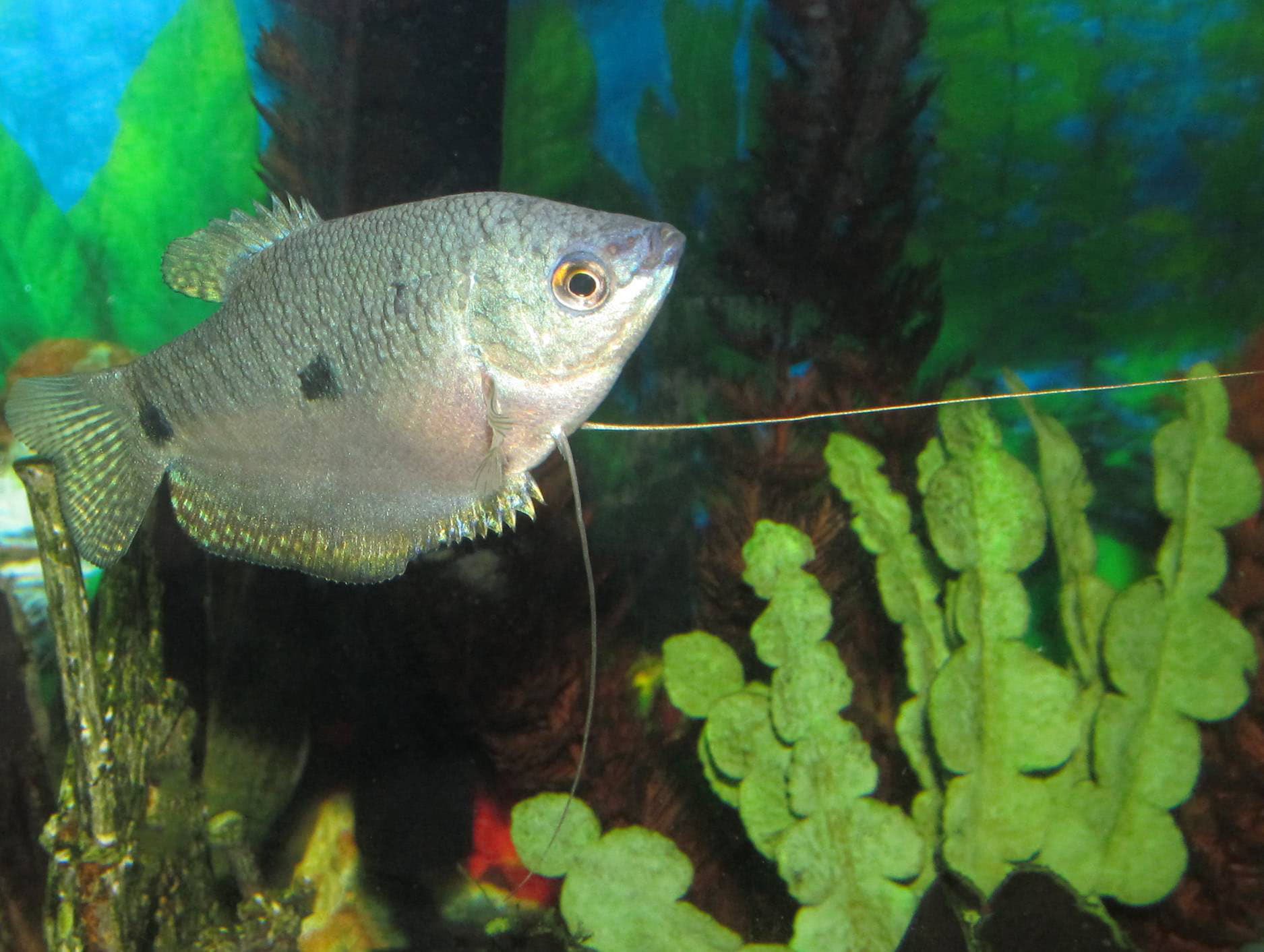
Three spot gourami
Trichogaster trichopterus
Parameter dashboard
24-30 °C
5.5-8.5
15 cm
5 years
Care guide
The three spot gourami is a widespread and adaptable anabantoid from Southeast Asia, found across much of Thailand, Vietnam, Cambodia, Laos, Malaysia, and Indonesia, as well as southern China. It inhabits a variety of lowland environments including swamps, marshes, rice paddies, and floodplains — habitats that are often low in dissolved oxygen. Like all gouramis, it possesses a labyrinth organ that allows it to breathe atmospheric air. The name 'three spot' refers to the two prominent dark spots on the body and the eye which together form three visible markings. Reaching up to 15 cm, it is a medium-sized gourami with a flattened, oval body.
A planted aquarium with some floating cover and open swimming areas suits this species well. The tank should measure at least 90 cm x 30 cm (~81 litres) and have a secure lid, as gouramis are known jumpers. While three spot gouramis tolerate a wide range of conditions, they do best in warm water (24–30 °C) with a pH of 5.5–8.5. They are generalised omnivores in the wild, consuming plant matter, algae, small invertebrates, and detritus, and they accept most prepared foods in the aquarium without fuss.
Three spot gouramis are a common choice for community aquaria, but their temperament can be unpredictable. Some individuals remain peaceful throughout their lives, while others become spiteful as they mature. Males are territorial and can be aggressive toward each other, especially during breeding. They are best kept with robust tankmates such as barbs, larger characins, loaches, and other medium-to-large gouramis. Males are distinguished by their larger size and pointed dorsal fin, while females have a shorter, rounded dorsal. Colour morphs include the popular opaline (marbled) and gold varieties.
Source
Further reading on identification and aquarium care.
Tankmate compatibility (sample)
Pairwise screening against other species in the database (prioritizing the same family when data is available).
Review first (11)
Caution or avoid from automated rules — confirm before mixing.
| Species | Assessment | Notes |
|---|---|---|
| Alien betta Betta splendens hybrid Caution | Caution | Fish 2x+ larger may eat smaller tankmates · close relatives, and one of them is territorial, so both claim the same kind of space Open pair in Compare → |
| Chocolate gourami Sphaerichthys osphromenoides Caution | Caution | Fish 2x+ larger may eat smaller tankmates · close relatives, and one of them is territorial, so both claim the same kind of space Open pair in Compare → |
| Crescent betta Betta imbellis Caution | Caution | Fish 2x+ larger may eat smaller tankmates · close relatives, and one of them is territorial, so both claim the same kind of space Open pair in Compare → |
| Dwarf gourami Trichogaster lalius Caution | Caution | Multiple territorial species in the same swim layer cause stress · close relatives, and one of them is territorial, so both claim the same kind of space Open pair in Compare → |
| Honey gourami Trichogaster chuna Caution | Caution | Fish 2x+ larger may eat smaller tankmates · close relatives, and one of them is territorial, so both claim the same kind of space Open pair in Compare → |
| Pearl gourami Trichopodus leerii Caution | Caution | close relatives, and one of them is territorial, so both claim the same kind of space Open pair in Compare → |
| Pygmy gourami Trichopsis pumila Caution | Caution | Fish 2x+ larger may eat smaller tankmates · close relatives, and one of them is territorial, so both claim the same kind of space Open pair in Compare → |
| Snakehead Betta Betta channoides Caution | Caution | Fish 2x+ larger may eat smaller tankmates · Multiple territorial species in the same swim layer cause stress · close relatives, and one of them is territorial, so both claim the same kind of space Open pair in Compare → |
| White Seam Betta Betta albimarginata Caution | Caution | Fish 2x+ larger may eat smaller tankmates · Multiple territorial species in the same swim layer cause stress · close relatives, and one of them is territorial, so both claim the same kind of space Open pair in Compare → |
| Galaxy betta Betta splendens Avoid | Avoid | Fish 2x+ larger may eat smaller tankmates · Multiple territorial species in the same swim layer cause stress · one of these species is highly aggressive and is usually best kept on its own · a highly aggressive fish takes long-finned tankmates for rivals and attacks them · close relatives, and one of them is territorial, so both claim the same kind of space Open pair in Compare → |
| Siamese fighting fish Betta splendens Avoid | Avoid | Fish 2x+ larger may eat smaller tankmates · Multiple territorial species in the same swim layer cause stress · one of these species is highly aggressive and is usually best kept on its own · a highly aggressive fish takes long-finned tankmates for rivals and attacks them · close relatives, and one of them is territorial, so both claim the same kind of space Open pair in Compare → |
Same rule engine as Compare. Not a substitute for observation, tank size, or acclimation.
Related species
Was this page useful? Spot anything wrong?