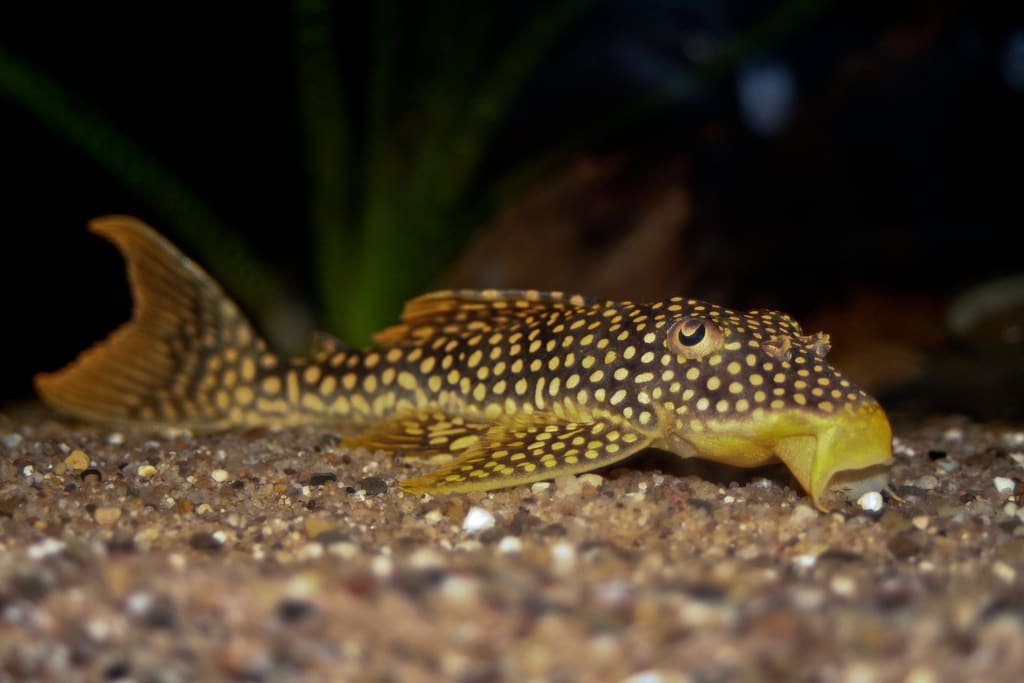
Sunshine Pleco
Scobinancistrus aureatus
Parameter dashboard
25-29 °C
5.5-7
29 cm
10 years
Care guide
The sunshine pleco (Scobinancistrus aureatus), also known by its L-number L-014, is a large, striking armored catfish from the Xingu River basin in Brazil. It was described by Warren E. Burgess in 1994 and reaches a maximum total length of 29 cm with a published maximum weight of 290 grams. The common name 'sunshine pleco' derives from its attractive golden-yellow base colouration overlaid with small dark spots, a pattern that makes it highly desirable among South American catfish enthusiasts. In nature it inhabits the clear, well-oxygenated waters of the Xingu River, a major tributary of the lower Amazon, where it is found among rock formations and submerged wood. The aquarium should be spacious with a minimum of 300 litres, featuring a soft sandy substrate, large driftwood pieces, and smooth rocks to replicate its natural habitat. Strong water movement and excellent filtration are essential. The sunshine pleco is omnivorous with a tendency toward carnivory — in nature it consumes snails, crustaceans, and insect larvae, and in captivity should be offered sinking pellets, frozen foods such as bloodworm and prawns, and occasional vegetable matter. It is generally peaceful toward tankmates too large to be intimidated but can become territorial with other bottom-dwelling catfish. The species is listed as Vulnerable on the IUCN Red List, threatened by habitat modification including hydroelectric dam construction in the Xingu basin.
Source
Further reading on identification and aquarium care.
Tankmate compatibility (sample)
Pairwise screening against other species in the database (prioritizing the same family when data is available).
Review first (12)
Caution or avoid from automated rules — confirm before mixing.
| Species | Assessment | Notes |
|---|---|---|
| Giant Whiptail Sturisomatichthys aureus Caution | Caution | the two share only a narrow band of temperature, so one of them sits at the edge of its range · close relatives, and one of them is territorial, so both claim the same kind of space · one is boisterous and the other a much smaller peaceful fish sharing the same floor, where it can be intimidated and outcompeted at feeding time Open pair in Compare → |
| Gold Nugget Pleco Baryancistrus xanthellus Caution | Caution | Multiple territorial species in the same swim layer cause stress · close relatives, and one of them is territorial, so both claim the same kind of space Open pair in Compare → |
| Leopard Frog Pleco Peckoltia compta Caution | Caution | Fish 2x+ larger may eat smaller tankmates · Multiple territorial species in the same swim layer cause stress · close relatives, and one of them is territorial, so both claim the same kind of space Open pair in Compare → |
| Nannoptopoma Nannoptopoma sternoptychum Caution | Caution | Fish 2x+ larger may eat smaller tankmates · close relatives, and one of them is territorial, so both claim the same kind of space · one is boisterous and the other a much smaller peaceful fish sharing the same floor, where it can be intimidated and outcompeted at feeding time Open pair in Compare → |
| Oxyropsis Oxyropsis carinata Caution | Caution | Fish 2x+ larger may eat smaller tankmates · close relatives, and one of them is territorial, so both claim the same kind of space · one is boisterous and the other a much smaller peaceful fish sharing the same floor, where it can be intimidated and outcompeted at feeding time Open pair in Compare → |
| Royal panaque Panaque nigrolineatus Caution | Caution | close relatives, and one of them is territorial, so both claim the same kind of space Open pair in Compare → |
| Twig Catfish Farlowella vittata Caution | Caution | close relatives, and one of them is territorial, so both claim the same kind of space · one is boisterous and the other a much smaller peaceful fish sharing the same floor, where it can be intimidated and outcompeted at feeding time Open pair in Compare → |
| Vampire Pleco Leporacanthicus galaxias Caution | Caution | Multiple territorial species in the same swim layer cause stress · the two share only a narrow band of temperature, so one of them sits at the edge of its range · close relatives, and one of them is territorial, so both claim the same kind of space Open pair in Compare → |
| Whiptail catfish Farlowella acus Caution | Caution | close relatives, and one of them is territorial, so both claim the same kind of space · one is boisterous and the other a much smaller peaceful fish sharing the same floor, where it can be intimidated and outcompeted at feeding time Open pair in Compare → |
| Zebra pleco Hypancistrus zebra Caution | Caution | Fish 2x+ larger may eat smaller tankmates · Multiple territorial species in the same swim layer cause stress · close relatives, and one of them is territorial, so both claim the same kind of space Open pair in Compare → |
| Blue-eye panaque Panaque suttonorum Avoid | Avoid | Species with non-overlapping temperature ranges cannot coexist · the two share only a narrow band of temperature, so one of them sits at the edge of its range · close relatives, and one of them is territorial, so both claim the same kind of space Open pair in Compare → |
| Zebra Oto Otocinclus cocama Avoid | Avoid | Fish 2x+ larger may eat smaller tankmates · Species with non-overlapping temperature ranges cannot coexist · the two share only a narrow band of temperature, so one of them sits at the edge of its range · close relatives, and one of them is territorial, so both claim the same kind of space · one is boisterous and the other a much smaller peaceful fish sharing the same floor, where it can be intimidated and outcompeted at feeding time Open pair in Compare → |
Same rule engine as Compare. Not a substitute for observation, tank size, or acclimation.
Related species
Was this page useful? Spot anything wrong?