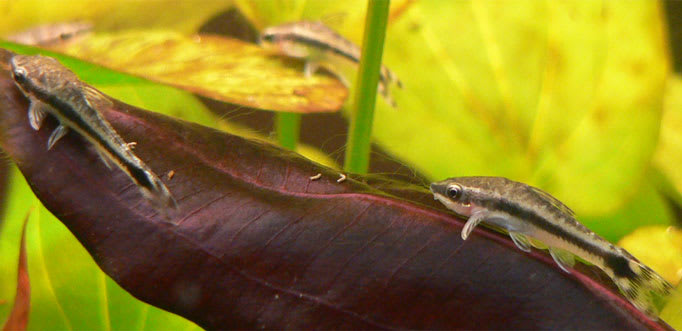
Common otocinclus
Otocinclus vittatus
Parameter dashboard
20-25 °C
6-7.5
3.3 cm
5 years
Care guide
The common otocinclus is one of the most popular algae-eating catfish in the planted-tank hobby, valued for its peaceful disposition and efficient grazing on soft green algae and diatom films. It ranges across much of South America — from the Amazon and Orinoco basins through the Paraná and Tocantins drainages — where it inhabits slow-moving tributaries and floodplain lakes with dense vegetation. Adults reach about 3.3 cm in total length and are best maintained in groups of six or more in a tank no smaller than 60 litres. A well-established aquarium with mature surfaces, moderate lighting, and stable water parameters between 20–25°C and pH 6.0–7.5 suits them well. Provide a continuous supply of soft algae and biofilm. Offer softened vegetables or algae-based grazing foods, but confirm that the fish actually eat them; acceptance varies between individuals. Add them only to mature, stable aquaria; a tank that has completed cycling may still lack enough food. Plan group size around the available grazing surfaces and supplementary food, rather than adding six fish to a bare new tank. They are entirely peaceful and do well with small tetras, rasboras, and dwarf shrimp, though they may be outcompeted for food by more aggressive grazers. The belly should remain rounded — a hollow or pinched belly indicates starvation, a common issue in underfed groups.
Sources
- fishbase.se — https://www.fishbase.se/summary/Otocinclus-vittatus.html
- aquariumcoop.com — https://www.aquariumcoop.com/blogs/aquarium/otocinclus-catfish
Further reading on identification and aquarium care.
Tankmate compatibility (sample)
Pairwise screening against other species in the database (prioritizing the same family when data is available).
Review first (10)
Caution or avoid from automated rules — confirm before mixing.
| Species | Assessment | Notes |
|---|---|---|
| Blue-eye panaque Panaque suttonorum Caution | Caution | Fish 2x+ larger may eat smaller tankmates Open pair in Compare → |
| Leopard Frog Pleco Peckoltia compta Caution | Caution | the two share only a narrow band of temperature, so one of them sits at the edge of its range · close relatives, and one of them is territorial, so both claim the same kind of space · one is boisterous and the other a much smaller peaceful fish sharing the same floor, where it can be intimidated and outcompeted at feeding time Open pair in Compare → |
| Royal Farlowella Sturisomatichthys festivus Caution | Caution | Fish 2x+ larger may eat smaller tankmates · the two share only a narrow band of temperature, so one of them sits at the edge of its range · close relatives, and one of them is territorial, so both claim the same kind of space · one is boisterous and the other a much smaller peaceful fish sharing the same floor, where it can be intimidated and outcompeted at feeding time Open pair in Compare → |
| Royal panaque Panaque nigrolineatus Caution | Caution | Fish 2x+ larger may eat smaller tankmates Open pair in Compare → |
| Twig Catfish Farlowella vittata Caution | Caution | Fish 2x+ larger may eat smaller tankmates · the two share only a narrow band of temperature, so one of them sits at the edge of its range Open pair in Compare → |
| Whiptail catfish Farlowella acus Caution | Caution | Fish 2x+ larger may eat smaller tankmates · the two share only a narrow band of temperature, so one of them sits at the edge of its range Open pair in Compare → |
| Gold Nugget Pleco Baryancistrus xanthellus Avoid | Avoid | Fish 2x+ larger may eat smaller tankmates · Species with non-overlapping temperature ranges cannot coexist · the two share only a narrow band of temperature, so one of them sits at the edge of its range · close relatives, and one of them is territorial, so both claim the same kind of space · one is boisterous and the other a much smaller peaceful fish sharing the same floor, where it can be intimidated and outcompeted at feeding time Open pair in Compare → |
| Medusa Pleco Ancistrus ranunculus Avoid | Avoid | Fish 2x+ larger may eat smaller tankmates · Species with non-overlapping temperature ranges cannot coexist · the two share only a narrow band of temperature, so one of them sits at the edge of its range Open pair in Compare → |
| Oxyropsis Oxyropsis carinata Avoid | Avoid | Fish 2x+ larger may eat smaller tankmates · Species with non-overlapping temperature ranges cannot coexist · the two share only a narrow band of temperature, so one of them sits at the edge of its range Open pair in Compare → |
| Zebra pleco Hypancistrus zebra Avoid | Avoid | Fish 2x+ larger may eat smaller tankmates · Species with non-overlapping temperature ranges cannot coexist · the two share only a narrow band of temperature, so one of them sits at the edge of its range · close relatives, and one of them is territorial, so both claim the same kind of space · one is boisterous and the other a much smaller peaceful fish sharing the same floor, where it can be intimidated and outcompeted at feeding time Open pair in Compare → |
2 species with compatible assessment in this sampleCollapse to hide the list; use “Open pair in Compare” for the full matrix.
| Species | Assessment | Notes |
|---|---|---|
| Nannoptopoma Nannoptopoma sternoptychum Compatible | Compatible | No rule-based conflicts detected for this pair. Open pair in Compare → |
| Zebra Oto Otocinclus cocama Compatible | Compatible | No rule-based conflicts detected for this pair. Open pair in Compare → |
Same rule engine as Compare. Not a substitute for observation, tank size, or acclimation.
Related species
Was this page useful? Spot anything wrong?