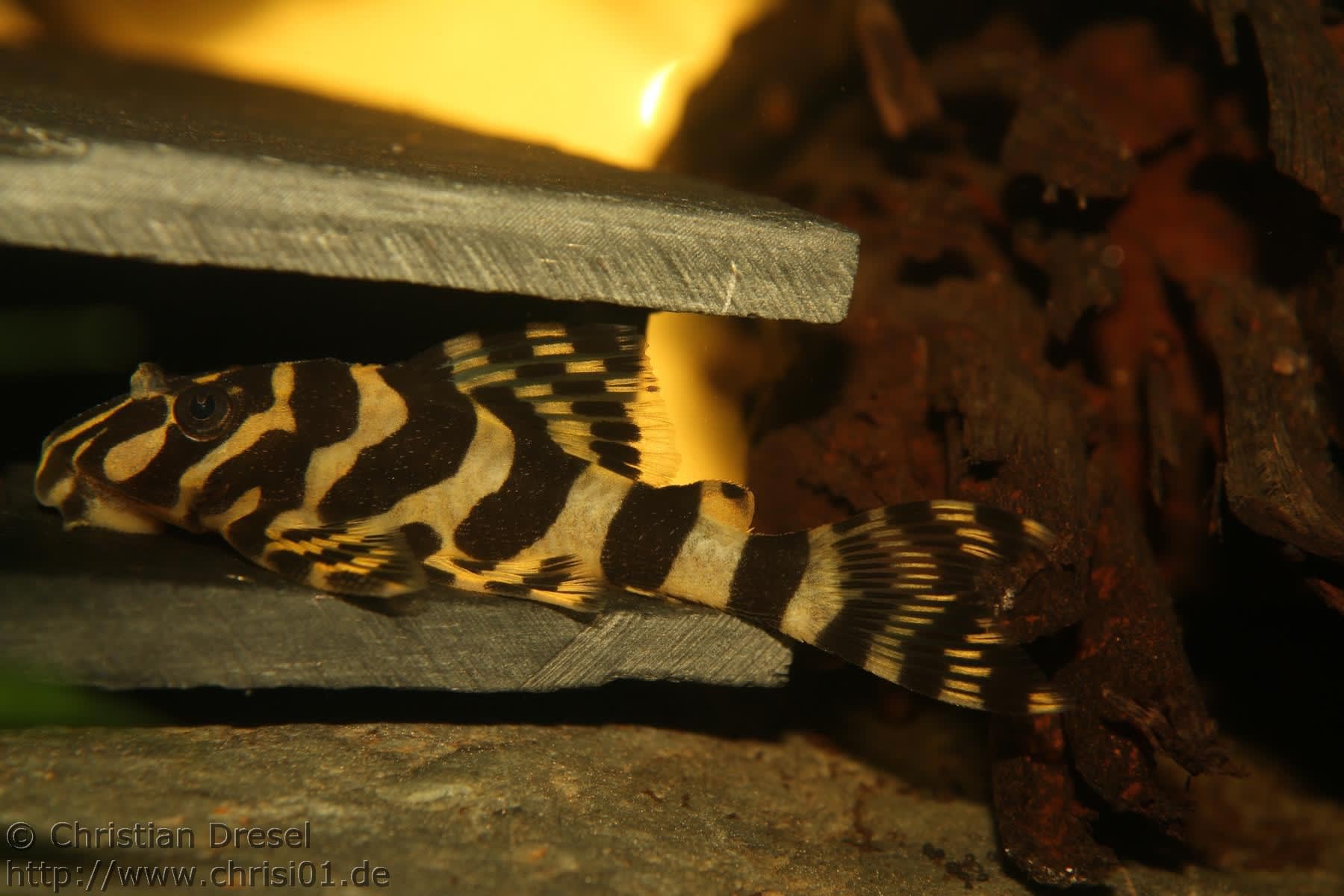
Leopard Frog Pleco
Peckoltia compta
Parameter dashboard
24-29 °C
6-7.5
6.2 cm
15 years
Care guide
The leopard frog pleco (Peckoltia compta), also known by its L-number L-134, is a small, attractively patterned armored catfish from the Tapajós River basin in the Brazilian Amazon. It was described as a new species in 2010 based primarily on its distinctive coloration, which features a clear stripe inside dark brown bars running from the snout tip to the anterior margin of the eyes. In the aquarium trade it is highly sought after by pleco enthusiasts and aquascapers alike for its bold pattern and manageable adult size of approximately 6.2 cm standard length. As a member of the genus Peckoltia within the Loricariidae family, it possesses the characteristic armored plating and ventral sucker mouth that define this group of catfishes. Its specific epithet compta is derived from the Latin word for 'adorned' or 'ornamented,' referring to its elaborate color pattern. The species is currently listed as Endangered on the IUCN Red List due to habitat degradation within its restricted range.
Source
Further reading on identification and aquarium care.
Tankmate compatibility (sample)
Pairwise screening against other species in the database (prioritizing the same family when data is available).
Review first (12)
Caution or avoid from automated rules — confirm before mixing.
| Species | Assessment | Notes |
|---|---|---|
| Gold Nugget Pleco Baryancistrus xanthellus Caution | Caution | Fish 2x+ larger may eat smaller tankmates · Multiple territorial species in the same swim layer cause stress · close relatives, and one of them is territorial, so both claim the same kind of space Open pair in Compare → |
| Medusa Pleco Ancistrus ranunculus Caution | Caution | Fish 2x+ larger may eat smaller tankmates · close relatives, and one of them is territorial, so both claim the same kind of space Open pair in Compare → |
| Nannoptopoma Nannoptopoma sternoptychum Caution | Caution | close relatives, and one of them is territorial, so both claim the same kind of space · one is boisterous and the other a much smaller peaceful fish sharing the same floor, where it can be intimidated and outcompeted at feeding time Open pair in Compare → |
| Oxyropsis Oxyropsis carinata Caution | Caution | close relatives, and one of them is territorial, so both claim the same kind of space Open pair in Compare → |
| Royal panaque Panaque nigrolineatus Caution | Caution | Fish 2x+ larger may eat smaller tankmates · close relatives, and one of them is territorial, so both claim the same kind of space Open pair in Compare → |
| Sunshine Pleco Scobinancistrus aureatus Caution | Caution | Fish 2x+ larger may eat smaller tankmates · Multiple territorial species in the same swim layer cause stress · close relatives, and one of them is territorial, so both claim the same kind of space Open pair in Compare → |
| Twig Catfish Farlowella vittata Caution | Caution | Fish 2x+ larger may eat smaller tankmates · close relatives, and one of them is territorial, so both claim the same kind of space Open pair in Compare → |
| Vampire Pleco Leporacanthicus galaxias Caution | Caution | Fish 2x+ larger may eat smaller tankmates · Multiple territorial species in the same swim layer cause stress · close relatives, and one of them is territorial, so both claim the same kind of space Open pair in Compare → |
| Whiptail catfish Farlowella acus Caution | Caution | Fish 2x+ larger may eat smaller tankmates · close relatives, and one of them is territorial, so both claim the same kind of space Open pair in Compare → |
| Whiptail Catfish Loricaria simillima Caution | Caution | Fish 2x+ larger may eat smaller tankmates · Multiple territorial species in the same swim layer cause stress · close relatives, and one of them is territorial, so both claim the same kind of space Open pair in Compare → |
| Zebra pleco Hypancistrus zebra Caution | Caution | Multiple territorial species in the same swim layer cause stress · close relatives, and one of them is territorial, so both claim the same kind of space Open pair in Compare → |
| Blue-eye panaque Panaque suttonorum Avoid | Avoid | Fish 2x+ larger may eat smaller tankmates · Species with non-overlapping temperature ranges cannot coexist · the two share only a narrow band of temperature, so one of them sits at the edge of its range · close relatives, and one of them is territorial, so both claim the same kind of space Open pair in Compare → |
Same rule engine as Compare. Not a substitute for observation, tank size, or acclimation.
Related species
Was this page useful? Spot anything wrong?