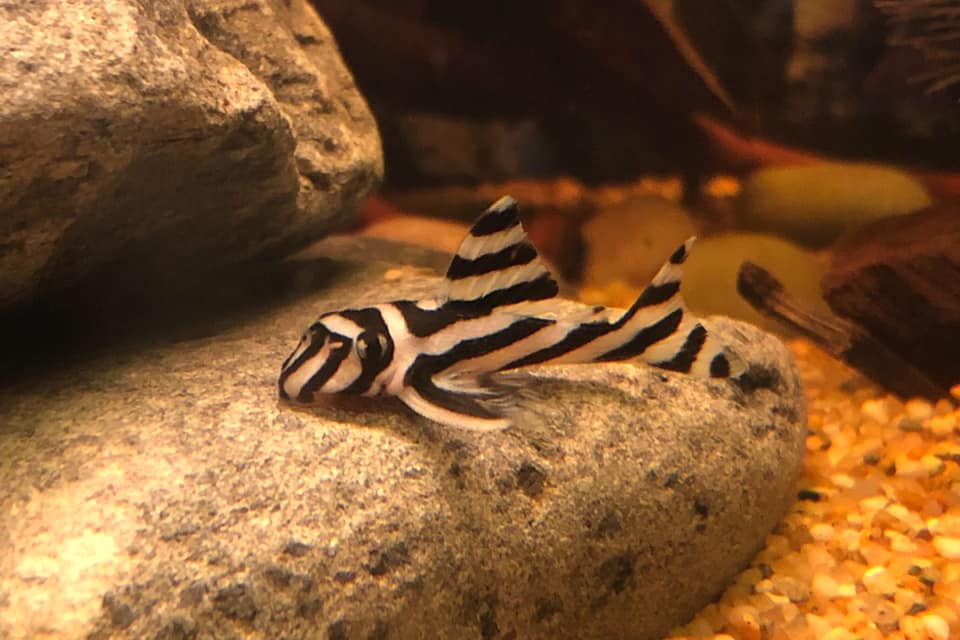
Zebra pleco
Hypancistrus zebra
Parameter dashboard
26-30 °C
6-7.5
8 cm
15 years
Care guide
The zebra pleco is one of the most coveted catfish in the aquarium hobby, named for its striking pattern of bold white or cream vertical stripes set against a deep black body — a contrast that earned it the L-number designations L046 and L098. Endemic to the Rio Xingu basin in Brazil, this species inhabits fast-flowing, highly oxygenated waters where it hides among rock crevices and rubble in deeper sections of the river. Part of the Loricariidae family, it reaches about 8 cm (3.2 inches) standard length and is armoured with bony plates rather than scales, with a suckermouth adapted for gripping surfaces in strong currents. Unfortunately, wild populations have come under pressure from habitat alteration associated with hydroelectric dam construction in the Xingu, making captive breeding programmes increasingly important for conservation.
In the aquarium, zebra plecos require pristine, well-oxygenated water with a temperature of 26–30°C and a pH of 6.0–7.5, with hardness between 2–15°H. A minimum 80-litre tank is recommended for a single adult, though the aquarium footprint matters more than volume since these are benthic fish that spend most of their time on the bottom. The ideal setup mimics their natural habitat: a soft sandy substrate topped with smooth pebbles and rocks of varying sizes, plus driftwood branches that provide crevices and tunnels for refuge. Strong water movement from a powerhead or two is essential for oxygenation, and while plants generally struggle in these conditions, hardy species like Anubias or Java fern attached to wood can survive. These catfish are somewhat reclusive and appreciate dimmer lighting, so floating plants or shaded areas help them feel secure.
Adult zebra plecos are carnivorous and require a meaty diet of live and frozen foods such as bloodworm, chopped mussel, prawn, and quality sinking carnivore pellets. Algae and vegetable matter are rarely taken, though the occasional slice of cucumber may be nibbled. They are generally peaceful towards tankmates too large to be considered food, with a semi-aggressive temperament best managed by providing ample hiding spots. Spawning in captivity is achievable with stable water conditions and a varied diet — males guard caves containing the eggs until they hatch. Aquarium lifespan estimates are around 15 years with suitable care. Check that each fish receives enough food, as faster-feeding bottom dwellers can outcompete them. Provide separate caves when keeping more than one male.
Sources
- seriouslyfish.com — https://www.seriouslyfish.com/species/hypancistrus-zebra/
- fishbase.se — https://www.fishbase.se/summary/Hypancistrus-zebra.html
Further reading on identification and aquarium care.
Tankmate compatibility (sample)
Pairwise screening against other species in the database (prioritizing the same family when data is available).
Review first (12)
Caution or avoid from automated rules — confirm before mixing.
| Species | Assessment | Notes |
|---|---|---|
| Gold Nugget Pleco Baryancistrus xanthellus Caution | Caution | Fish 2x+ larger may eat smaller tankmates · Multiple territorial species in the same swim layer cause stress · close relatives, and one of them is territorial, so both claim the same kind of space Open pair in Compare → |
| Nannoptopoma Nannoptopoma sternoptychum Caution | Caution | Fish 2x+ larger may eat smaller tankmates · close relatives, and one of them is territorial, so both claim the same kind of space · one is boisterous and the other a much smaller peaceful fish sharing the same floor, where it can be intimidated and outcompeted at feeding time Open pair in Compare → |
| Oxyropsis Oxyropsis carinata Caution | Caution | close relatives, and one of them is territorial, so both claim the same kind of space Open pair in Compare → |
| Royal Farlowella Sturisomatichthys festivus Caution | Caution | Fish 2x+ larger may eat smaller tankmates · Multiple territorial species in the same swim layer cause stress · close relatives, and one of them is territorial, so both claim the same kind of space Open pair in Compare → |
| Royal panaque Panaque nigrolineatus Caution | Caution | Fish 2x+ larger may eat smaller tankmates · close relatives, and one of them is territorial, so both claim the same kind of space Open pair in Compare → |
| Twig Catfish Farlowella vittata Caution | Caution | the two share only a narrow band of temperature, so one of them sits at the edge of its range · close relatives, and one of them is territorial, so both claim the same kind of space Open pair in Compare → |
| Whiptail catfish Farlowella acus Caution | Caution | the two share only a narrow band of temperature, so one of them sits at the edge of its range · close relatives, and one of them is territorial, so both claim the same kind of space Open pair in Compare → |
| Whiptail Catfish Loricaria simillima Caution | Caution | Fish 2x+ larger may eat smaller tankmates · Multiple territorial species in the same swim layer cause stress · the two share only a narrow band of temperature, so one of them sits at the edge of its range · close relatives, and one of them is territorial, so both claim the same kind of space Open pair in Compare → |
| Common otocinclus Otocinclus vittatus Avoid | Avoid | Fish 2x+ larger may eat smaller tankmates · Species with non-overlapping temperature ranges cannot coexist · the two share only a narrow band of temperature, so one of them sits at the edge of its range · close relatives, and one of them is territorial, so both claim the same kind of space · one is boisterous and the other a much smaller peaceful fish sharing the same floor, where it can be intimidated and outcompeted at feeding time Open pair in Compare → |
| Giant Whiptail Sturisomatichthys aureus Avoid | Avoid | Species with non-overlapping temperature ranges cannot coexist · the two share only a narrow band of temperature, so one of them sits at the edge of its range · close relatives, and one of them is territorial, so both claim the same kind of space Open pair in Compare → |
| Vampire Pleco Leporacanthicus galaxias Avoid | Avoid | Fish 2x+ larger may eat smaller tankmates · Multiple territorial species in the same swim layer cause stress · Species with non-overlapping temperature ranges cannot coexist · the two share only a narrow band of temperature, so one of them sits at the edge of its range · close relatives, and one of them is territorial, so both claim the same kind of space Open pair in Compare → |
| Zebra Oto Otocinclus cocama Avoid | Avoid | Species with non-overlapping temperature ranges cannot coexist · the two share only a narrow band of temperature, so one of them sits at the edge of its range · close relatives, and one of them is territorial, so both claim the same kind of space · one is boisterous and the other a much smaller peaceful fish sharing the same floor, where it can be intimidated and outcompeted at feeding time Open pair in Compare → |
Same rule engine as Compare. Not a substitute for observation, tank size, or acclimation.
Related species
Was this page useful? Spot anything wrong?