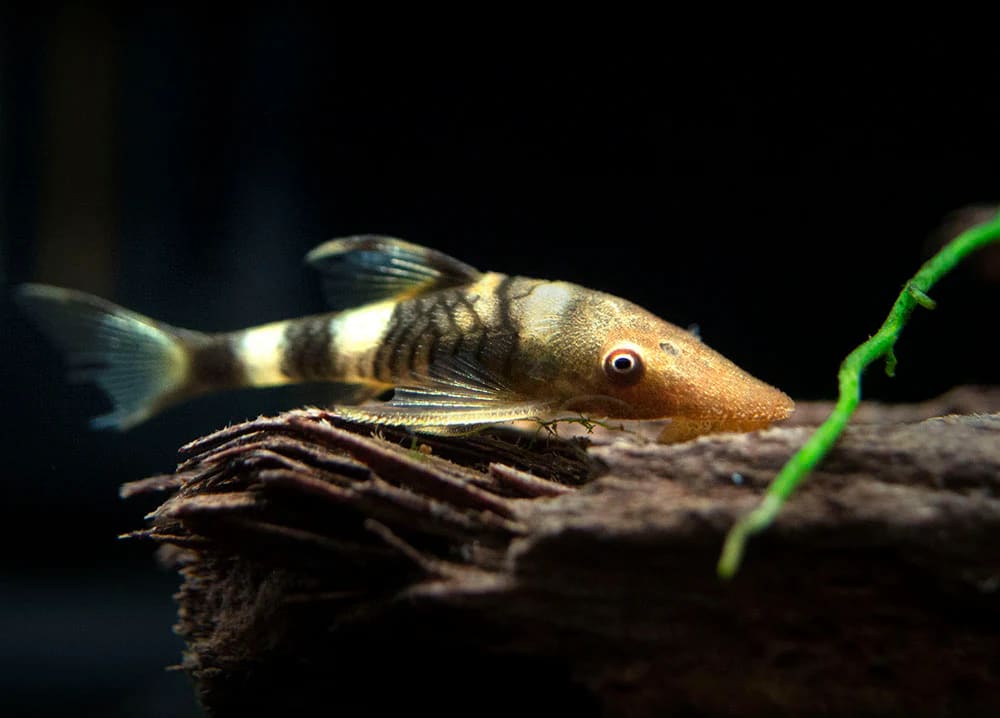
Zebra Oto
Otocinclus cocama
Parameter dashboard
21-25 °C
6-7.5
4.5 cm
5 years
Care guide
The zebra oto (Otocinclus cocama) is a distinctive small suckermouth catfish from the lower Ucayali and Marañón river basins in Peru, first described to science as recently as 2004. It reaches a maximum size of only 4–4.5 cm (1.6–1.8 in) and is named for its striking zebra-like vertical dark bars on a pale body — a pattern that makes it one of the most visually striking members of the genus. In the wild it inhabits small tributaries and slow-flowing marginal zones with dense aquatic vegetation and clear water.
This species is more delicate than the common Otocinclus macrospilus and must be added only to mature, well-established aquariums with a reliable supply of soft algae and biofilm, which form the bulk of its diet. A tank of at least 40 L (10 gal) with dense planting, floating vegetation, driftwood, and dried leaf litter is ideal. Water conditions should be stable: pH 6.0–7.5, temperature 21–25°C, with gentle filtration — an air-powered sponge filter is perfect. They are extremely sensitive to deteriorating water quality and should never be introduced to an immature tank.
Zebra otos are very peaceful, gregarious fish that must be kept in groups of at least six. They spend their daylight hours constantly grazing algae from plant leaves, wood, rocks, and tank walls. Supplement their diet with sinking algae wafers, spirulina-based foods, and blanched vegetables such as cucumber and zucchini. Compatible tankmates include small, peaceful characins, Corydoras species, and dwarf shrimp. The IUCN lists O. cocama as Endangered due to its limited range and collection pressure for the ornamental trade.
Source
Further reading on identification and aquarium care.
Tankmate compatibility (sample)
Pairwise screening against other species in the database (prioritizing the same family when data is available).
Review first (10)
Caution or avoid from automated rules — confirm before mixing.
| Species | Assessment | Notes |
|---|---|---|
| Blue-eye panaque Panaque suttonorum Caution | Caution | Fish 2x+ larger may eat smaller tankmates Open pair in Compare → |
| Giant Whiptail Sturisomatichthys aureus Caution | Caution | Fish 2x+ larger may eat smaller tankmates Open pair in Compare → |
| Leopard Frog Pleco Peckoltia compta Caution | Caution | the two share only a narrow band of temperature, so one of them sits at the edge of its range · close relatives, and one of them is territorial, so both claim the same kind of space · one is boisterous and the other a much smaller peaceful fish sharing the same floor, where it can be intimidated and outcompeted at feeding time Open pair in Compare → |
| Royal panaque Panaque nigrolineatus Caution | Caution | Fish 2x+ larger may eat smaller tankmates Open pair in Compare → |
| Twig Catfish Farlowella vittata Caution | Caution | Fish 2x+ larger may eat smaller tankmates · the two share only a narrow band of temperature, so one of them sits at the edge of its range Open pair in Compare → |
| Whiptail Catfish Loricaria simillima Caution | Caution | Fish 2x+ larger may eat smaller tankmates · the two share only a narrow band of temperature, so one of them sits at the edge of its range · close relatives, and one of them is territorial, so both claim the same kind of space · one is boisterous and the other a much smaller peaceful fish sharing the same floor, where it can be intimidated and outcompeted at feeding time Open pair in Compare → |
| Medusa Pleco Ancistrus ranunculus Avoid | Avoid | Fish 2x+ larger may eat smaller tankmates · Species with non-overlapping temperature ranges cannot coexist · the two share only a narrow band of temperature, so one of them sits at the edge of its range Open pair in Compare → |
| Oxyropsis Oxyropsis carinata Avoid | Avoid | Species with non-overlapping temperature ranges cannot coexist · the two share only a narrow band of temperature, so one of them sits at the edge of its range Open pair in Compare → |
| Sunshine Pleco Scobinancistrus aureatus Avoid | Avoid | Fish 2x+ larger may eat smaller tankmates · Species with non-overlapping temperature ranges cannot coexist · the two share only a narrow band of temperature, so one of them sits at the edge of its range · close relatives, and one of them is territorial, so both claim the same kind of space · one is boisterous and the other a much smaller peaceful fish sharing the same floor, where it can be intimidated and outcompeted at feeding time Open pair in Compare → |
| Zebra pleco Hypancistrus zebra Avoid | Avoid | Species with non-overlapping temperature ranges cannot coexist · the two share only a narrow band of temperature, so one of them sits at the edge of its range · close relatives, and one of them is territorial, so both claim the same kind of space · one is boisterous and the other a much smaller peaceful fish sharing the same floor, where it can be intimidated and outcompeted at feeding time Open pair in Compare → |
2 species with compatible assessment in this sampleCollapse to hide the list; use “Open pair in Compare” for the full matrix.
| Species | Assessment | Notes |
|---|---|---|
| Common otocinclus Otocinclus vittatus Compatible | Compatible | No rule-based conflicts detected for this pair. Open pair in Compare → |
| Nannoptopoma Nannoptopoma sternoptychum Compatible | Compatible | No rule-based conflicts detected for this pair. Open pair in Compare → |
Same rule engine as Compare. Not a substitute for observation, tank size, or acclimation.
Related species
Was this page useful? Spot anything wrong?