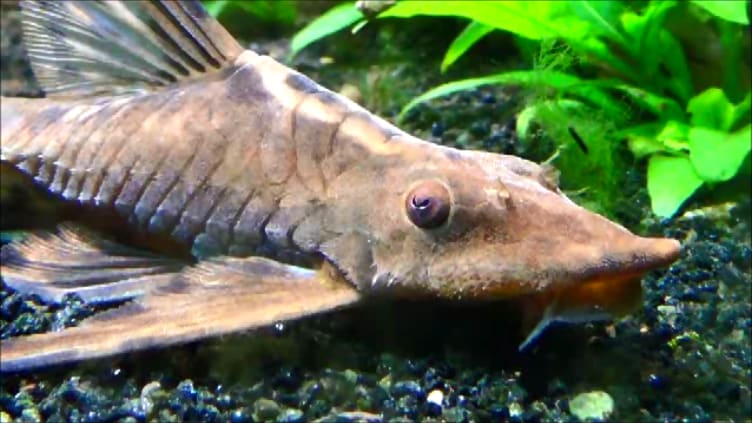
Royal Farlowella
Sturisomatichthys festivus
Parameter dashboard
24-28 °C
6-7.5
16.9 cm
Care guide
The royal farlowella (Sturisomatichthys festivus, formerly Sturisoma festivum) is a distinctive suckermouth catfish endemic to the Lake Maracaibo basin in Colombia and Venezuela. Reaching a standard length of 16.9 cm (6.7 in), it has an extremely elongated, slender body with a pointed snout and a long, whip-like tail, giving it a striking resemblance to a twig or blade of grass. The body is tan to olive brown with a dark horizontal stripe and subtle mottling, providing excellent camouflage among submerged branches and driftwood.
This species is generally peaceful toward non-conspecifics and makes a fascinating addition to a spacious community aquarium of at least 200 L (53 gal). It requires a well-oxygenated tank with moderate water flow and plenty of driftwood, which serves both as a hiding place and as a surface for grazing biofilm and algae. A sand substrate is ideal, and plants such as Anubias or Java fern attached to woodwork well. Water parameters should be 24-28C (75-82F), pH 6.0-7.5, with moderate hardness. As a member of Loricariidae, it is a facultative air breather and may occasionally gulp at the surface.
Royal farlowellas are primarily herbivorous and should be offered high-quality vegetable-based sinking wafers, blanched zucchini, cucumber, and spirulina tablets. They will also graze naturally on algae and biofilm in a mature tank. Males develop a bristly odontodal growth on the snout as they mature, while females remain smoother. Breeding has been accomplished in captivity but is uncommon.
Sources
- fishbase.se — https://www.fishbase.se/summary/Sturisomatichthys-festivus
- en.wikipedia.org — https://en.wikipedia.org/wiki/Sturisomatichthys_festivus
Further reading on identification and aquarium care.
Tankmate compatibility (sample)
Pairwise screening against other species in the database (prioritizing the same family when data is available).
Review first (12)
Caution or avoid from automated rules — confirm before mixing.
| Species | Assessment | Notes |
|---|---|---|
| Common otocinclus Otocinclus vittatus Caution | Caution | Fish 2x+ larger may eat smaller tankmates · the two share only a narrow band of temperature, so one of them sits at the edge of its range · close relatives, and one of them is territorial, so both claim the same kind of space · one is boisterous and the other a much smaller peaceful fish sharing the same floor, where it can be intimidated and outcompeted at feeding time Open pair in Compare → |
| Giant Whiptail Sturisomatichthys aureus Caution | Caution | close relatives, and one of them is territorial, so both claim the same kind of space Open pair in Compare → |
| Gold Nugget Pleco Baryancistrus xanthellus Caution | Caution | Multiple territorial species in the same swim layer cause stress · the two share only a narrow band of temperature, so one of them sits at the edge of its range · close relatives, and one of them is territorial, so both claim the same kind of space Open pair in Compare → |
| Medusa Pleco Ancistrus ranunculus Caution | Caution | close relatives, and one of them is territorial, so both claim the same kind of space Open pair in Compare → |
| Nannoptopoma Nannoptopoma sternoptychum Caution | Caution | Fish 2x+ larger may eat smaller tankmates · close relatives, and one of them is territorial, so both claim the same kind of space · one is boisterous and the other a much smaller peaceful fish sharing the same floor, where it can be intimidated and outcompeted at feeding time Open pair in Compare → |
| Oxyropsis Oxyropsis carinata Caution | Caution | Fish 2x+ larger may eat smaller tankmates · close relatives, and one of them is territorial, so both claim the same kind of space · one is boisterous and the other a much smaller peaceful fish sharing the same floor, where it can be intimidated and outcompeted at feeding time Open pair in Compare → |
| Royal panaque Panaque nigrolineatus Caution | Caution | Fish 2x+ larger may eat smaller tankmates · close relatives, and one of them is territorial, so both claim the same kind of space Open pair in Compare → |
| Sunshine Pleco Scobinancistrus aureatus Caution | Caution | Multiple territorial species in the same swim layer cause stress · close relatives, and one of them is territorial, so both claim the same kind of space Open pair in Compare → |
| Twig Catfish Farlowella vittata Caution | Caution | close relatives, and one of them is territorial, so both claim the same kind of space Open pair in Compare → |
| Zebra Oto Otocinclus cocama Caution | Caution | Fish 2x+ larger may eat smaller tankmates · the two share only a narrow band of temperature, so one of them sits at the edge of its range · close relatives, and one of them is territorial, so both claim the same kind of space · one is boisterous and the other a much smaller peaceful fish sharing the same floor, where it can be intimidated and outcompeted at feeding time Open pair in Compare → |
| Zebra pleco Hypancistrus zebra Caution | Caution | Fish 2x+ larger may eat smaller tankmates · Multiple territorial species in the same swim layer cause stress · close relatives, and one of them is territorial, so both claim the same kind of space Open pair in Compare → |
| Blue-eye panaque Panaque suttonorum Avoid | Avoid | Species with non-overlapping temperature ranges cannot coexist · the two share only a narrow band of temperature, so one of them sits at the edge of its range · close relatives, and one of them is territorial, so both claim the same kind of space Open pair in Compare → |
Same rule engine as Compare. Not a substitute for observation, tank size, or acclimation.
Related species
Was this page useful? Spot anything wrong?