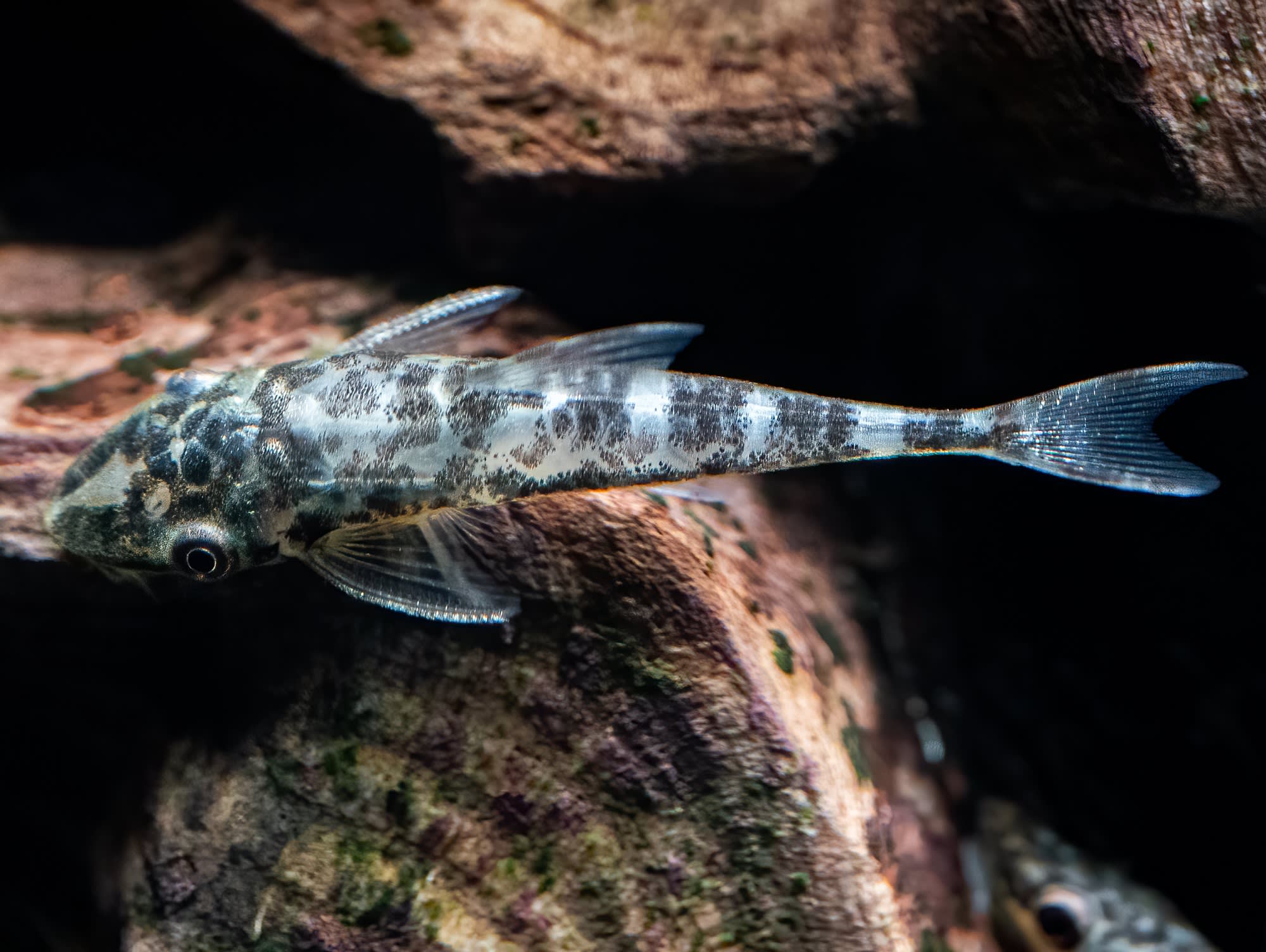
Nannoptopoma
Nannoptopoma sternoptychum
Parameter dashboard
—
—
3.3 cm
Care guide
Sold as an otocinclus far more often than under its own name, and the confusion has a taxonomic root: Scott Schaefer erected the genus Nannoptopoma in 1996 around Otocinclus spectabilis, so this fish spent its earlier career inside the genus hobbyists already knew. FishBase records a maximum standard length of 3.3 cm, small even by suckermouth catfish standards.
Identification is a plate-counting job rather than a colour one. Schaefer separated the genus on the pattern of abdominal plating, a pair of slender plates behind the coracoids followed by one to three unpaired plates down the midline, and on a coracoid process that curves hard enough for its tip to point upward. Against its only congener, N. spectabile, this species carries thoracic plates, 21 to 22 lateral plates and 21 to 37 teeth on the dentary. The body is elongate and the fin count modest: one dorsal spine, seven dorsal rays, six anal rays, 26 vertebrae.
In the wild it is a bottom-hugging freshwater fish of tributaries feeding the upper Amazon in Ecuador and Peru, and of the central Amazon and upper Madeira in Bolivia and Peru. IUCN assessed it as Least Concern in 2020, and it carries no commercial fishery pressure.
Sources
- fishbase.de — https://www.fishbase.de/summary/Nannoptopoma-sternoptychum.html
- en.wikipedia.org — https://en.wikipedia.org/wiki/Nannoptopoma
Further reading on identification and aquarium care.
Tankmate compatibility (sample)
Pairwise screening against other species in the database (prioritizing the same family when data is available).
Review first (10)
Caution or avoid from automated rules — confirm before mixing.
| Species | Assessment | Notes |
|---|---|---|
| Blue-eye panaque Panaque suttonorum Caution | Caution | Fish 2x+ larger may eat smaller tankmates Open pair in Compare → |
| Giant Whiptail Sturisomatichthys aureus Caution | Caution | Fish 2x+ larger may eat smaller tankmates Open pair in Compare → |
| Gold Nugget Pleco Baryancistrus xanthellus Caution | Caution | Fish 2x+ larger may eat smaller tankmates · close relatives, and one of them is territorial, so both claim the same kind of space · one is boisterous and the other a much smaller peaceful fish sharing the same floor, where it can be intimidated and outcompeted at feeding time Open pair in Compare → |
| Oxyropsis Oxyropsis carinata Caution | Caution | Fish 2x+ larger may eat smaller tankmates Open pair in Compare → |
| Royal Farlowella Sturisomatichthys festivus Caution | Caution | Fish 2x+ larger may eat smaller tankmates · close relatives, and one of them is territorial, so both claim the same kind of space · one is boisterous and the other a much smaller peaceful fish sharing the same floor, where it can be intimidated and outcompeted at feeding time Open pair in Compare → |
| Royal panaque Panaque nigrolineatus Caution | Caution | Fish 2x+ larger may eat smaller tankmates Open pair in Compare → |
| Sunshine Pleco Scobinancistrus aureatus Caution | Caution | Fish 2x+ larger may eat smaller tankmates · close relatives, and one of them is territorial, so both claim the same kind of space · one is boisterous and the other a much smaller peaceful fish sharing the same floor, where it can be intimidated and outcompeted at feeding time Open pair in Compare → |
| Vampire Pleco Leporacanthicus galaxias Caution | Caution | Fish 2x+ larger may eat smaller tankmates · close relatives, and one of them is territorial, so both claim the same kind of space · one is boisterous and the other a much smaller peaceful fish sharing the same floor, where it can be intimidated and outcompeted at feeding time Open pair in Compare → |
| Whiptail Catfish Loricaria simillima Caution | Caution | Fish 2x+ larger may eat smaller tankmates · close relatives, and one of them is territorial, so both claim the same kind of space · one is boisterous and the other a much smaller peaceful fish sharing the same floor, where it can be intimidated and outcompeted at feeding time Open pair in Compare → |
| Zebra pleco Hypancistrus zebra Caution | Caution | Fish 2x+ larger may eat smaller tankmates · close relatives, and one of them is territorial, so both claim the same kind of space · one is boisterous and the other a much smaller peaceful fish sharing the same floor, where it can be intimidated and outcompeted at feeding time Open pair in Compare → |
2 species with compatible assessment in this sampleCollapse to hide the list; use “Open pair in Compare” for the full matrix.
| Species | Assessment | Notes |
|---|---|---|
| Common otocinclus Otocinclus vittatus Compatible | Compatible | No rule-based conflicts detected for this pair. Open pair in Compare → |
| Zebra Oto Otocinclus cocama Compatible | Compatible | No rule-based conflicts detected for this pair. Open pair in Compare → |
Same rule engine as Compare. Not a substitute for observation, tank size, or acclimation.
Related species
Was this page useful? Spot anything wrong?