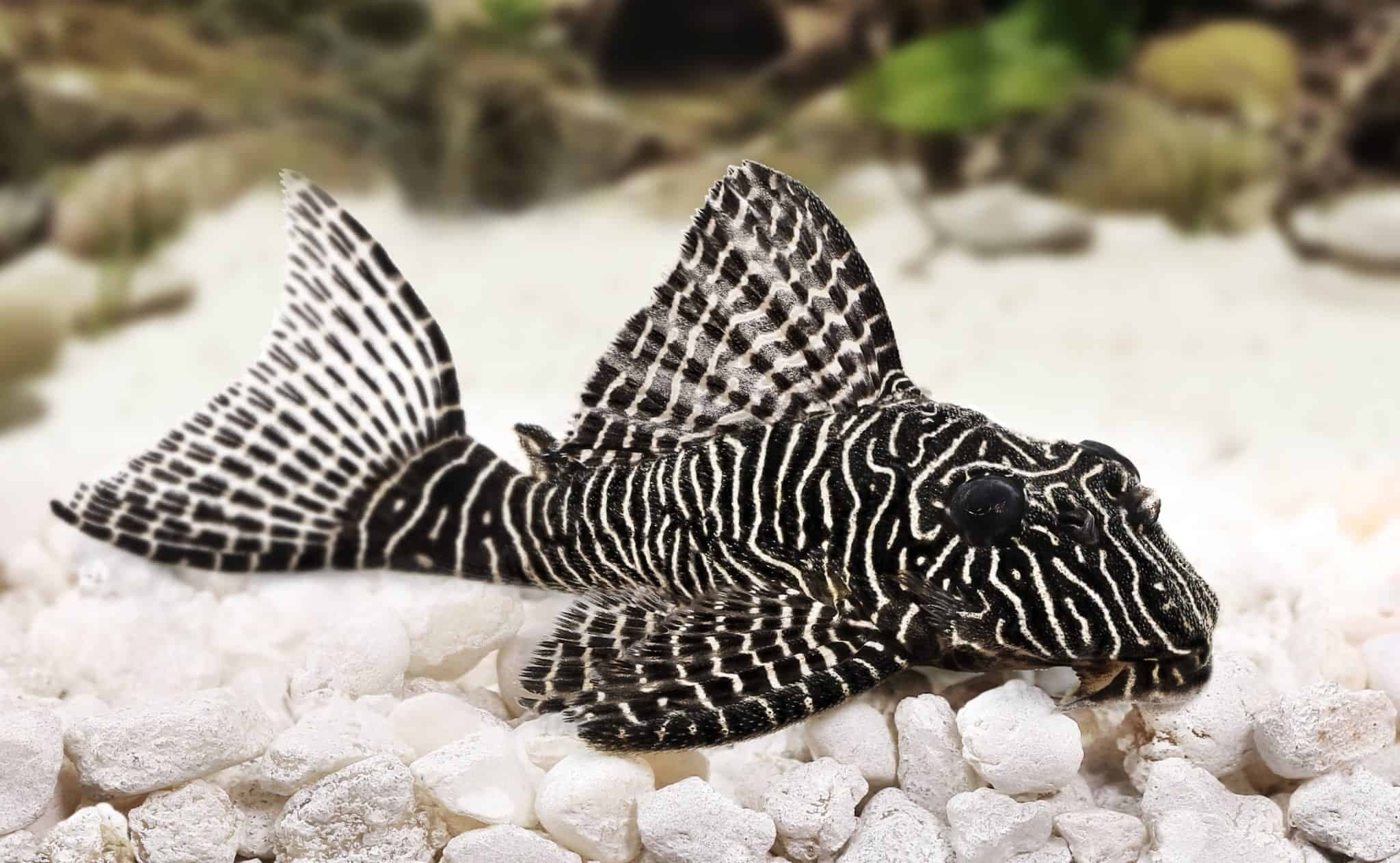
Vampire Pleco
Leporacanthicus galaxias
Parameter dashboard
22-26 °C
5.6-7
25 cm
Care guide
The vampire pleco, also known as the galaxy plec or L029, is a striking Loricariid from the fast-flowing rapids of Brazil's Amazon and Tocantins river basins. Its dark body is covered in contrasting white or golden spots, and its common name comes from the two large fang-like teeth in its upper jaw — thought to help grip prey such as snails. This is a relatively large pleco, reaching up to 25 cm in standard length, and requires a spacious aquarium to thrive.
As a reophilic species adapted to oxygen-rich, fast-moving waters, the vampire pleco demands excellent water quality with high dissolved oxygen and strong flow. A tank measuring at least 120 cm x 45 cm x 45 cm (243 litres) is needed to house one properly. The setup should include a sandy substrate, smooth rocks, and substantial driftwood for shelter. Dim lighting and powerheads or large airstones help replicate its natural environment. This species produces considerable waste, so efficient filtration is essential.
Though territorial toward other bottom-dwellers, the vampire pleco is generally peaceful with fish that inhabit the upper and middle water layers, making it suitable for a community of appropriately sized tankmates. Its diet is notably carnivorous for a Loricariid — it relishes meaty foods such as earthworms, prawns, mussels, and bloodworm, and has a particular fondness for snails. Sinking dried foods are also accepted. This species has been bred in the hobby but few details are documented.
Source
Further reading on identification and aquarium care.
Tankmate compatibility (sample)
Pairwise screening against other species in the database (prioritizing the same family when data is available).
Review first (12)
Caution or avoid from automated rules — confirm before mixing.
| Species | Assessment | Notes |
|---|---|---|
| Common otocinclus Otocinclus vittatus Caution | Caution | Fish 2x+ larger may eat smaller tankmates · close relatives, and one of them is territorial, so both claim the same kind of space · one is boisterous and the other a much smaller peaceful fish sharing the same floor, where it can be intimidated and outcompeted at feeding time Open pair in Compare → |
| Giant Whiptail Sturisomatichthys aureus Caution | Caution | close relatives, and one of them is territorial, so both claim the same kind of space · one is boisterous and the other a much smaller peaceful fish sharing the same floor, where it can be intimidated and outcompeted at feeding time Open pair in Compare → |
| Leopard Frog Pleco Peckoltia compta Caution | Caution | Fish 2x+ larger may eat smaller tankmates · Multiple territorial species in the same swim layer cause stress · close relatives, and one of them is territorial, so both claim the same kind of space Open pair in Compare → |
| Medusa Pleco Ancistrus ranunculus Caution | Caution | the two share only a narrow band of temperature, so one of them sits at the edge of its range · close relatives, and one of them is territorial, so both claim the same kind of space · one is boisterous and the other a much smaller peaceful fish sharing the same floor, where it can be intimidated and outcompeted at feeding time Open pair in Compare → |
| Royal Farlowella Sturisomatichthys festivus Caution | Caution | Multiple territorial species in the same swim layer cause stress · close relatives, and one of them is territorial, so both claim the same kind of space Open pair in Compare → |
| Royal panaque Panaque nigrolineatus Caution | Caution | close relatives, and one of them is territorial, so both claim the same kind of space Open pair in Compare → |
| Twig Catfish Farlowella vittata Caution | Caution | close relatives, and one of them is territorial, so both claim the same kind of space · one is boisterous and the other a much smaller peaceful fish sharing the same floor, where it can be intimidated and outcompeted at feeding time Open pair in Compare → |
| Whiptail catfish Farlowella acus Caution | Caution | close relatives, and one of them is territorial, so both claim the same kind of space · one is boisterous and the other a much smaller peaceful fish sharing the same floor, where it can be intimidated and outcompeted at feeding time Open pair in Compare → |
| Whiptail Catfish Loricaria simillima Caution | Caution | Multiple territorial species in the same swim layer cause stress · close relatives, and one of them is territorial, so both claim the same kind of space Open pair in Compare → |
| Zebra Oto Otocinclus cocama Caution | Caution | Fish 2x+ larger may eat smaller tankmates · close relatives, and one of them is territorial, so both claim the same kind of space · one is boisterous and the other a much smaller peaceful fish sharing the same floor, where it can be intimidated and outcompeted at feeding time Open pair in Compare → |
| Oxyropsis Oxyropsis carinata Avoid | Avoid | Fish 2x+ larger may eat smaller tankmates · Species with non-overlapping temperature ranges cannot coexist · the two share only a narrow band of temperature, so one of them sits at the edge of its range · close relatives, and one of them is territorial, so both claim the same kind of space · one is boisterous and the other a much smaller peaceful fish sharing the same floor, where it can be intimidated and outcompeted at feeding time Open pair in Compare → |
| Zebra pleco Hypancistrus zebra Avoid | Avoid | Fish 2x+ larger may eat smaller tankmates · Multiple territorial species in the same swim layer cause stress · Species with non-overlapping temperature ranges cannot coexist · the two share only a narrow band of temperature, so one of them sits at the edge of its range · close relatives, and one of them is territorial, so both claim the same kind of space Open pair in Compare → |
Same rule engine as Compare. Not a substitute for observation, tank size, or acclimation.
Related species
Was this page useful? Spot anything wrong?