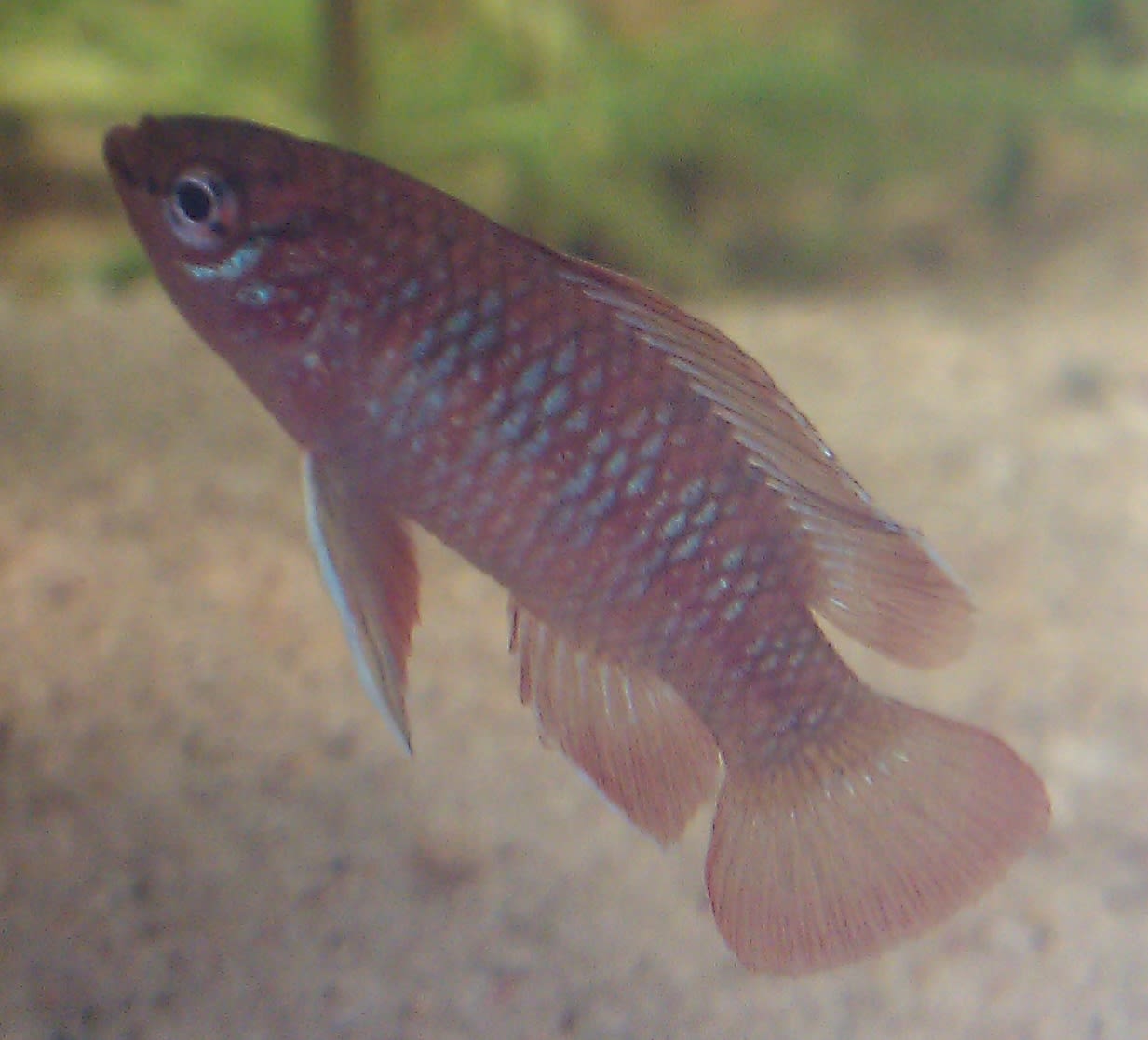
Scarlet badis
Dario dario
Parameter dashboard
18-26 °C
6.5-8.5
2 cm
3 years
Care guide
The scarlet badis (Dario dario) is one of the smallest percoid fishes known, reaching a maximum standard length of just 20 mm. It is native to the Brahmaputra River drainage in West Bengal and Assam states of India, where it inhabits shallow, clear water streams with sand or gravel substrates and dense growths of marginal and aquatic vegetation including Hygrophila, Limnophila, and Rotala. Males are strikingly beautiful, displaying vibrant red and blue coloration with a series of seven iridescent blue vertical bars on the flanks — a pattern unique to this species among its congeners. Females are smaller and much plainer, lacking red and blue pigmentation. The scarlet badis is a micropredator that feeds on small aquatic crustaceans, worms, and insect larvae, and in captivity requires a steady supply of live or frozen micro-foods such as Artemia nauplii, Daphnia, and microworm. It is a retiring, slow-moving fish that is easily outcompeted by more boisterous tankmates, making it best suited to a dedicated nano-aquarium or a carefully chosen community of small, peaceful species. Rival males can be highly aggressive toward one another, and only a single pair or one male with several females should be housed in smaller aquaria. A pair requires a tank with base dimensions of at least 45 × 30 cm furnished with dense planting and plenty of cover including Cryptocoryne, Microsorum, and leaf litter.
Source
Further reading on identification and aquarium care.
Tankmate compatibility (sample)
Pairwise screening against other species in the database (prioritizing the same family when data is available).
Review first (10)
Caution or avoid from automated rules — confirm before mixing.
| Species | Assessment | Notes |
|---|---|---|
| Chameleon fish Badis badis Caution | Caution | Fish 2x+ larger may eat smaller tankmates · close relatives, and one of them is territorial, so both claim the same kind of space Open pair in Compare → |
| Chinese barb Barbodes semifasciolatus Caution | Caution | Fish 2x+ larger may eat smaller tankmates Open pair in Compare → |
| Colombian Tetra Hyphessobrycon columbianus Caution | Caution | Fish 2x+ larger may eat smaller tankmates Open pair in Compare → |
| Fiveband barb Desmopuntius pentazona Caution | Caution | Fish 2x+ larger may eat smaller tankmates Open pair in Compare → |
| Greenstreaked eartheater Biotodoma cupido Caution | Caution | Fish 2x+ larger may eat smaller tankmates Open pair in Compare → |
| Guitarrita Bunocephalus coracoideus Caution | Caution | Fish 2x+ larger may eat smaller tankmates Open pair in Compare → |
| Oscar Astronotus ocellatus Caution | Caution | Fish 2x+ larger may eat smaller tankmates Open pair in Compare → |
| Splash tetra Copella arnoldi Caution | Caution | Fish 2x+ larger may eat smaller tankmates Open pair in Compare → |
| Boeseman's rainbowfish Melanotaenia boesemani Avoid | Avoid | Fish 2x+ larger may eat smaller tankmates · Species with non-overlapping temperature ranges cannot coexist · the two share only a narrow band of temperature, so one of them sits at the edge of its range Open pair in Compare → |
| Panda Uaru Uaru fernandezyepezi Avoid | Avoid | Fish 2x+ larger may eat smaller tankmates · Species with non-overlapping temperature ranges cannot coexist · Species with non-overlapping pH ranges may not thrive together · the two share only a narrow band of temperature, so one of them sits at the edge of its range Open pair in Compare → |
2 species with compatible assessment in this sampleCollapse to hide the list; use “Open pair in Compare” for the full matrix.
| Species | Assessment | Notes |
|---|---|---|
| Asian Stone Catfish Hara jerdoni Compatible | Compatible | No rule-based conflicts detected for this pair. Open pair in Compare → |
| Pygmy corydoras Corydoras pygmaeus Compatible | Compatible | No rule-based conflicts detected for this pair. Open pair in Compare → |
Same rule engine as Compare. Not a substitute for observation, tank size, or acclimation.
Related species
Was this page useful? Spot anything wrong?