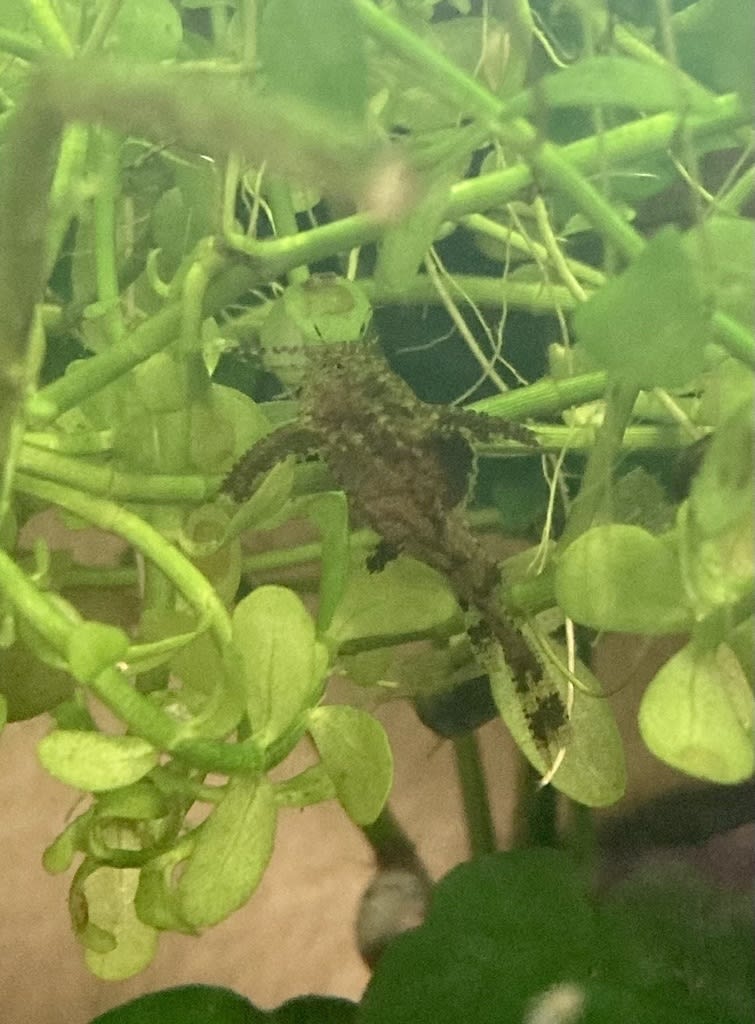
Asian Stone Catfish
Hara jerdoni
Parameter dashboard
18-24 °C
5.6-7.6
3 cm
Care guide
The Asian stone catfish reaches about 3 cm standard length and is one of the smallest catfish species in the hobby. Its body is flattened, mottled brown and beige, designed to blend into rocky and sandy streambeds across northern India and Bangladesh. These are inactive fish that do well in small, species-specific tanks — a base of 30 by 20 cm (about 12.5 L) can house a small group. Temperature of 18–24 °C and pH 5.6–7.6 with moderate hardness suit them; they do not need a heater in most indoor setups. Diet consists of small live and frozen foods such as bloodworm and daphnia, plus fine sinking pellets — they are strictly nocturnal feeders, so offer food after lights out. They are very peaceful but easily outcompeted by active bottom-dwellers, so keep only with other small, gentle species. The genus was recently revised and many fish sold as H. jerdoni may represent other closely related species. They spend most of the day wedged under or on top of smooth stones, emerging at night to forage over the substrate with their sensory barbels. A fine sand or smooth gravel substrate is essential.
Source
Further reading on identification and aquarium care.
Tankmate compatibility (sample)
Pairwise screening against other species in the database (prioritizing the same family when data is available).
Review first (6)
Caution or avoid from automated rules — confirm before mixing.
| Species | Assessment | Notes |
|---|---|---|
| Greenstreaked eartheater Biotodoma cupido Caution | Caution | Fish 2x+ larger may eat smaller tankmates · the two share only a narrow band of temperature, so one of them sits at the edge of its range Open pair in Compare → |
| Guitarrita Bunocephalus coracoideus Caution | Caution | Fish 2x+ larger may eat smaller tankmates Open pair in Compare → |
| Jack Dempsey Rocio octofasciata Caution | Caution | Fish 2x+ larger may eat smaller tankmates · one is boisterous and the other a much smaller peaceful fish sharing the same floor, where it can be intimidated and outcompeted at feeding time Open pair in Compare → |
| Zebra loach Botia striata Caution | Caution | Fish 2x+ larger may eat smaller tankmates Open pair in Compare → |
| Electric blue ram Mikrogeophagus ramirezi Avoid | Avoid | Species with non-overlapping temperature ranges cannot coexist · the two share only a narrow band of temperature, so one of them sits at the edge of its range Open pair in Compare → |
| Honey blue eye Pseudomugil mellis Avoid | Avoid | Species with non-overlapping temperature ranges cannot coexist · the two share only a narrow band of temperature, so one of them sits at the edge of its range Open pair in Compare → |
6 species with compatible assessment in this sampleCollapse to hide the list; use “Open pair in Compare” for the full matrix.
| Species | Assessment | Notes |
|---|---|---|
| Black phantom tetra Hyphessobrycon megalopterus Compatible | Compatible | No rule-based conflicts detected for this pair. Open pair in Compare → |
| Cherry Shrimp Neocaridina davidi Compatible | Compatible | No rule-based conflicts detected for this pair. Open pair in Compare → |
| Chili Rasbora Boraras brigittae Compatible | Compatible | No rule-based conflicts detected for this pair. Open pair in Compare → |
| Ghost shrimp Palaemon paludosus Compatible | Compatible | No rule-based conflicts detected for this pair. Open pair in Compare → |
| Honey gourami Trichogaster chuna Compatible | Compatible | No rule-based conflicts detected for this pair. Open pair in Compare → |
| Strawberry Rasbora Boraras naevus Compatible | Compatible | No rule-based conflicts detected for this pair. Open pair in Compare → |
Same rule engine as Compare. Not a substitute for observation, tank size, or acclimation.
Was this page useful? Spot anything wrong?