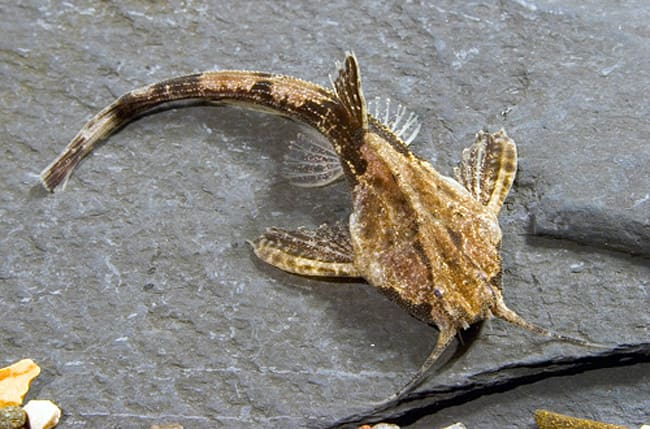
Guitarrita
Bunocephalus coracoideus
Parameter dashboard
20-27 °C
5.8-7.8
15 cm
8 years
Care guide
The banjo catfish (Bunocephalus coracoideus), known locally as 'Guitarrita' or 'little guitar' for its distinctive shape when viewed from above, is a uniquely adapted member of the Aspredinidae family native to Bolivia, Peru, and Brazil. Its flattened body, mottled brown coloration, and trailing filamentous barbels give it the appearance of a dead leaf — an extraordinary camouflage that makes it nearly invisible against a substrate of leaf litter and driftwood. Rather than swimming to escape a net, these fish will typically drift motionless in the current until they settle on the bottom, relying on their cryptic appearance for protection.
Despite being regularly available in the trade, the banjo catfish is not an ideal community fish. It is largely inactive and secretive, spending daylight hours buried or pressed against the substrate, only emerging to feed under cover of darkness. It grows to a maximum standard length of around 15 cm (6 inches) and is unfussy regarding diet, readily accepting sinking dried foods, live or frozen bloodworm, earthworms, and similar protein-rich offerings — though food should be added after lights-out to ensure it receives its share. It is totally unaggressive toward tankmates of any size and can be kept singly or in small groups with equal success.
A well-established aquarium of 70–100 liters with sand substrate and plenty of shaded hiding spots suits this species best. Dim lighting, scattered dried oak or beech leaves, and driftwood roots replicate its natural forest-stream habitat. Recommended water parameters include a temperature of 20–27°C, pH 5.8–7.8, and hardness 2–20°H. Banjo catfish occasionally shed their skin — a poorly understood but normal behavior — and have a novel jerky swimming motion produced by drawing water through the mouth and expelling it via the gills. Breeding is rarely achieved in aquaria but possible with a group of six or more mature specimens; eggs are laid on the substrate and hatch in approximately three days.
Source
Further reading on identification and aquarium care.
Tankmate compatibility (sample)
Pairwise screening against other species in the database (prioritizing the same family when data is available).
Review first (9)
Caution or avoid from automated rules — confirm before mixing.
| Species | Assessment | Notes |
|---|---|---|
| Fasciatus Shell Dweller Altolamprologus fasciatus Caution | Caution | Species with non-overlapping pH ranges may not thrive together Open pair in Compare → |
| Glass catfish Kryptopterus vitreolus Caution | Caution | Fish 2x+ larger may eat smaller tankmates Open pair in Compare → |
| Hillstream loach Gastromyzon punctulatus Caution | Caution | Fish 2x+ larger may eat smaller tankmates Open pair in Compare → |
| Indonesian snakehead Channa micropeltes Caution | Caution | Fish 2x+ larger may eat smaller tankmates Open pair in Compare → |
| Malabar pufferfish Carinotetraodon travancoricus Caution | Caution | Fish 2x+ larger may eat smaller tankmates Open pair in Compare → |
| Nannoptopoma Nannoptopoma sternoptychum Caution | Caution | Fish 2x+ larger may eat smaller tankmates Open pair in Compare → |
| Oscar Astronotus ocellatus Caution | Caution | Fish 2x+ larger may eat smaller tankmates Open pair in Compare → |
| Surrufus Stiphodon Stiphodon surrufus Caution | Caution | Fish 2x+ larger may eat smaller tankmates Open pair in Compare → |
| Zebra danio Danio rerio Caution | Caution | Fish 2x+ larger may eat smaller tankmates Open pair in Compare → |
3 species with compatible assessment in this sampleCollapse to hide the list; use “Open pair in Compare” for the full matrix.
| Species | Assessment | Notes |
|---|---|---|
| Bolivian Ram Mikrogeophagus altispinosus Compatible | Compatible | No rule-based conflicts detected for this pair. Open pair in Compare → |
| Giant Whiptail Sturisomatichthys aureus Compatible | Compatible | No rule-based conflicts detected for this pair. Open pair in Compare → |
| Lizard Loach Homaloptera orthogoniata Compatible | Compatible | No rule-based conflicts detected for this pair. Open pair in Compare → |
Same rule engine as Compare. Not a substitute for observation, tank size, or acclimation.
Was this page useful? Spot anything wrong?