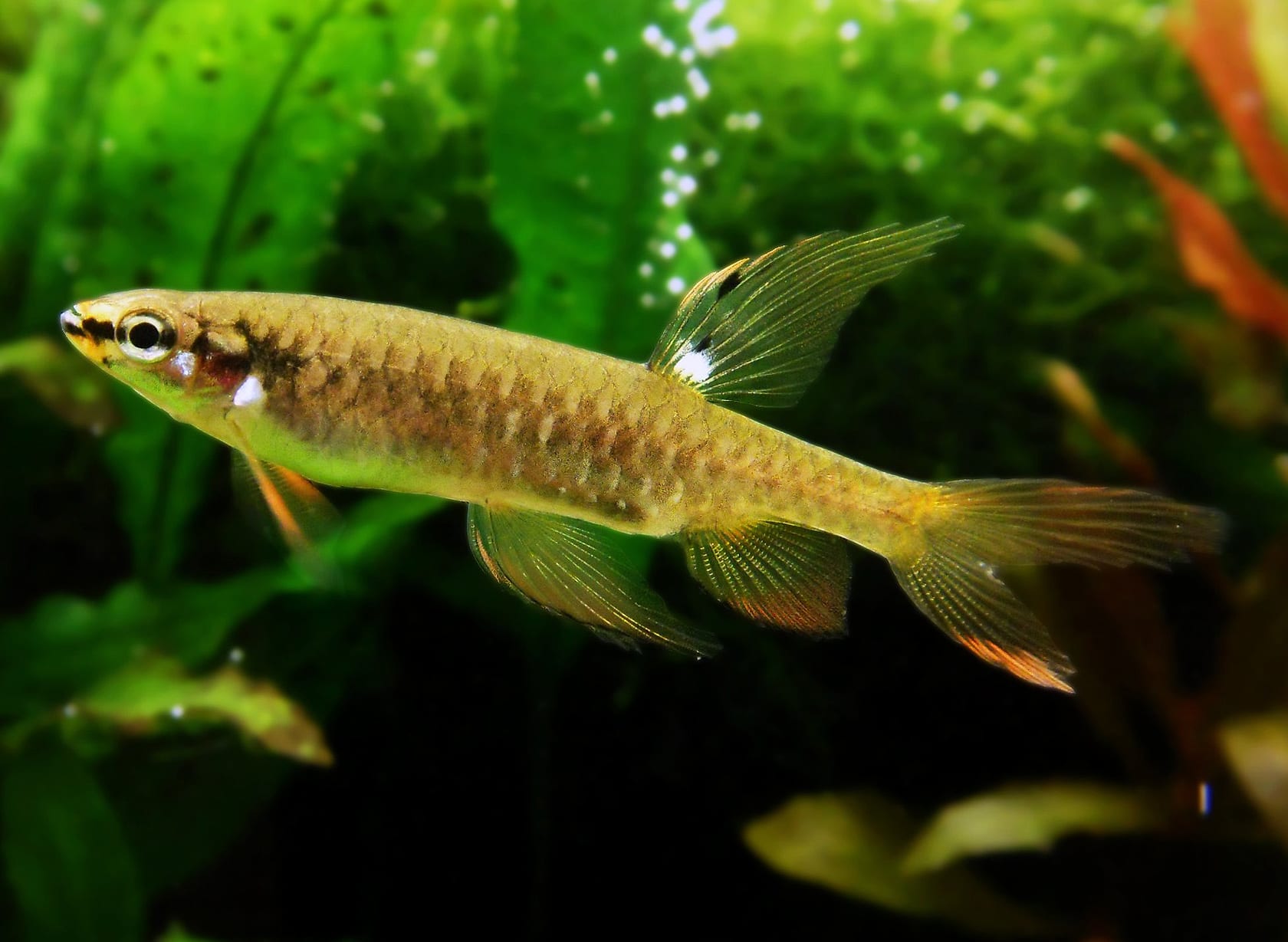
Splash tetra
Copella arnoldi
Parameter dashboard
20-28 °C
4-7.5
5.5 cm
3 years
Care guide
The splash tetra (Copella arnoldi) is a remarkable characiform fish from the lower Amazon Basin in Brazil and the coastal drainages of Guyana, Suriname, and French Guiana. Reaching 4.5–5.5 cm (1.8–2.2 in), it is a slender, surface-dwelling species with an elongated body and an upturned mouth adapted for feeding at the water surface. Males develop longer, more colourful fins with red and black margins, while females remain plainer and rounder when gravid. The species is best known for its extraordinary reproductive behaviour.
Splash tetras require a tank with a large surface area — at least 90 × 30 cm (~80 L / 21 gal) — and a tight-fitting lid, as they are accomplished jumpers. The aquarium should be densely planted with floating plants, overhanging vegetation, driftwood, and dried leaf litter to simulate the blackwater conditions of their native habitat. Dim lighting, gentle surface agitation, and stable water chemistry (pH 4.0–7.5, temperature 20–28°C) are essential. They are sensitive to parameter swings and should only be added to mature tanks.
The splash tetra's breeding strategy is unique among aquarium fish. The pair leaps out of the water together and clings to the underside of an overhanging leaf or the tank cover glass using their pelvic fins, depositing 5–10 eggs per event until 100–200 total eggs are laid. The male then splashes water onto the eggs with his tail every minute for 36–72 hours — day and night — until they hatch and the fry drop into the water. Breeding requires a tank with accessible overhanging surfaces at the correct height. Feed a varied diet of live and frozen foods (Daphnia, Artemia, bloodworm, fruit flies) supplemented with high-quality flake. Keep in groups of 8–10 with peaceful, similarly sized tankmates.
Source
Further reading on identification and aquarium care.
Tankmate compatibility (sample)
Pairwise screening against other species in the database (prioritizing the same family when data is available).
Review first (7)
Caution or avoid from automated rules — confirm before mixing.
| Species | Assessment | Notes |
|---|---|---|
| Amano Shrimp Caridina multidentata Caution | Caution | this fish is not shrimp-safe, so shrimplets get eaten and adult shrimp can be harassed Open pair in Compare → |
| Bluegray mbuna Melanochromis johannii Caution | Caution | Species with non-overlapping pH ranges may not thrive together Open pair in Compare → |
| Cardinal Shrimp Caridina dennerli Caution | Caution | Fish 2x+ larger may eat smaller tankmates · Species with non-overlapping pH ranges may not thrive together · this fish is not shrimp-safe, so shrimplets get eaten and adult shrimp can be harassed Open pair in Compare → |
| Denison barb Sahyadria denisonii Caution | Caution | Fish 2x+ larger may eat smaller tankmates Open pair in Compare → |
| Medusa Pleco Ancistrus ranunculus Caution | Caution | Fish 2x+ larger may eat smaller tankmates Open pair in Compare → |
| Scarlet badis Dario dario Caution | Caution | Fish 2x+ larger may eat smaller tankmates Open pair in Compare → |
| Zebra Archerfish Toxotes blythii Caution | Caution | Fish 2x+ larger may eat smaller tankmates Open pair in Compare → |
5 species with compatible assessment in this sampleCollapse to hide the list; use “Open pair in Compare” for the full matrix.
| Species | Assessment | Notes |
|---|---|---|
| Blue lyretail Fundulopanchax gardneri Compatible | Compatible | No rule-based conflicts detected for this pair. Open pair in Compare → |
| Honey blue eye Pseudomugil mellis Compatible | Compatible | No rule-based conflicts detected for this pair. Open pair in Compare → |
| Leopard corydoras Corydoras julii Compatible | Compatible | No rule-based conflicts detected for this pair. Open pair in Compare → |
| Madagascar Rainbow Bedotia madagascarensis Compatible | Compatible | No rule-based conflicts detected for this pair. Open pair in Compare → |
| Orange Fin Danio Danio kyathit Compatible | Compatible | No rule-based conflicts detected for this pair. Open pair in Compare → |
Same rule engine as Compare. Not a substitute for observation, tank size, or acclimation.
Was this page useful? Spot anything wrong?