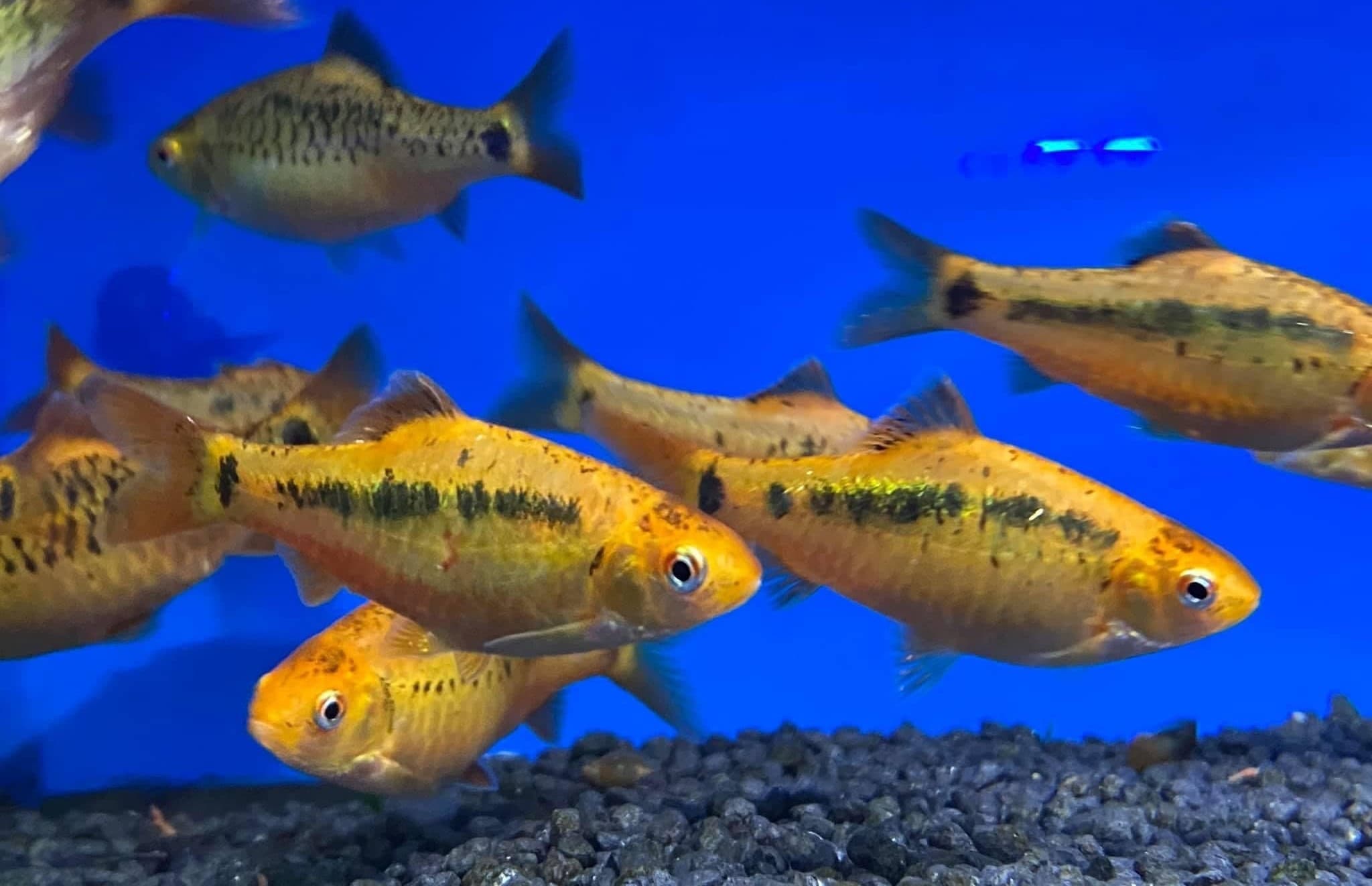
Chinese barb
Barbodes semifasciolatus
Parameter dashboard
16-24 °C
6-8
7.5 cm
5 years
Care guide
The golden barb (Barbodes semifasciolatus), also known as the Chinese barb or green barb, is a hardy cyprinid native to slow-moving tributaries, swamps, and irrigation channels across Vietnam, Taiwan, southwestern China, and northern Laos. The wild 'green' form displays an attractive metallic green flank with reddish-brown fins and a series of dark vertical bars — arguably among the most attractive small cyprinids. However, the fish almost universally seen in the aquarium trade is the selectively-bred 'golden' strain, developed in the 1960s by American Thomas Schubert, which displays a brilliant uniform gold-orange coloration. Both forms are farmed in huge numbers and are among the most popular freshwater aquarium fishes.
Golden barbs are a shoaling species and should be maintained in groups of 8–10 or more, where they form a lively, constantly active school that adds considerable movement to any community tank. They are very peaceful and mix well with comparably-sized, non-aggressive tankmates. In nature they are foraging omnivores feeding on benthic diatoms, algae, organic detritus, small insects, worms, crustaceans, and other zooplankton. In the aquarium they accept a wide range of foods including quality dried flakes, granules, and pellets supplemented with small live and frozen offerings such as bloodworm, Daphnia, and Artemia. A varied diet with some plant or algal content brings out their best color and condition.
An aquarium with base dimensions of at least 90 × 30 cm (roughly 80 liters) is recommended. While very adaptable, they show better coloration in a heavily-planted set-up with a dark substrate. The addition of floating plants and driftwood roots to diffuse overhead light is also appreciated. Recommended water parameters include a temperature of 16–24°C, pH 6.0–8.0, and hardness 36–357 ppm. Notably, this species thrives in cooler water compared to most tropical community fish — aim for the recommended 16–24°C care range. Breeding is straightforward as with most small cyprinids: adults are egg-scatterers exhibiting no parental care, and eggs hatch within 24–48 hours.
Source
Further reading on identification and aquarium care.
Tankmate compatibility (sample)
Pairwise screening against other species in the database (prioritizing the same family when data is available).
Review first (7)
Caution or avoid from automated rules — confirm before mixing.
| Species | Assessment | Notes |
|---|---|---|
| Chili Rasbora Boraras brigittae Caution | Caution | Fish 2x+ larger may eat smaller tankmates Open pair in Compare → |
| Dwarf rasbora Boraras maculatus Caution | Caution | Fish 2x+ larger may eat smaller tankmates Open pair in Compare → |
| Flying fox Epalzeorhynchos kalopterum Caution | Caution | Fish 2x+ larger may eat smaller tankmates Open pair in Compare → |
| Reticulated Sae Crossocheilus reticulatus Caution | Caution | Fish 2x+ larger may eat smaller tankmates Open pair in Compare → |
| Sawbwa barb Sawbwa resplendens Caution | Caution | Fish 2x+ larger may eat smaller tankmates Open pair in Compare → |
| Strawberry Rasbora Boraras naevus Caution | Caution | Fish 2x+ larger may eat smaller tankmates Open pair in Compare → |
| Sumatra barb Puntigrus tetrazona Caution | Caution | close relatives, and one of them is territorial, so both claim the same kind of space Open pair in Compare → |
5 species with compatible assessment in this sampleCollapse to hide the list; use “Open pair in Compare” for the full matrix.
| Species | Assessment | Notes |
|---|---|---|
| Black ruby barb Pethia nigrofasciata Compatible | Compatible | No rule-based conflicts detected for this pair. Open pair in Compare → |
| Cherry barb Puntius titteya Compatible | Compatible | No rule-based conflicts detected for this pair. Open pair in Compare → |
| Chinese Bitterling Rhodeus ocellatus Compatible | Compatible | No rule-based conflicts detected for this pair. Open pair in Compare → |
| Denison barb Sahyadria denisonii Compatible | Compatible | No rule-based conflicts detected for this pair. Open pair in Compare → |
| Fiveband barb Desmopuntius pentazona Compatible | Compatible | No rule-based conflicts detected for this pair. Open pair in Compare → |
Same rule engine as Compare. Not a substitute for observation, tank size, or acclimation.
Related species
Was this page useful? Spot anything wrong?