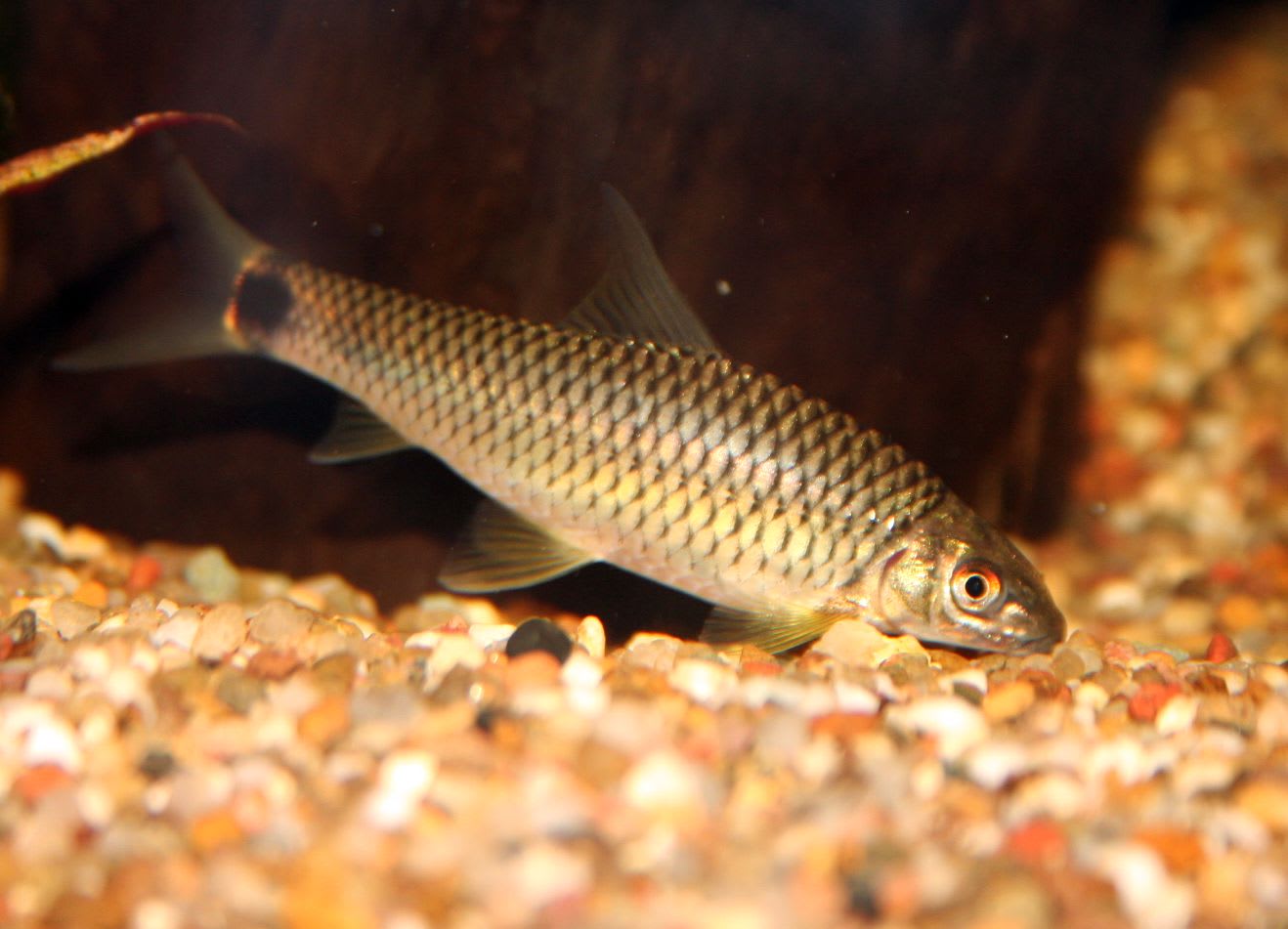
Reticulated Sae
Crossocheilus reticulatus
Parameter dashboard
16-24 °C
6-7.5
17 cm
10 years
Care guide
The reticulated flying fox or reticulated SAE (Crossocheilus reticulatus) is a large, attractive algae-eating cyprinid from the rivers of mainland Southeast Asia. It occurs throughout the Chao Phraya drainage in central Thailand and the Mekong basin in eastern Thailand, Cambodia, Laos, Vietnam, and southern China. This species inhabits flowing streams and tributaries with substrates of boulders, pebbles, gravel, and sand, often in areas with submerged driftwood or tree roots. The combination of a silvery body, dark-edged scales creating a reticulated pattern, and a distinctive dark blotch on the caudal peduncle sets it apart from all other members of the genus.
Reaching 16–17 cm (6.3–6.7 in) in standard length, this is one of the larger members of Crossocheilus and a group requires a spacious aquarium with base dimensions of at least 180 × 45 cm (approximately 365 L / 96 gal). They are shoaling fish that develop a distinct pecking order and should be maintained in groups of six or more, as smaller numbers can result in weaker individuals being incessantly bullied. Like other members of the genus, they are aufwuchs grazers that feed on algae, diatoms, phytoplankton, and associated microorganisms in nature.
In the aquarium, a varied diet of quality dried foods with added Spirulina, supplemented with fresh vegetables such as blanched courgette, spinach, shelled peas, and chopped fruit, is ideal. High-protein foods should be avoided as the fish cannot metabolise them efficiently. This species requires cool, well-oxygenated water with a temperature of 16–24°C, pH 6.0–7.5, and hardness of 18–215 ppm, and is intolerant of organic waste accumulation. A river-style set-up with variably-sized rocks, gravel, driftwood, and robust plants such as Microsorum, Bolbitis, or Anubias attached to the décor replicates its natural habitat well.
Sources
- seriouslyfish.com — https://www.seriouslyfish.com/species/crossocheilus-reticulatus/
- fishbase.se — https://www.fishbase.se/summary/Crossocheilus-reticulatus.html
Further reading on identification and aquarium care.
Tankmate compatibility (sample)
Pairwise screening against other species in the database (prioritizing the same family when data is available).
Review first (8)
Caution or avoid from automated rules — confirm before mixing.
| Species | Assessment | Notes |
|---|---|---|
| Blackline rasbora Rasbora borapetensis Caution | Caution | Fish 2x+ larger may eat smaller tankmates Open pair in Compare → |
| Cherry barb Puntius titteya Caution | Caution | Fish 2x+ larger may eat smaller tankmates Open pair in Compare → |
| Chili Rasbora Boraras brigittae Caution | Caution | Fish 2x+ larger may eat smaller tankmates Open pair in Compare → |
| Chinese barb Barbodes semifasciolatus Caution | Caution | Fish 2x+ larger may eat smaller tankmates Open pair in Compare → |
| Clown rasbora Rasbora kalochroma Caution | Caution | the two share only a narrow band of temperature, so one of them sits at the edge of its range Open pair in Compare → |
| Fiveband barb Desmopuntius pentazona Caution | Caution | Fish 2x+ larger may eat smaller tankmates Open pair in Compare → |
| Slender Bitterling Tanakia himantegus Caution | Caution | Fish 2x+ larger may eat smaller tankmates Open pair in Compare → |
| Tinfoil barb Barbonymus schwanenfeldii Caution | Caution | Fish 2x+ larger may eat smaller tankmates Open pair in Compare → |
4 species with compatible assessment in this sampleCollapse to hide the list; use “Open pair in Compare” for the full matrix.
| Species | Assessment | Notes |
|---|---|---|
| Chinese Bitterling Rhodeus ocellatus Compatible | Compatible | No rule-based conflicts detected for this pair. Open pair in Compare → |
| Denison barb Sahyadria denisonii Compatible | Compatible | No rule-based conflicts detected for this pair. Open pair in Compare → |
| Flying fox Epalzeorhynchos kalopterum Compatible | Compatible | No rule-based conflicts detected for this pair. Open pair in Compare → |
| Three-lined rasbora Rasbora trilineata Compatible | Compatible | No rule-based conflicts detected for this pair. Open pair in Compare → |
Same rule engine as Compare. Not a substitute for observation, tank size, or acclimation.
Related species
Was this page useful? Spot anything wrong?