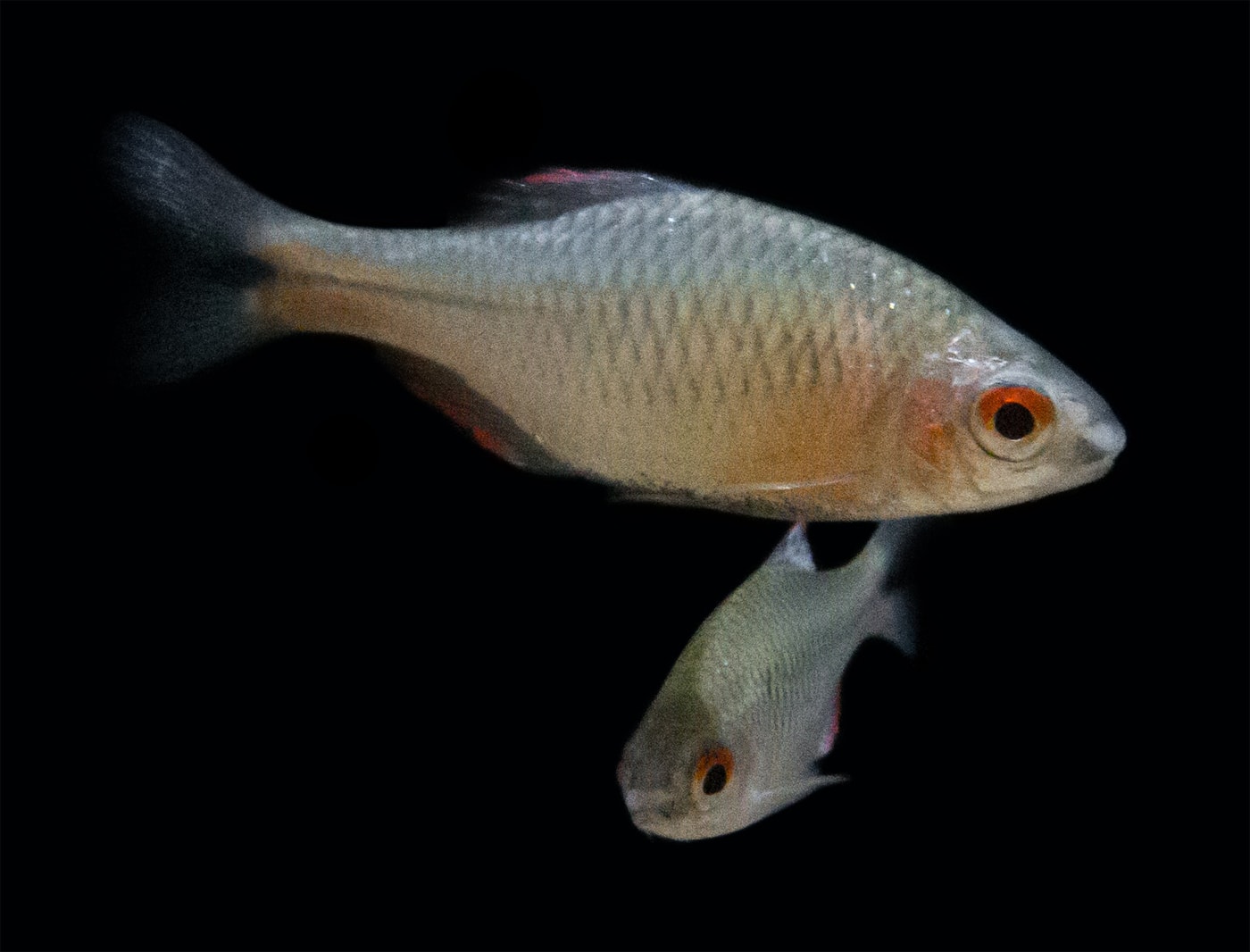
Slender Bitterling
Tanakia himantegus
Parameter dashboard
15-28 °C
6.5-7.8
8 cm
Care guide
The slender bitterling, also known as the Taiwanese bitterling, is a temperate freshwater cyprinid native to Taiwan and parts of eastern China, including Jiangsu, Anhui, and Fujian provinces. It reaches about 6–8 cm in length and displays a silvery body with a subtle blue-green iridescence along the flank, highlighted by a dark lateral stripe that becomes more pronounced during the breeding season. Males develop brighter colours — particularly red-orange on the fins and body — when in spawning condition. The species has been classified under multiple scientific names including Paratanakia himantegus and Acheilognathus himantegus, reflecting ongoing taxonomic refinement within the bitterling group.
As a subtropical species, the slender bitterling is more tolerant of cooler temperatures than most aquarium fish. They thrive in a range of 15–28°C, making them suitable for unheated indoor tanks in temperate climates, though stable conditions are still important. A minimum of 80 litres is recommended for a small group, with larger being better for a proper school of six or more. The aquarium should have moderate to strong water flow with plenty of oxygenation — a powerhead is beneficial. Décor can include a gravel or sand substrate, smooth rocks, and driftwood branches, with robust plants that can tolerate the flow. These fish are known jumpers, so a secure lid is necessary. Water should be neutral to slightly alkaline with a pH of 6.5–7.8.
Slender bitterlings are peaceful, active shoalers that mix well with other temperate community fish of similar size — danios, minnows, barbs, and Stiphodon gobies are all suitable companions. They are omnivorous and accept most aquarium foods: quality flake, micro-pellets, and live or frozen daphnia, brine shrimp, bloodworms, and mosquito larvae. They also browse on algae. A fascinating aspect of their natural history is their breeding strategy: bitterlings are obligate mussel-spawners, with females using a long ovipositor to deposit eggs into the mantle cavity of live freshwater mussels, where the eggs develop safely. This makes home breeding challenging, though possible with appropriate unionid mussels.
Sources
- fishkeeper.co.uk — https://www.fishkeeper.co.uk/fish/freshwater/cyprinids/taiwan-bitterling-
- fishbase.se — https://www.fishbase.se/summary/Tanakia-himantegus.html
Further reading on identification and aquarium care.
Tankmate compatibility (sample)
Pairwise screening against other species in the database (prioritizing the same family when data is available).
Review first (7)
Caution or avoid from automated rules — confirm before mixing.
| Species | Assessment | Notes |
|---|---|---|
| Least rasbora Boraras urophthalmoides Caution | Caution | Fish 2x+ larger may eat smaller tankmates Open pair in Compare → |
| Red Cherry Rasbora Rasbora lacrimula Caution | Caution | Fish 2x+ larger may eat smaller tankmates Open pair in Compare → |
| Sawbwa barb Sawbwa resplendens Caution | Caution | Fish 2x+ larger may eat smaller tankmates Open pair in Compare → |
| Siamese flying fox Crossocheilus oblongus Caution | Caution | Fish 2x+ larger may eat smaller tankmates Open pair in Compare → |
| Strawberry Rasbora Boraras naevus Caution | Caution | Fish 2x+ larger may eat smaller tankmates Open pair in Compare → |
| Sumatra barb Puntigrus tetrazona Caution | Caution | close relatives, and one of them is territorial, so both claim the same kind of space Open pair in Compare → |
| Tinfoil barb Barbonymus schwanenfeldii Caution | Caution | Fish 2x+ larger may eat smaller tankmates Open pair in Compare → |
5 species with compatible assessment in this sampleCollapse to hide the list; use “Open pair in Compare” for the full matrix.
| Species | Assessment | Notes |
|---|---|---|
| Black ruby barb Pethia nigrofasciata Compatible | Compatible | No rule-based conflicts detected for this pair. Open pair in Compare → |
| Chinese barb Barbodes semifasciolatus Compatible | Compatible | No rule-based conflicts detected for this pair. Open pair in Compare → |
| Denison barb Sahyadria denisonii Compatible | Compatible | No rule-based conflicts detected for this pair. Open pair in Compare → |
| Fiveband barb Desmopuntius pentazona Compatible | Compatible | No rule-based conflicts detected for this pair. Open pair in Compare → |
| Rosy barb Pethia conchonius Compatible | Compatible | No rule-based conflicts detected for this pair. Open pair in Compare → |
Same rule engine as Compare. Not a substitute for observation, tank size, or acclimation.
Related species
Was this page useful? Spot anything wrong?