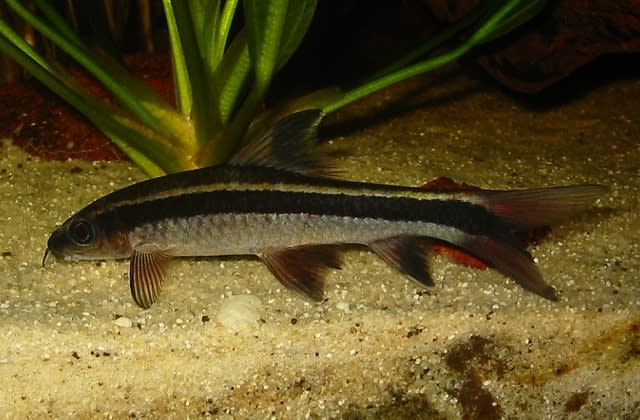
Flying fox
Epalzeorhynchos kalopterum
Parameter dashboard
20-26 °C
6-7.5
16 cm
12 years
Care guide
The flying fox is a striking cyprinid from the blackwater streams and forested rivers of Southeast Asia, where it is found in southern Thailand, Peninsular Malaysia, Borneo, Sumatra, and Java. It is frequently confused with the Siamese algae-eater (Crossocheilus oblongus) and the false siamese algae-eater (Garra cambodgiensis), but can be distinguished by its distinctive colour pattern: a thick black horizontal stripe that extends through the eye and tail fin, bordered above by a gold band, and translucent fins with a distinctive bright white leading edge on the pelvic fins. Aquarium lifespan estimates are around 12 years with suitable care.
Despite its reputation as an algae-eater, the flying fox is an omnivorous aufwuchs grazer with a diet that shifts increasingly toward protein as it matures. It will consume some soft algae but should not be relied upon as a primary clean-up crew. Importantly, this species becomes increasingly territorial and pugnacious with age, particularly toward conspecifics and similar-looking species such as Crossocheilus and Garra. It is best kept singly in most home aquariums. A tank with base dimensions of 120 cm x 45 cm (approximately 240 litres) with a strong current, smooth rocks, driftwood, and robust planting provides a suitable environment. A tight-fitting cover is essential — flying foxes are prodigious jumpers.
Water parameters: 20-26°C, pH 6.0-7.5, with soft to moderately hard water. The diet should include sinking algae wafers, blanched vegetables such as courgette and cucumber, and regular offerings of live and frozen foods including bloodworm, Daphnia, Artemia, and Mysis shrimp. The flying fox is an attractive, characterful species for the intermediate aquarist, but its territorial nature and space requirements mean it must be chosen with careful consideration of the tank's existing inhabitants.
Sources
- seriouslyfish.com — https://www.seriouslyfish.com/species/epalzeorhynchos-kalopterum/
- fishbase.org — https://www.fishbase.org/summary/Epalzeorhynchos-kalopterus.html
- en.aqua-fish.net — https://en.aqua-fish.net/fish/flying-fox
Further reading on identification and aquarium care.
Tankmate compatibility (sample)
Pairwise screening against other species in the database (prioritizing the same family when data is available).
Review first (8)
Caution or avoid from automated rules — confirm before mixing.
| Species | Assessment | Notes |
|---|---|---|
| Cherry barb Puntius titteya Caution | Caution | Fish 2x+ larger may eat smaller tankmates Open pair in Compare → |
| Chili Rasbora Boraras brigittae Caution | Caution | Fish 2x+ larger may eat smaller tankmates Open pair in Compare → |
| Fiveband barb Desmopuntius pentazona Caution | Caution | Fish 2x+ larger may eat smaller tankmates Open pair in Compare → |
| Harlequin rasbora Trigonostigma heteromorpha Caution | Caution | Fish 2x+ larger may eat smaller tankmates Open pair in Compare → |
| Red Cherry Rasbora Rasbora lacrimula Caution | Caution | Fish 2x+ larger may eat smaller tankmates Open pair in Compare → |
| Slender Bitterling Tanakia himantegus Caution | Caution | Fish 2x+ larger may eat smaller tankmates Open pair in Compare → |
| Strawberry Rasbora Boraras naevus Caution | Caution | Fish 2x+ larger may eat smaller tankmates Open pair in Compare → |
| Sumatra barb Puntigrus tetrazona Caution | Caution | Fish 2x+ larger may eat smaller tankmates · close relatives, and one of them is territorial, so both claim the same kind of space Open pair in Compare → |
4 species with compatible assessment in this sampleCollapse to hide the list; use “Open pair in Compare” for the full matrix.
| Species | Assessment | Notes |
|---|---|---|
| Chinese Bitterling Rhodeus ocellatus Compatible | Compatible | No rule-based conflicts detected for this pair. Open pair in Compare → |
| Rosy barb Pethia conchonius Compatible | Compatible | No rule-based conflicts detected for this pair. Open pair in Compare → |
| Siamese flying fox Crossocheilus oblongus Compatible | Compatible | No rule-based conflicts detected for this pair. Open pair in Compare → |
| Three-lined rasbora Rasbora trilineata Compatible | Compatible | No rule-based conflicts detected for this pair. Open pair in Compare → |
Same rule engine as Compare. Not a substitute for observation, tank size, or acclimation.
Related species
Was this page useful? Spot anything wrong?