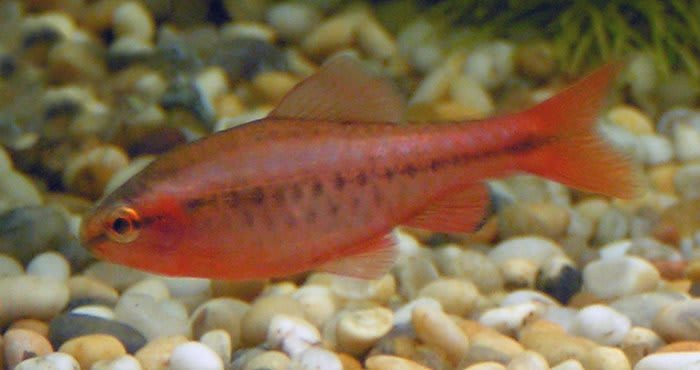
Cherry barb
Puntius titteya
Parameter dashboard
20-27 °C
6-8
5 cm
4 years
Care guide
The cherry barb (Puntius titteya) is a small, peaceful cyprinid endemic to Sri Lanka, where it is restricted to the Kelani and Nilwala river basins in the southwestern 'wet zone'. This species inhabits shaded, slow-moving forest streams with sandy substrates covered by leaf litter and fallen branches. Water in its natural habitat is soft and slightly acidic with relatively cool temperatures, as little sunlight penetrates the dense canopy. The cherry barb has long been a staple of the aquarium hobby and is among the most ubiquitous small cyprinids in the trade, with the vast majority of specimens now commercially farmed rather than wild-collected.
Measuring up to 5 cm (2 in) in standard length, the cherry barb is a schooling species that should be maintained in groups of at least 6–10 specimens. Males are noticeably slimmer and more vividly coloured than females, particularly when in spawning condition, developing a deep cherry-red hue along the body. Several ornamental strains have been developed through selective breeding, including albino and 'super red' forms. A well-planted aquarium with a dark substrate and some floating plants helps bring out the best colouration in these fish.
In the aquarium, cherry barbs are adaptable and undemanding, accepting a varied diet of quality dried flakes and granules supplemented with small live and frozen foods such as bloodworm, Daphnia, and Artemia. They are an ideal choice for beginners and community aquaria, mixing well with other small cyprinids, tetras, livebearers, rainbowfishes, anabantoids, catfishes, and loaches. Water temperature should be maintained between 20–27°C, pH 6.0–8.0, with a tank of at least 50 L (13 gal) for a small group.
Sources
- seriouslyfish.com — https://www.seriouslyfish.com/species/puntius-titteya/
- fishbase.se — https://www.fishbase.se/summary/Puntius-titteya.html
Further reading on identification and aquarium care.
Tankmate compatibility (sample)
Pairwise screening against other species in the database (prioritizing the same family when data is available).
Review first (5)
Caution or avoid from automated rules — confirm before mixing.
| Species | Assessment | Notes |
|---|---|---|
| Denison barb Sahyadria denisonii Caution | Caution | Fish 2x+ larger may eat smaller tankmates Open pair in Compare → |
| Least rasbora Boraras urophthalmoides Caution | Caution | Fish 2x+ larger may eat smaller tankmates Open pair in Compare → |
| Strawberry Rasbora Boraras naevus Caution | Caution | Fish 2x+ larger may eat smaller tankmates Open pair in Compare → |
| Three-lined rasbora Rasbora trilineata Caution | Caution | Fish 2x+ larger may eat smaller tankmates Open pair in Compare → |
| Tinfoil barb Barbonymus schwanenfeldii Caution | Caution | Fish 2x+ larger may eat smaller tankmates Open pair in Compare → |
7 species with compatible assessment in this sampleCollapse to hide the list; use “Open pair in Compare” for the full matrix.
| Species | Assessment | Notes |
|---|---|---|
| Checkered barb Oliotius oligolepis Compatible | Compatible | No rule-based conflicts detected for this pair. Open pair in Compare → |
| Chinese Bitterling Rhodeus ocellatus Compatible | Compatible | No rule-based conflicts detected for this pair. Open pair in Compare → |
| Melon Barb Haludaria fasciata Compatible | Compatible | No rule-based conflicts detected for this pair. Open pair in Compare → |
| Panda Garra Garra flavatra Compatible | Compatible | No rule-based conflicts detected for this pair. Open pair in Compare → |
| Red Cherry Rasbora Rasbora lacrimula Compatible | Compatible | No rule-based conflicts detected for this pair. Open pair in Compare → |
| Ruby barb Pethia padamya Compatible | Compatible | No rule-based conflicts detected for this pair. Open pair in Compare → |
| Slender Bitterling Tanakia himantegus Compatible | Compatible | No rule-based conflicts detected for this pair. Open pair in Compare → |
Same rule engine as Compare. Not a substitute for observation, tank size, or acclimation.
Related species
Was this page useful? Spot anything wrong?