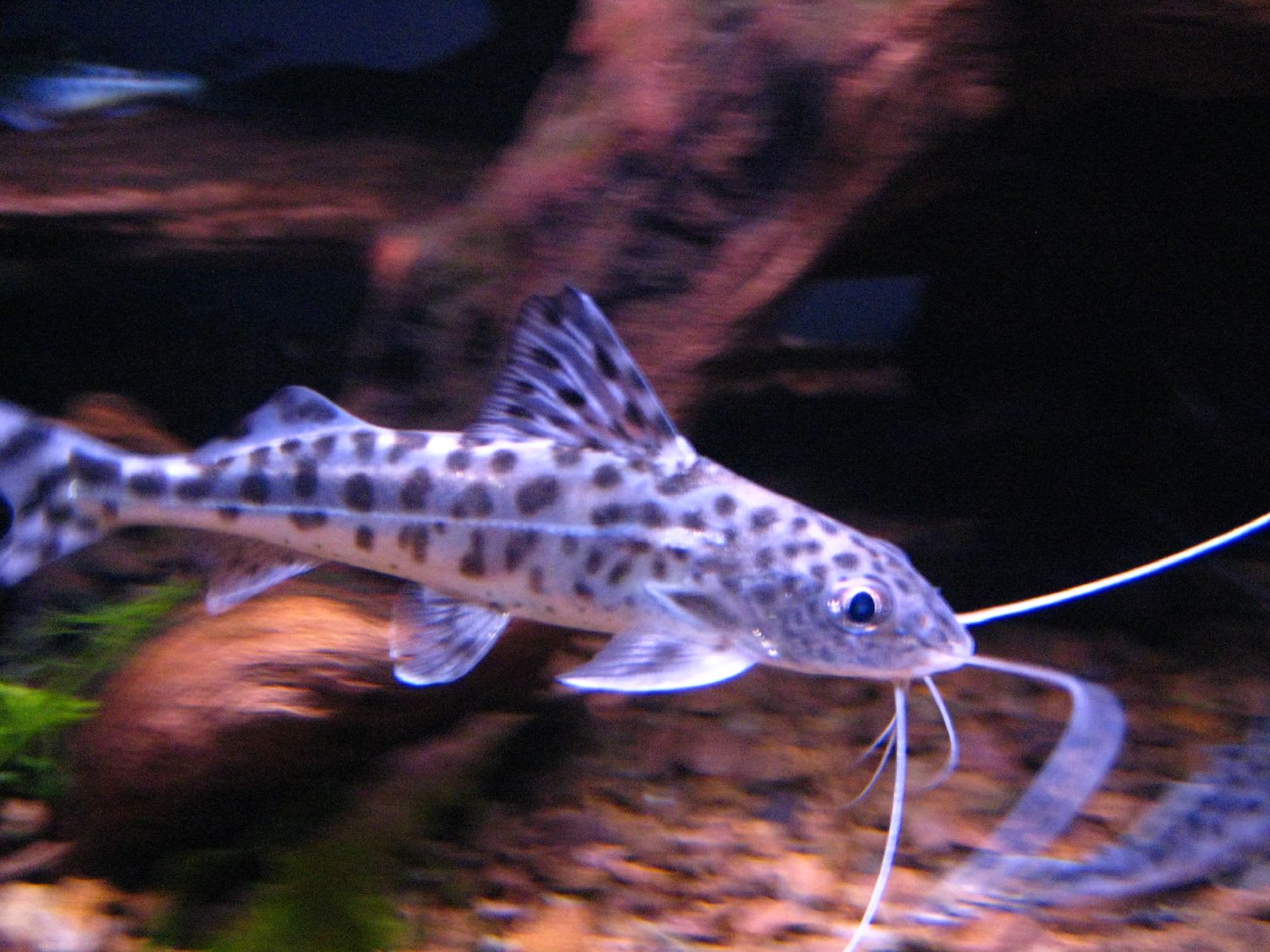
Pictus cat
Pimelodus pictus
Parameter dashboard
22-25 °C
5.8-6.8
12 cm
8 years
Care guide
The pictus catfish comes from the Amazon and Orinoco basins, working the sandy and muddy bottoms of shallow, flowing channels across Colombia, Venezuela, Peru and Brazil. It is silver with a scatter of dark spots that carry on into a deeply forked tail, and it wears three pairs of long barbels that it drags over the substrate to find food. Adults grow to about 12 cm.
Two things catch new keepers out. First, the leading pectoral and dorsal rays are stiff spines coated in mild venom; a netted fish tangles easily and the spine can prick you, so move it in a jug or container instead. Second, this is a predator. It is peaceable enough with fish it cannot swallow, but neons, guppies and other small tankmates tend to disappear. Pair it with active, sturdy fish of reasonable size — rainbowfish, larger tetras, medium barbs.
It is a restless, mostly crepuscular swimmer that shows best under dim light and does far better in numbers; keep six or more, or it sulks in cover all day. Give it a 243 litre tank with a fine sand bed, some driftwood, and strong, well-oxygenated flow. Keep up regular water changes. Check a medication’s instructions and suitability for the species before use. Water should sit at 22–25 °C, pH 5.8–6.8, on the soft side.
Its feeding response turns frantic once it smells food. Sinking pellets form the base, topped up with bloodworm, small earthworms and other meaty items — but do not overfeed, as it will gorge itself. Home breeding is essentially unheard of; almost all fish for sale are wild-caught.
Sources
- seriouslyfish.com — https://www.seriouslyfish.com/species/pimelodus-pictus/
- fishbase.se — https://www.fishbase.se/summary/Pimelodus-pictus.html
Further reading on identification and aquarium care.
Tankmate compatibility (sample)
Pairwise screening against other species in the database (prioritizing the same family when data is available).
Review first (12)
Caution or avoid from automated rules — confirm before mixing.
| Species | Assessment | Notes |
|---|---|---|
| Bigtooth river stingray Potamotrygon henlei Caution | Caution | Fish 2x+ larger may eat smaller tankmates Open pair in Compare → |
| Blackline penguinfish Thayeria boehlkei Caution | Caution | Fish 2x+ larger may eat smaller tankmates Open pair in Compare → |
| Bleeding-heart tetra Hyphessobrycon erythrostigma Caution | Caution | Fish 2x+ larger may eat smaller tankmates Open pair in Compare → |
| Blue-eye panaque Panaque suttonorum Caution | Caution | Fish 2x+ larger may eat smaller tankmates Open pair in Compare → |
| Celebes rainbowfish Marosatherina ladigesi Caution | Caution | Species with non-overlapping pH ranges may not thrive together Open pair in Compare → |
| Freshwater angelfish Pterophyllum scalare Caution | Caution | the two share only a narrow band of temperature, so one of them sits at the edge of its range Open pair in Compare → |
| Glowlight tetra Hemigrammus erythrozonus Caution | Caution | Fish 2x+ larger may eat smaller tankmates · the two share only a narrow band of temperature, so one of them sits at the edge of its range Open pair in Compare → |
| Gold Shell Dweller Lamprologus ocellatus Caution | Caution | Fish 2x+ larger may eat smaller tankmates · Species with non-overlapping pH ranges may not thrive together Open pair in Compare → |
| Peppered corydoras Hoplisoma paleatum Caution | Caution | one is boisterous and the other a much smaller peaceful fish sharing the same floor, where it can be intimidated and outcompeted at feeding time Open pair in Compare → |
| Redstriped eartheater Geophagus surinamensis Caution | Caution | Multiple territorial species in the same swim layer cause stress · the two share only a narrow band of temperature, so one of them sits at the edge of its range Open pair in Compare → |
| Siamese fighting fish Betta splendens Caution | Caution | one of these species is highly aggressive and is usually best kept on its own Open pair in Compare → |
| Three spot gourami Trichogaster trichopterus Caution | Caution | the two share only a narrow band of temperature, so one of them sits at the edge of its range Open pair in Compare → |
Same rule engine as Compare. Not a substitute for observation, tank size, or acclimation.
Was this page useful? Spot anything wrong?