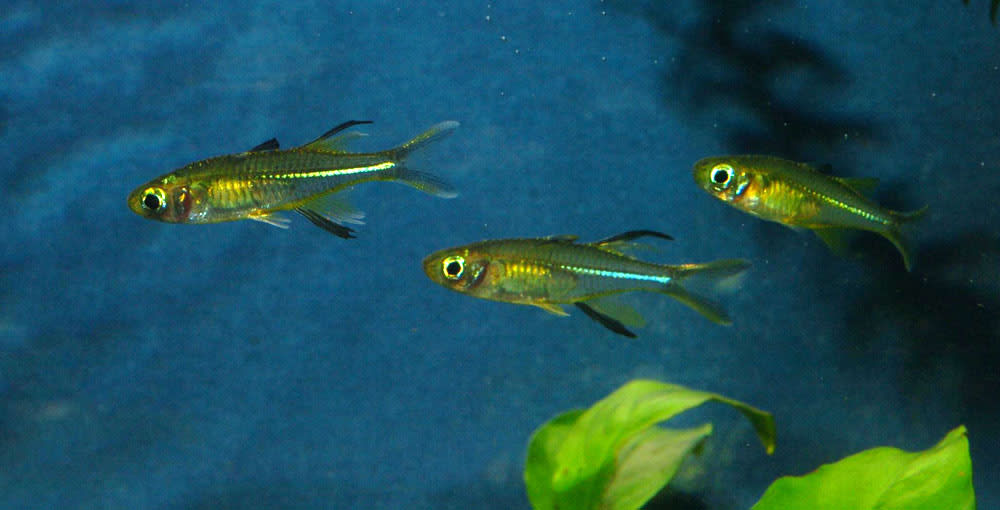
Celebes rainbowfish
Marosatherina ladigesi
Parameter dashboard
22-28 °C
7-8
8 cm
5 years
Care guide
Celebes rainbowfish come from clear, slow-flowing streams in the island of Sulawesi, Indonesia, and are the sole species in the genus Marosatherina. Males reach about 8 cm standard length and develop striking iridescent blue-green flanks, a yellow dorsal fin, and elongated extensions to the second dorsal and anal fin rays, attributes that make them one of the more elegant rainbowfish in the hobby. Females are noticeably plainer and smaller. A 70-litre tank is adequate for a small shoal of six to eight, though larger is always better. They need a well-planted setup with floating plants to diffuse the light and open swimming space in the middle layers. Water should be neutral to alkaline (pH 7.0–8.0) and medium-hard to hard; they will not thrive in soft, acidic conditions. Temperature of 22–28°C covers their needs, and while they can tolerate mildly brackish conditions, salt is not required despite what some older literature claims. They are sensitive to rapid water chemistry swings, so slow acclimation and regular weekly water changes of moderate volume are important. Celebes rainbowfish are peaceful and shoaling — keep them in groups of eight or more, with two to three females per male to spread male attention and allow the best colour displays. They accept most dried, frozen, and live foods; a varied diet brings out the best colouration. Breeding is an egg-scattering affair over several weeks, with eggs hatching in 5–10 days; fry need infusoria initially.
Source
Further reading on identification and aquarium care.
Tankmate compatibility (sample)
Pairwise screening against other species in the database (prioritizing the same family when data is available).
Review first (9)
Caution or avoid from automated rules — confirm before mixing.
| Species | Assessment | Notes |
|---|---|---|
| Black Arowana Osteoglossum ferreirai Caution | Caution | Fish 2x+ larger may eat smaller tankmates Open pair in Compare → |
| Daisy's Rice Fish Oryzias woworae Caution | Caution | Fish 2x+ larger may eat smaller tankmates Open pair in Compare → |
| Neon tetra Paracheirodon innesi Caution | Caution | Fish 2x+ larger may eat smaller tankmates Open pair in Compare → |
| Pond loach Misgurnus anguillicaudatus Caution | Caution | Fish 2x+ larger may eat smaller tankmates · the two share only a narrow band of temperature, so one of them sits at the edge of its range Open pair in Compare → |
| Siamese flying fox Crossocheilus oblongus Caution | Caution | Fish 2x+ larger may eat smaller tankmates Open pair in Compare → |
| Snakehead Betta Betta channoides Caution | Caution | Fish 2x+ larger may eat smaller tankmates · Species with non-overlapping pH ranges may not thrive together Open pair in Compare → |
| Whiptail catfish Farlowella acus Caution | Caution | Species with non-overlapping pH ranges may not thrive together Open pair in Compare → |
| Zebra Nerite Vittina natalensis Caution | Caution | Fish 2x+ larger may eat smaller tankmates Open pair in Compare → |
| Galaxy betta Betta splendens Avoid | Avoid | one of these species is highly aggressive and is usually best kept on its own · a highly aggressive fish takes long-finned tankmates for rivals and attacks them Open pair in Compare → |
3 species with compatible assessment in this sampleCollapse to hide the list; use “Open pair in Compare” for the full matrix.
| Species | Assessment | Notes |
|---|---|---|
| Cherry barb Puntius titteya Compatible | Compatible | No rule-based conflicts detected for this pair. Open pair in Compare → |
| Cockatoo cichlid Apistogramma cacatuoides Compatible | Compatible | No rule-based conflicts detected for this pair. Open pair in Compare → |
| Slender Bitterling Tanakia himantegus Compatible | Compatible | No rule-based conflicts detected for this pair. Open pair in Compare → |
Same rule engine as Compare. Not a substitute for observation, tank size, or acclimation.
Was this page useful? Spot anything wrong?