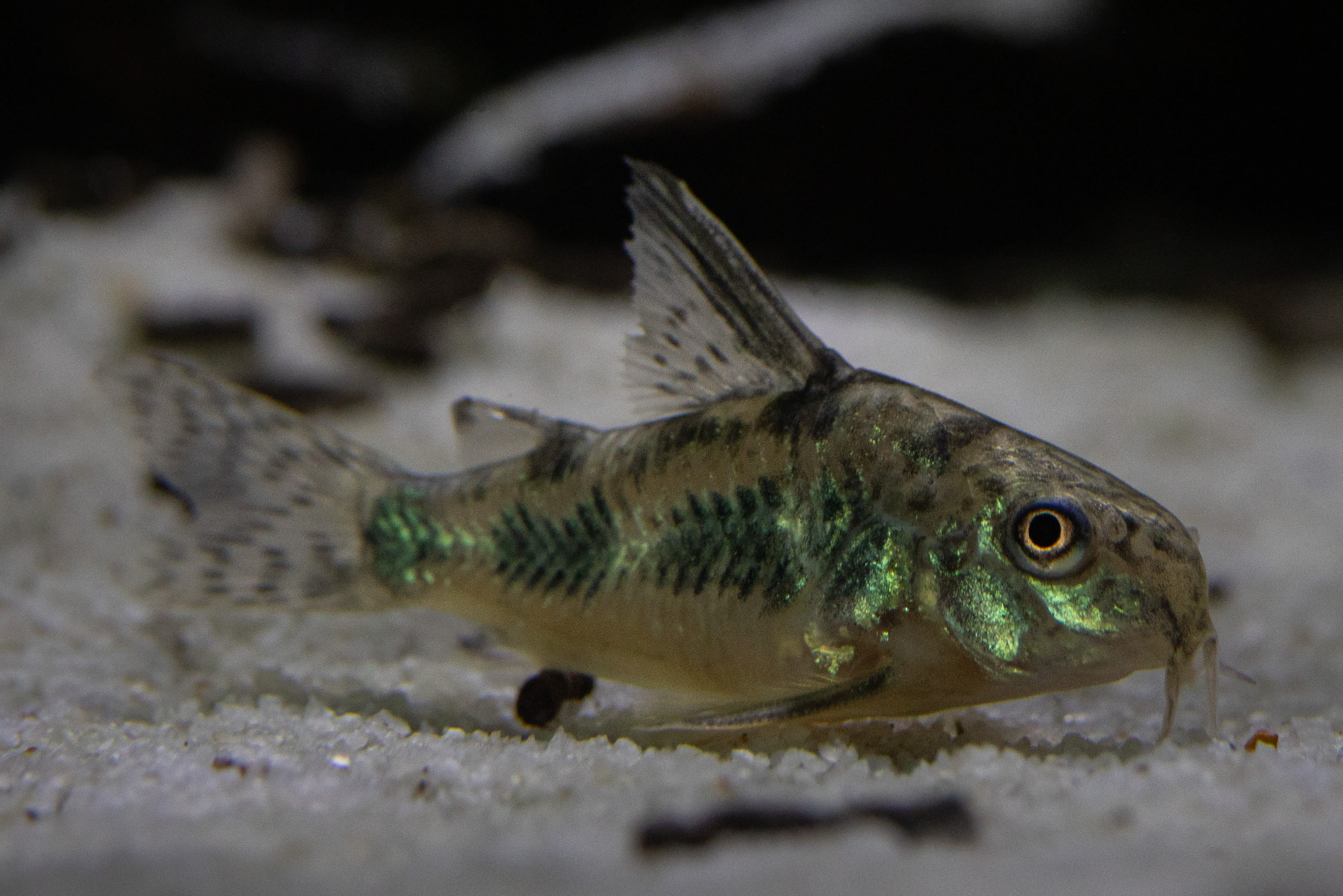
Peppered corydoras
Hoplisoma paleatum
Parameter dashboard
22-26 °C
6-7
7 cm
5 years
Care guide
The peppered corydoras is a charming, subtly patterned catfish from the cool, sluggish waters of southeastern South America — including Argentina, Brazil and Uruguay. Hoplisoma paleatum is also known by its older name Corydoras paleatus. Its body is a soft olive-grey covered in irregular dark speckles and blotches, giving it the 'peppered' look that lends the species its common name. It has no dark bar crossing the eye. Like all corydoras, it has bony armour plates and protective spines in its dorsal and pectoral fins.
Peppered cories are among the most peaceful community fish available. They spend nearly all their time foraging along the bottom in small groups, emerging occasionally to dart to the surface for air. Keep a group; these are social bottom-dwelling fish. They are generally compatible with suitable peaceful tankmates that will not outcompete them for food: tetras, rasboras, small livebearers, and dwarf cichlids all make excellent companions. Their diet should include sinking catfish pellets, live and frozen bloodworms, daphnia, brine shrimp, and occasional vegetable matter. Notably, this species is subtropical and prefers cooler temperatures than most tropical fish — an unheated aquarium is suitable only if its actual temperature meets the selected care interval.
Provide a base of at least 61 × 38 cm. A soft sand substrate is recommended; rough gravel can abrade their barbels and lead to infection. Keep water at 22–26°C and pH 6.0–7.0. Peppered cories breed readily in the home aquarium: the female deposits a small batch of adhesive eggs on plant leaves or the aquarium glass, and the classic 'T-position' mating embrace is regularly observed in well-conditioned groups. Eggs hatch in around three days; start the fry on suitably small food such as microworms and later progress to Artemia nauplii and powdered foods. Water quality remains critical.
Sources
- seriouslyfish.com — https://www.seriouslyfish.com/species/hoplisoma-paleatum
- fishbase.de — https://www.fishbase.de/summary/10926
Further reading on identification and aquarium care.
Tankmate compatibility (sample)
Pairwise screening against other species in the database (prioritizing the same family when data is available).
Review first (2)
Caution or avoid from automated rules — confirm before mixing.
| Species | Assessment | Notes |
|---|---|---|
| Hoplo Catfish Megalechis thoracata Caution | Caution | Fish 2x+ larger may eat smaller tankmates · close relatives, and one of them is territorial, so both claim the same kind of space · one is boisterous and the other a much smaller peaceful fish sharing the same floor, where it can be intimidated and outcompeted at feeding time Open pair in Compare → |
| Pygmy corydoras Corydoras pygmaeus Caution | Caution | Fish 2x+ larger may eat smaller tankmates Open pair in Compare → |
8 species with compatible assessment in this sampleCollapse to hide the list; use “Open pair in Compare” for the full matrix.
| Species | Assessment | Notes |
|---|---|---|
| Adolf's catfish Corydoras adolfoi Compatible | Compatible | No rule-based conflicts detected for this pair. Open pair in Compare → |
| Bronze corydoras Osteogaster aenea Compatible | Compatible | No rule-based conflicts detected for this pair. Open pair in Compare → |
| Leopard corydoras Corydoras julii Compatible | Compatible | No rule-based conflicts detected for this pair. Open pair in Compare → |
| Palespotted corydoras Hoplisoma gossei Compatible | Compatible | No rule-based conflicts detected for this pair. Open pair in Compare → |
| Panda corydoras Corydoras panda Compatible | Compatible | No rule-based conflicts detected for this pair. Open pair in Compare → |
| Schwartz's catfish Corydoras schwartzi Compatible | Compatible | No rule-based conflicts detected for this pair. Open pair in Compare → |
| Sterba's cory Corydoras sterbai Compatible | Compatible | No rule-based conflicts detected for this pair. Open pair in Compare → |
| Twosaddle corydoras Hoplisoma weitzmani Compatible | Compatible | No rule-based conflicts detected for this pair. Open pair in Compare → |
Same rule engine as Compare. Not a substitute for observation, tank size, or acclimation.
Related species
Was this page useful? Spot anything wrong?