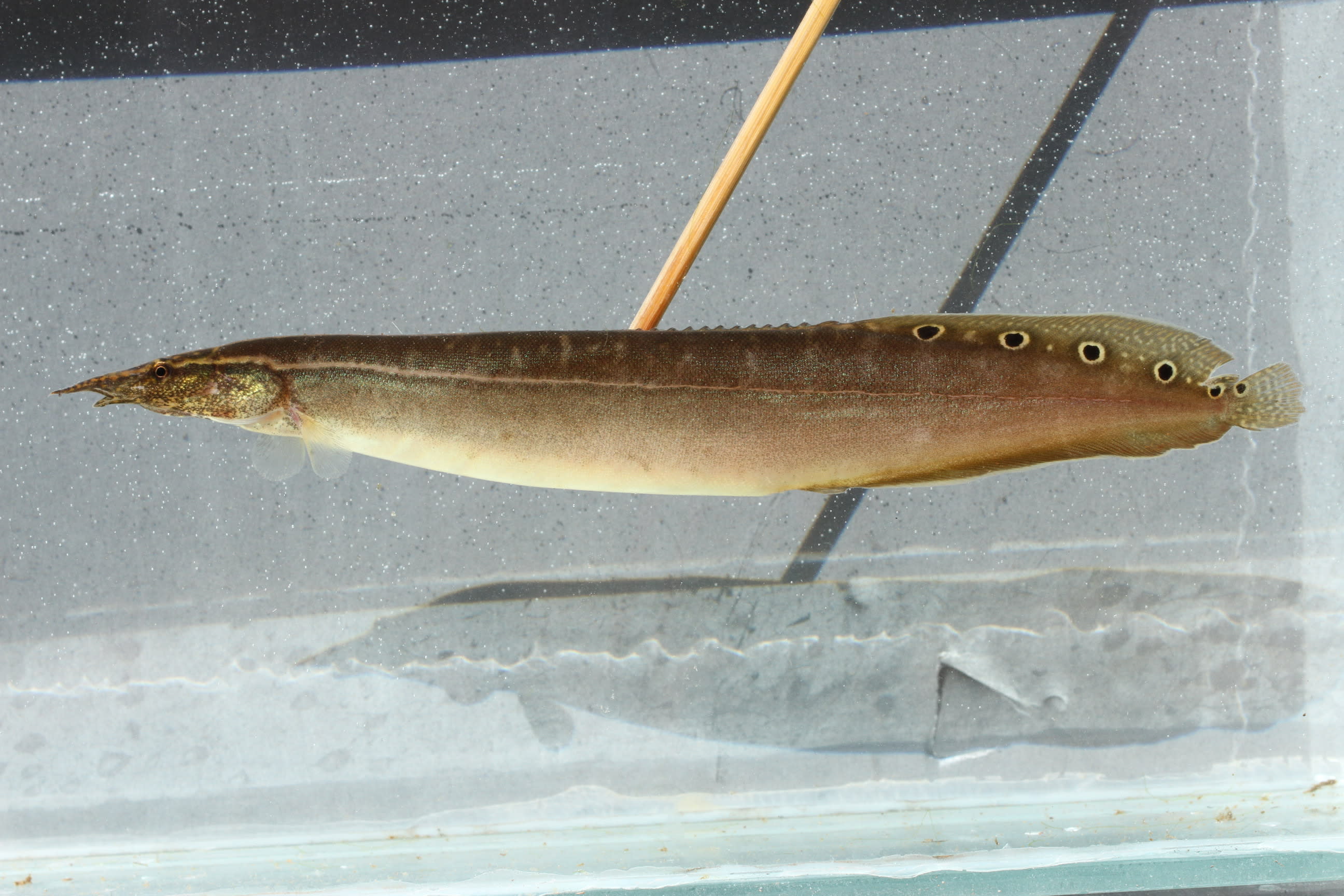
Peacock eel
Macrognathus siamensis
Parameter dashboard
23-28 °C
6-7.5
30 cm
5 years
Care guide
The peacock eel is a slender, elongated spiny eel native to the slow-moving streams, floodplains, and marshes of mainland Southeast Asia, including Thailand, Cambodia, Vietnam, and Myanmar. Despite its eel-like appearance reaching up to 30 cm in captivity, it is not a true eel but a member of the family Mastacembelidae, distinguished by the series of small dorsal spines preceding its soft-rayed dorsal fin. Its common name comes from the attractive peacock-like pattern of dark spots and irregular markings along a brownish-tan body, with a faint lateral stripe running from the gill cover to the tail. Like all spiny eels, it has a pointed snout used for rooting through soft substrate in search of food.
Peacock eels are primarily nocturnal and spend much of the day buried in soft sand with only the snout and eyes visible — a normal and entertaining behaviour. The aquarium must have a soft sand substrate, as gravel will abrade their delicate skin and lead to infections. A 150-litre tank is the recommended minimum for a single adult, with the footprint being far more important than height since these are bottom-dwellers. The setup should include plenty of hiding places: driftwood caves, PVC pipes, smooth rocks, and dense plant thickets, with dim lighting and floating plants to diffuse the light. Water conditions should be stable with a temperature of 23–28°C and a pH of 6.0–7.5. A secure, tight-fitting lid is absolutely mandatory — these eels are notorious escape artists that can squeeze through remarkably small gaps.
Peacock eels are carnivorous predators that prefer live and frozen foods such as bloodworms, brine shrimp, blackworms, chopped earthworms, and Mysis shrimp. Some individuals can be weaned onto sinking carnivore pellets, but most require live food when first introduced. They are peaceful towards fish too large to be eaten, making them suitable companions for medium-sized community fish like larger rasboras, rainbowfish, large gouramis, and peaceful cichlids. However, anything that fits in their mouth — small tetras, shrimp, or fry — will be consumed. They are prone to ich and sensitive to medications, so quarantine is essential for new arrivals. Aquarium lifespan estimates are around 5 years with suitable care.
Sources
- en.aqua-fish.net — https://en.aqua-fish.net/fish/peacock-eel
- fishkeeper.co.uk — https://www.fishkeeper.co.uk/fish/freshwater/miscellaneous/peacock-spiny-eel
Further reading on identification and aquarium care.
Tankmate compatibility (sample)
Pairwise screening against other species in the database (prioritizing the same family when data is available).
Review first (9)
Caution or avoid from automated rules — confirm before mixing.
| Species | Assessment | Notes |
|---|---|---|
| Cherry barb Puntius titteya Caution | Caution | Fish 2x+ larger may eat smaller tankmates Open pair in Compare → |
| Cobalt Blue Goby Stiphodon semoni Caution | Caution | Fish 2x+ larger may eat smaller tankmates Open pair in Compare → |
| Desert goby Chlamydogobius eremius Caution | Caution | Fish 2x+ larger may eat smaller tankmates Open pair in Compare → |
| Emerald Dwarf Rasbora Danio erythromicron Caution | Caution | Fish 2x+ larger may eat smaller tankmates · the two share only a narrow band of temperature, so one of them sits at the edge of its range Open pair in Compare → |
| Fire eel Mastacembelus erythrotaenia Caution | Caution | Fish 2x+ larger may eat smaller tankmates Open pair in Compare → |
| Harlequin rasbora Trigonostigma heteromorpha Caution | Caution | Fish 2x+ larger may eat smaller tankmates Open pair in Compare → |
| Peppered corydoras Hoplisoma paleatum Caution | Caution | Fish 2x+ larger may eat smaller tankmates Open pair in Compare → |
| Spotted blue-eye Pseudomugil gertrudae Caution | Caution | Fish 2x+ larger may eat smaller tankmates Open pair in Compare → |
| Zig-zag eel Mastacembelus armatus Caution | Caution | Fish 2x+ larger may eat smaller tankmates · close relatives, and one of them is territorial, so both claim the same kind of space Open pair in Compare → |
3 species with compatible assessment in this sampleCollapse to hide the list; use “Open pair in Compare” for the full matrix.
| Species | Assessment | Notes |
|---|---|---|
| Asian bumblebee catfish Pseudomystus siamensis Compatible | Compatible | No rule-based conflicts detected for this pair. Open pair in Compare → |
| Biajaca Nandopsis tetracanthus Compatible | Compatible | No rule-based conflicts detected for this pair. Open pair in Compare → |
| Red Spotted Severum Heros efasciatus Compatible | Compatible | No rule-based conflicts detected for this pair. Open pair in Compare → |
Same rule engine as Compare. Not a substitute for observation, tank size, or acclimation.
Related species
Was this page useful? Spot anything wrong?