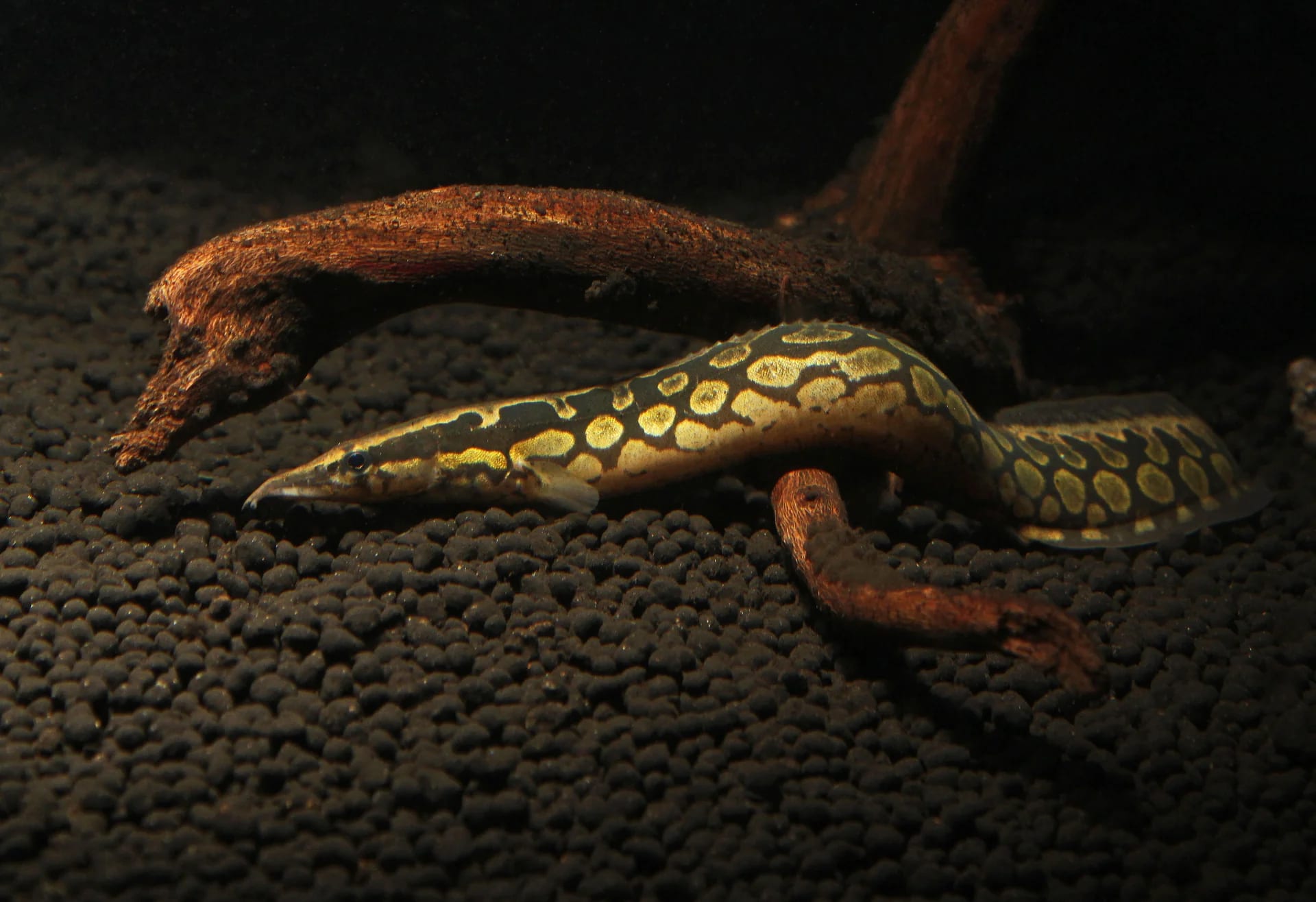
Zig-zag eel
Mastacembelus armatus
Parameter dashboard
24-28 °C
6-7
91 cm
Care guide
The zig-zag eel (Mastacembelus armatus), also known as the tire-track eel or white-spotted spiny eel, is a distinctive freshwater fish native to riverine systems across the Indian subcontinent, Sri Lanka, South China, and Southeast Asia including Thailand, Malaysia, Vietnam, Cambodia, and Indonesia. Reaching up to 91 cm (36 in) in length, this elongated, snake-like fish lacks pelvic fins and possesses a continuous dorsal-anal-caudal fin arrangement preceded by numerous spines along the back. Its body is dull brown with darker longitudinal zigzag lines forming a reticulated pattern on the upper two-thirds, providing excellent camouflage in the turbid, slow-moving waters it inhabits.
Despite its intimidating size, the zig-zag eel is generally peaceful toward tankmates too large to be considered prey and can be kept in spacious community aquariums. A minimum of 500 L (130 gal) is required for adult specimens, though juveniles can be raised in smaller quarters. The tank should be well-planted with abundant hiding spots using bogwood, rock caves, and PVC piping, with a sand substrate to allow burrowing. A tight-fitting lid is essential as these eels are accomplished escape artists. Dimmer lighting encourages more active daytime behavior, and water flow should be gentle. They thrive in mildly brackish conditions at 24-28C (75-82F), pH 6.0-7.0, with moderate hardness.
As obligate carnivores, zig-zag eels prefer meaty foods such as prawns, krill, lancefish, earthworms, and frozen bloodworms, though some may accept high-quality sinking pellets once established. They are nocturnal by nature, spending daylight hours hidden among decor and emerging at dusk to hunt. Only one specimen should be kept per tank unless housed in groups of five or more to diffuse conspecific aggression. Breeding has not been documented in home aquariums.
Sources
- seriouslyfish.com — https://www.seriouslyfish.com/species/mastacembelus-armatus/
- en.wikipedia.org — https://en.wikipedia.org/wiki/Zig-zag_eel
Further reading on identification and aquarium care.
Tankmate compatibility (sample)
Pairwise screening against other species in the database (prioritizing the same family when data is available).
Review first (12)
Caution or avoid from automated rules — confirm before mixing.
| Species | Assessment | Notes |
|---|---|---|
| Amano Shrimp Caridina multidentata Caution | Caution | Fish 2x+ larger may eat smaller tankmates · this fish is not shrimp-safe, so shrimplets get eaten and adult shrimp can be harassed Open pair in Compare → |
| Common otocinclus Otocinclus vittatus Caution | Caution | Fish 2x+ larger may eat smaller tankmates · the two share only a narrow band of temperature, so one of them sits at the edge of its range Open pair in Compare → |
| Diamond tetra Moenkhausia pittieri Caution | Caution | Fish 2x+ larger may eat smaller tankmates Open pair in Compare → |
| Electric blue ram Mikrogeophagus ramirezi Caution | Caution | Fish 2x+ larger may eat smaller tankmates · Multiple territorial species in the same swim layer cause stress · the two share only a narrow band of temperature, so one of them sits at the edge of its range Open pair in Compare → |
| Fire eel Mastacembelus erythrotaenia Caution | Caution | close relatives, and one of them is territorial, so both claim the same kind of space Open pair in Compare → |
| Guayas cichlid Cichlasoma festae Caution | Caution | Fish 2x+ larger may eat smaller tankmates · Multiple territorial species in the same swim layer cause stress · Species with non-overlapping pH ranges may not thrive together Open pair in Compare → |
| Lemon tetra Hyphessobrycon pulchripinnis Caution | Caution | Fish 2x+ larger may eat smaller tankmates Open pair in Compare → |
| Orange Fin Danio Danio kyathit Caution | Caution | Fish 2x+ larger may eat smaller tankmates Open pair in Compare → |
| Oxyropsis Oxyropsis carinata Caution | Caution | Fish 2x+ larger may eat smaller tankmates Open pair in Compare → |
| Peacock eel Macrognathus siamensis Caution | Caution | Fish 2x+ larger may eat smaller tankmates · close relatives, and one of them is territorial, so both claim the same kind of space Open pair in Compare → |
| Tinfoil barb Barbonymus schwanenfeldii Caution | Caution | Fish 2x+ larger may eat smaller tankmates Open pair in Compare → |
| Horsehead Opsariichthys bidens Avoid | Avoid | Fish 2x+ larger may eat smaller tankmates · Species with non-overlapping temperature ranges cannot coexist · the two share only a narrow band of temperature, so one of them sits at the edge of its range Open pair in Compare → |
Same rule engine as Compare. Not a substitute for observation, tank size, or acclimation.
Related species
Was this page useful? Spot anything wrong?