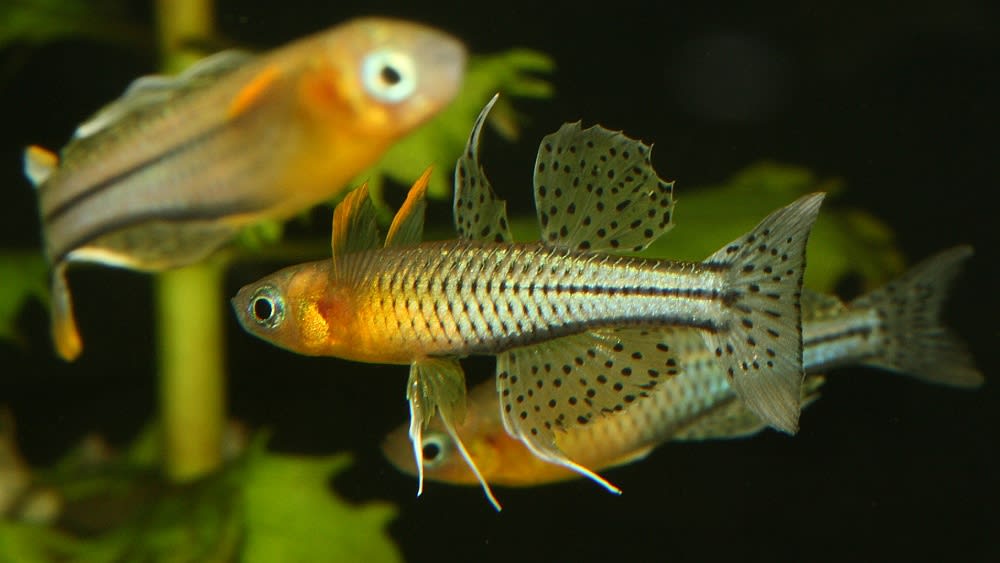
Spotted blue-eye
Pseudomugil gertrudae
Parameter dashboard
21-28 °C
4.5-7.5
3.8 cm
3 years
Care guide
The spotted blue-eye is a small rainbowfish relative from the shallow, vegetated margins of creeks and swamps in northern Australia, Papua New Guinea, and nearby Indonesian islands. Males reach about 3.8 cm and are strikingly coloured for their size, with iridescent blue eyes, yellow fins edged in black, and a scattering of small dark spots on the body. Females are paler and lack the extended fin rays the males use in display. A group of eight or more should be the minimum — they are social fish that feel secure only in numbers, and males show their best colours when competing for attention. The tank should hold at least 40 litres with plenty of fine-leaved plants and open swimming space. Temperature between 21°C and 28°C suits them well, with a pH range of 4.5 to 7.5 reflecting the variable conditions of their native habitats — some localities have clear near-neutral water while others are stained dark with tannins and very acidic. They are planktivores by nature, constantly browsing the water column for tiny crustaceans and insect larvae, so offer fine-grade flake, crushed pellets, and regular helpings of Daphnia or Artemia. Breeding is straightforward in a planted tank — they scatter eggs daily among Java moss or spawning mops, and the fry emerge after about ten days. Aquarium lifespan estimates are around 3 years with suitable care.
Source
Further reading on identification and aquarium care.
Tankmate compatibility (sample)
Pairwise screening against other species in the database (prioritizing the same family when data is available).
Review first (8)
Caution or avoid from automated rules — confirm before mixing.
| Species | Assessment | Notes |
|---|---|---|
| Assamese snakehead Channa stewartii Caution | Caution | Fish 2x+ larger may eat smaller tankmates Open pair in Compare → |
| Boeseman's rainbowfish Melanotaenia boesemani Caution | Caution | Fish 2x+ larger may eat smaller tankmates · the two share only a narrow band of temperature, so one of them sits at the edge of its range Open pair in Compare → |
| Hoplo Catfish Megalechis thoracata Caution | Caution | Fish 2x+ larger may eat smaller tankmates Open pair in Compare → |
| Leleupi Cichlid Neolamprologus leleupi Caution | Caution | Fish 2x+ larger may eat smaller tankmates · Species with non-overlapping pH ranges may not thrive together Open pair in Compare → |
| Panda Garra Garra flavatra Caution | Caution | Fish 2x+ larger may eat smaller tankmates Open pair in Compare → |
| Vampire Shrimp Atya gabonensis Caution | Caution | Fish 2x+ larger may eat smaller tankmates Open pair in Compare → |
| Zebra loach Botia striata Caution | Caution | Fish 2x+ larger may eat smaller tankmates Open pair in Compare → |
| Yellow belly cichlid Cichlasoma salvini Avoid | Avoid | Fin nippers should not be kept with long-finned species · Fish 2x+ larger may eat smaller tankmates Open pair in Compare → |
4 species with compatible assessment in this sampleCollapse to hide the list; use “Open pair in Compare” for the full matrix.
| Species | Assessment | Notes |
|---|---|---|
| Endlers guppy Poecilia wingei Compatible | Compatible | No rule-based conflicts detected for this pair. Open pair in Compare → |
| Forktail rainbowfish Pseudomugil furcatus Compatible | Compatible | No rule-based conflicts detected for this pair. Open pair in Compare → |
| Hillstream loach Gastromyzon punctulatus Compatible | Compatible | No rule-based conflicts detected for this pair. Open pair in Compare → |
| Honey blue eye Pseudomugil mellis Compatible | Compatible | No rule-based conflicts detected for this pair. Open pair in Compare → |
Same rule engine as Compare. Not a substitute for observation, tank size, or acclimation.
Related species
Was this page useful? Spot anything wrong?