Fire eel
Mastacembelus erythrotaenia
Parameter dashboard
24-28 °C
6-7
100 cm
10 years
Care guide
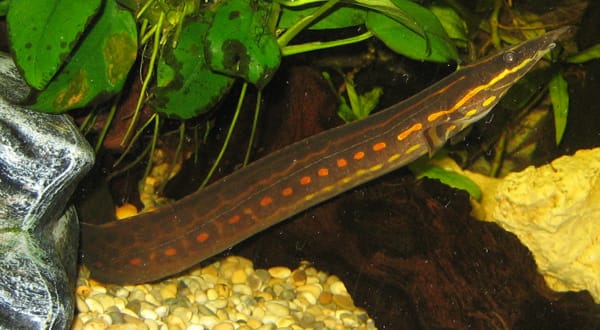
The fire eel is one of the largest spiny eels in the hobby, reaching a full metre in length, though most aquarium specimens stay somewhat smaller. It comes from sluggish rivers and floodplains across Southeast Asia, where it spends the day buried in soft sediment with only its nose poking out. A tank of at least 500 litres is essential, with fine sand for burrowing and a tight-fitting lid — these eels are notorious escapers. Temperature should be 24°C to 28°C with a pH of 6.0 to 7.0 and soft to moderate hardness, matching the soft, slightly acidic waters of its lowland habitat. Despite its size the fire eel is not aggressive toward fish it cannot eat, but it will consume any tankmate small enough to swallow, so choose companions that are too large to be mistaken for food. It is a carnivore that thrives on a varied diet of prawn, krill, mussel, and earthworms, with occasional live foods to keep it active. Frozen bloodworms alone will not sustain a full-grown specimen long-term. The striking pattern of red and black spots along the body gives the fish its common name, and each individual's marking is unique. Aquarium lifespan estimates are around 10 years with suitable care. They are best kept singly due to potential aggression toward conspecifics.
Source
Further reading on identification and aquarium care.
Tankmate compatibility (sample)
Pairwise screening against other species in the database (prioritizing the same family when data is available).
Review first (12)
Caution or avoid from automated rules — confirm before mixing.
| Species | Assessment | Notes |
|---|---|---|
| Assamese snakehead Channa stewartii Caution | Caution | Fish 2x+ larger may eat smaller tankmates · the two share only a narrow band of temperature, so one of them sits at the edge of its range Open pair in Compare → |
| Ember tetra Hyphessobrycon amandae Caution | Caution | Fish 2x+ larger may eat smaller tankmates Open pair in Compare → |
| Freshwater butterflyfish Pantodon buchholzi Caution | Caution | Fish 2x+ larger may eat smaller tankmates Open pair in Compare → |
| Glass bloodfin Prionobrama filigera Caution | Caution | Fish 2x+ larger may eat smaller tankmates Open pair in Compare → |
| Livingstonii Cichlid Nimbochromis livingstonii Caution | Caution | Fish 2x+ larger may eat smaller tankmates · Species with non-overlapping pH ranges may not thrive together Open pair in Compare → |
| Malawi eyebiter Dimidiochromis compressiceps Caution | Caution | Fish 2x+ larger may eat smaller tankmates · Species with non-overlapping pH ranges may not thrive together Open pair in Compare → |
| Peacock eel Macrognathus siamensis Caution | Caution | Fish 2x+ larger may eat smaller tankmates Open pair in Compare → |
| Princess of Burundi Neolamprologus brichardi Caution | Caution | Fish 2x+ larger may eat smaller tankmates · Species with non-overlapping pH ranges may not thrive together Open pair in Compare → |
| Splash tetra Copella arnoldi Caution | Caution | Fish 2x+ larger may eat smaller tankmates Open pair in Compare → |
| Zig-zag eel Mastacembelus armatus Caution | Caution | close relatives, and one of them is territorial, so both claim the same kind of space Open pair in Compare → |
| Chinese algae-eater Gyrinocheilus aymonieri Avoid | Avoid | Fin nippers should not be kept with long-finned species · Fish 2x+ larger may eat smaller tankmates Open pair in Compare → |
| Panda Loach Yaoshania pachychilus Avoid | Avoid | Fish 2x+ larger may eat smaller tankmates · Species with non-overlapping temperature ranges cannot coexist · the two share only a narrow band of temperature, so one of them sits at the edge of its range Open pair in Compare → |
Same rule engine as Compare. Not a substitute for observation, tank size, or acclimation.
Related species
Was this page useful? Spot anything wrong?