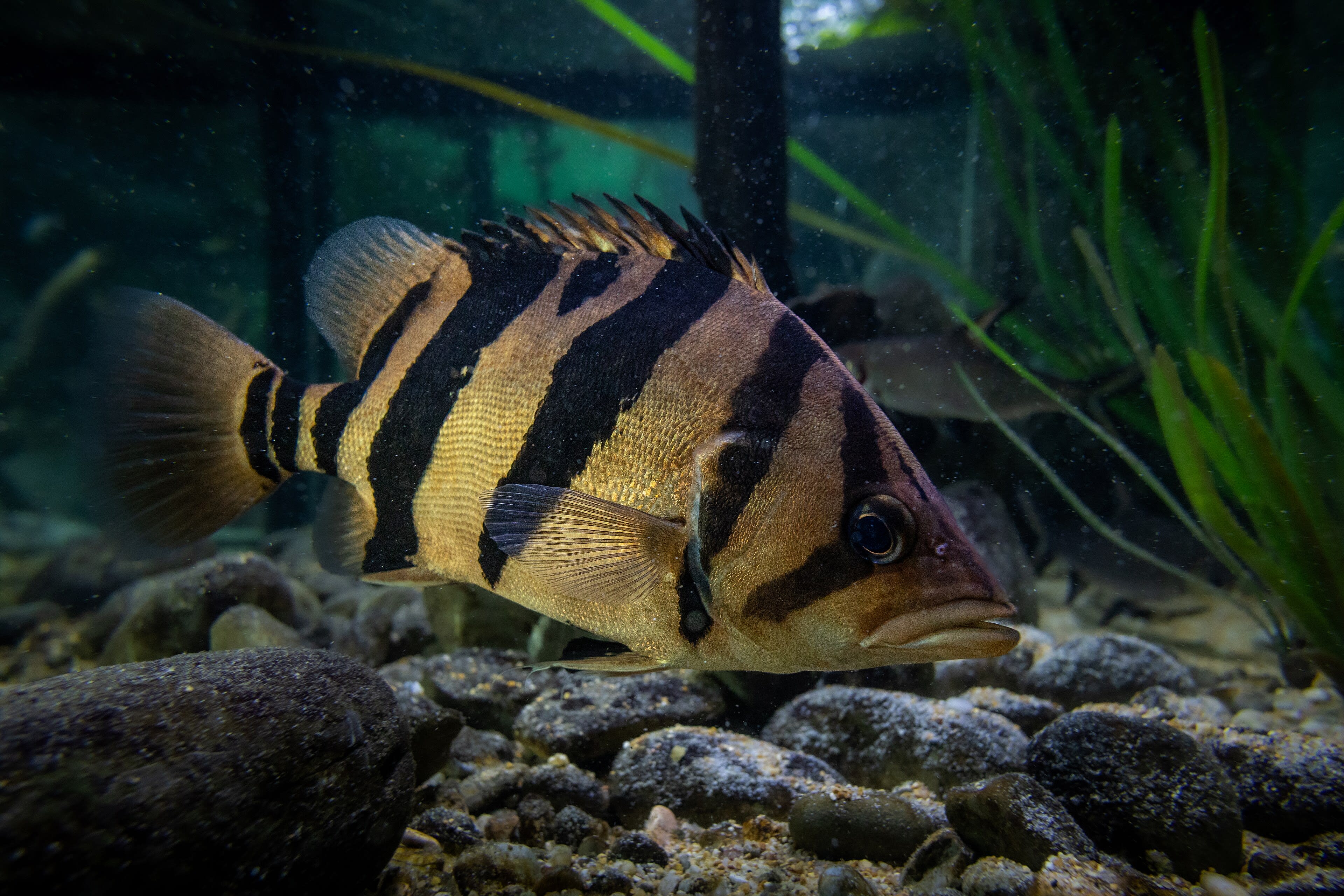
Finescale tigerfish
Datnioides microlepis
Parameter dashboard
20-28 °C
5.5-7.5
50 cm
15 years
Care guide
The finescale tigerfish or Indonesian datnoid (Datnioides microlepis) is a large, striking predatory fish from the rivers of Southeast Asia. Its range includes the Malay Peninsula and western Indonesia, where it is found in the Perak and Selangor river systems of Peninsular Malaysia, the Batang Hari and Musi watersheds of Sumatra, and the Kapuas basin of Borneo. It is an exclusive inhabitant of large, deep, lowland freshwater rivers and enters flooded forests during the annual wet season. In the ornamental trade it is the most widely available tiger perch, distinguished from its rarer congener D. pulcher by its dirty yellowish-grey base colour and 6–7 wide dark bars on the body.
This species reaches an impressive 40–50 cm (16–20 in) in standard length in adulthood, making it suitable only for the largest private aquaria or public installations. Juveniles and subadults appreciate well-decorated planted aquaria with driftwood roots and branches, while larger individuals are less demanding of décor. The species produces a significant amount of waste, necessitating large external filtration with robust heater protection, as adults have been known to damage submerged equipment. They do not travel well and can be challenging to stabilise post-import.
In the aquarium, D. microlepis is a piscivorous predator that should be offered strips of fish flesh, whole prawns, mussels, live river shrimp, and larger earthworms for adults, while juveniles accept bloodworm, small earthworms, and chopped prawn. Adults only require feeding 2–3 times per week. Best maintained singly or in a group of five or more to diffuse aggression, they are compatible with similarly-sized robust fish. Water temperature should be 20–28°C, pH 5.5–7.5, with a hardness of 36–268 ppm. Breeding has not been recorded in captivity.
Sources
- seriouslyfish.com — https://www.seriouslyfish.com/species/datnioides-microlepis/
- fishbase.se — https://www.fishbase.se/summary/Datnioides-microlepis.html
Further reading on identification and aquarium care.
Tankmate compatibility (sample)
Pairwise screening against other species in the database (prioritizing the same family when data is available).
Review first (10)
Caution or avoid from automated rules — confirm before mixing.
| Species | Assessment | Notes |
|---|---|---|
| Agassiz's dwarf cichlid Apistogramma agassizii Caution | Caution | Fish 2x+ larger may eat smaller tankmates Open pair in Compare → |
| Electric blue ram Mikrogeophagus ramirezi Caution | Caution | Fish 2x+ larger may eat smaller tankmates · Multiple territorial species in the same swim layer cause stress · the two share only a narrow band of temperature, so one of them sits at the edge of its range Open pair in Compare → |
| Emerald Dwarf Rasbora Danio erythromicron Caution | Caution | Fish 2x+ larger may eat smaller tankmates Open pair in Compare → |
| Galaxy rasbora Danio margaritatus Caution | Caution | Fish 2x+ larger may eat smaller tankmates Open pair in Compare → |
| Giant kuhli loach Pangio myersi Caution | Caution | Fish 2x+ larger may eat smaller tankmates Open pair in Compare → |
| Gold Shell Dweller Lamprologus ocellatus Caution | Caution | Fish 2x+ larger may eat smaller tankmates · Multiple territorial species in the same swim layer cause stress · Species with non-overlapping pH ranges may not thrive together Open pair in Compare → |
| Indonesian snakehead Channa micropeltes Caution | Caution | Fish 2x+ larger may eat smaller tankmates · Multiple territorial species in the same swim layer cause stress Open pair in Compare → |
| Red phantom tetra Hyphessobrycon sweglesi Caution | Caution | Fish 2x+ larger may eat smaller tankmates Open pair in Compare → |
| Redhump eartheater Geophagus steindachneri Caution | Caution | Fish 2x+ larger may eat smaller tankmates · Multiple territorial species in the same swim layer cause stress Open pair in Compare → |
| Strawberry Rasbora Boraras naevus Caution | Caution | Fish 2x+ larger may eat smaller tankmates Open pair in Compare → |
2 species with compatible assessment in this sampleCollapse to hide the list; use “Open pair in Compare” for the full matrix.
| Species | Assessment | Notes |
|---|---|---|
| Arawana Osteoglossum bicirrhosum Compatible | Compatible | No rule-based conflicts detected for this pair. Open pair in Compare → |
| Bigtooth river stingray Potamotrygon henlei Compatible | Compatible | No rule-based conflicts detected for this pair. Open pair in Compare → |
Same rule engine as Compare. Not a substitute for observation, tank size, or acclimation.
Was this page useful? Spot anything wrong?