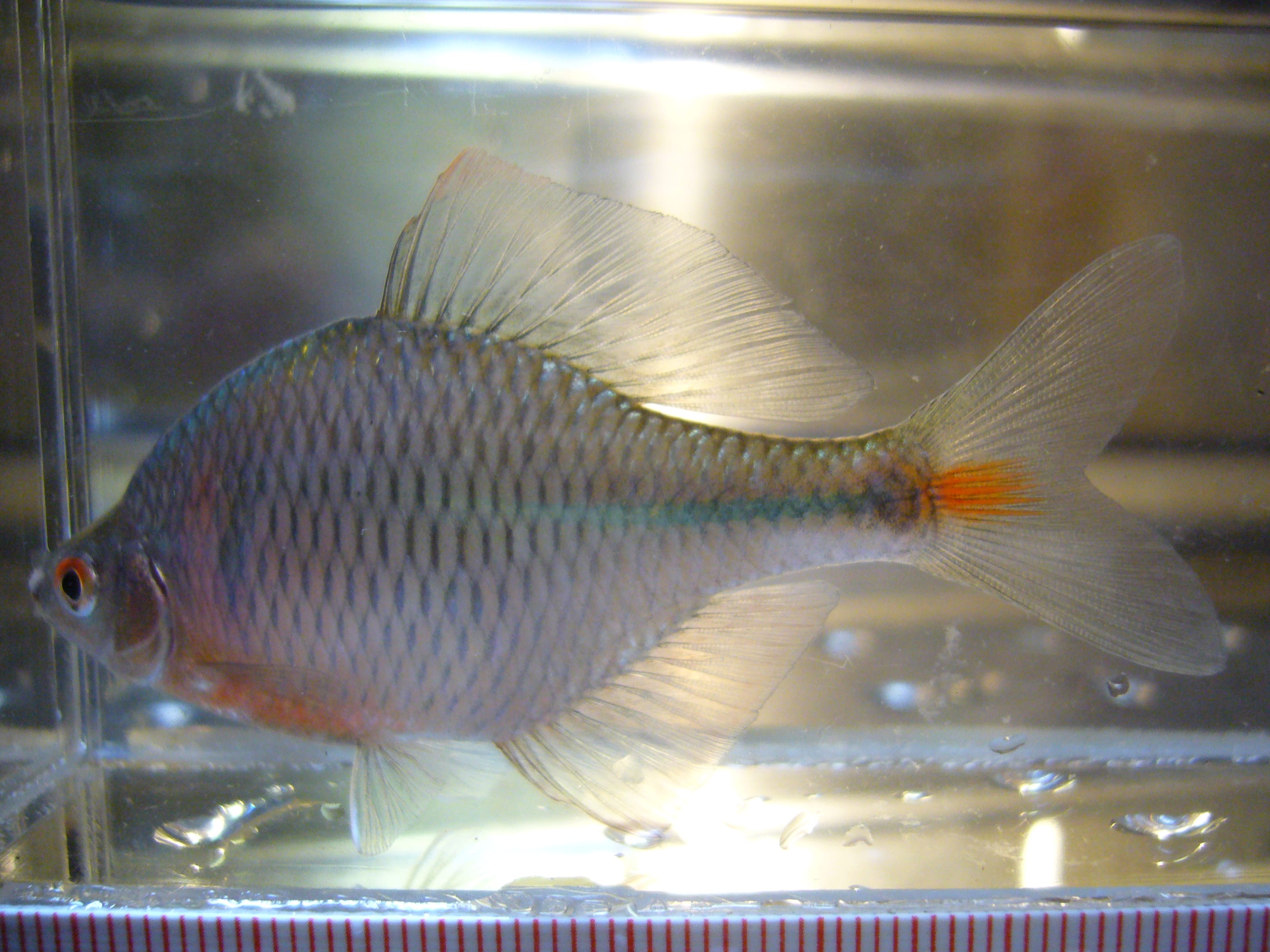
Rose bitterling
Rhodeus ocellatus
Parameter dashboard
18-24 °C
7-7.5
9.2 cm
Care guide
The rose bitterling (Rhodeus ocellatus) is a small, peaceful East Asian fish with one of the strangest breeding habits in fresh water. For most of the year it is an unassuming silvery fish up to 9.2 cm standard length. Then, from spring into summer, breeding males flush a deep rosy red, sometimes purple, to court females, which is where the name comes from. It is a subtropical, cool-water species reported from eastern Asia, including Taiwan and Russia; an unheated tank is suitable only where room temperatures meet its seasonal requirements, comfortable somewhere around 18-24 °C at pH 7.0–7.5 in moderately hard water; with a cooler winter rest. Feed it as the omnivore it is, on algae, soft plant matter, and small live or frozen foods.
The remarkable part is how it breeds, because it cannot do so without a partner of a completely different kind: a living freshwater mussel. A breeding female uses an egg-laying tube to deposit eggs inside a living mussel; the male fertilises them there, and the young remain in the bivalve until they can swim. Keeping the mussel alive is itself demanding, so breeding should be attempted only with a suitable mussel-care plan.
So if you want to watch the full life cycle, you need healthy mussels in the tank, which is a real challenge of its own. Without them you can still enjoy a hardy, active fish that colors up beautifully at spawning time; you just won't get fry.
Provide a cool winter rest, circulation and good oxygenation.
Sources
- fishbase.se — https://www.fishbase.se/summary/Rhodeus-ocellatus.html
- fishkeeper.co.uk — https://www.fishkeeper.co.uk/fish/freshwater/cyprinids/rosy-bitterling
Further reading on identification and aquarium care.
Tankmate compatibility (sample)
Pairwise screening against other species in the database (prioritizing the same family when data is available).
Review first (9)
Caution or avoid from automated rules — confirm before mixing.
| Species | Assessment | Notes |
|---|---|---|
| Blackline penguinfish Thayeria boehlkei Caution | Caution | Fish 2x+ larger may eat smaller tankmates Open pair in Compare → |
| Demon eartheater Satanoperca jurupari Caution | Caution | Fish 2x+ larger may eat smaller tankmates Open pair in Compare → |
| Gold Cap Caudopunctatus Neolamprologus caudopunctatus Caution | Caution | Species with non-overlapping pH ranges may not thrive together · the two share only a narrow band of temperature, so one of them sits at the edge of its range Open pair in Compare → |
| Japanese rice fish Oryzias latipes Caution | Caution | Fish 2x+ larger may eat smaller tankmates Open pair in Compare → |
| Red phantom tetra Hyphessobrycon sweglesi Caution | Caution | Fish 2x+ larger may eat smaller tankmates Open pair in Compare → |
| Sawbwa barb Sawbwa resplendens Caution | Caution | Fish 2x+ larger may eat smaller tankmates Open pair in Compare → |
| Palespotted corydoras Hoplisoma gossei Avoid | Avoid | Species with non-overlapping temperature ranges cannot coexist · the two share only a narrow band of temperature, so one of them sits at the edge of its range Open pair in Compare → |
| Temporaris Shell Dweller Telmatochromis temporalis Avoid | Avoid | Fish 2x+ larger may eat smaller tankmates · Species with non-overlapping temperature ranges cannot coexist · Species with non-overlapping pH ranges may not thrive together · the two share only a narrow band of temperature, so one of them sits at the edge of its range Open pair in Compare → |
| Zebra pleco Hypancistrus zebra Avoid | Avoid | Species with non-overlapping temperature ranges cannot coexist · the two share only a narrow band of temperature, so one of them sits at the edge of its range Open pair in Compare → |
3 species with compatible assessment in this sampleCollapse to hide the list; use “Open pair in Compare” for the full matrix.
| Species | Assessment | Notes |
|---|---|---|
| Bleeding-heart tetra Hyphessobrycon erythrostigma Compatible | Compatible | No rule-based conflicts detected for this pair. Open pair in Compare → |
| Panda corydoras Corydoras panda Compatible | Compatible | No rule-based conflicts detected for this pair. Open pair in Compare → |
| Zebra danio Danio rerio Compatible | Compatible | No rule-based conflicts detected for this pair. Open pair in Compare → |
Same rule engine as Compare. Not a substitute for observation, tank size, or acclimation.
Was this page useful? Spot anything wrong?