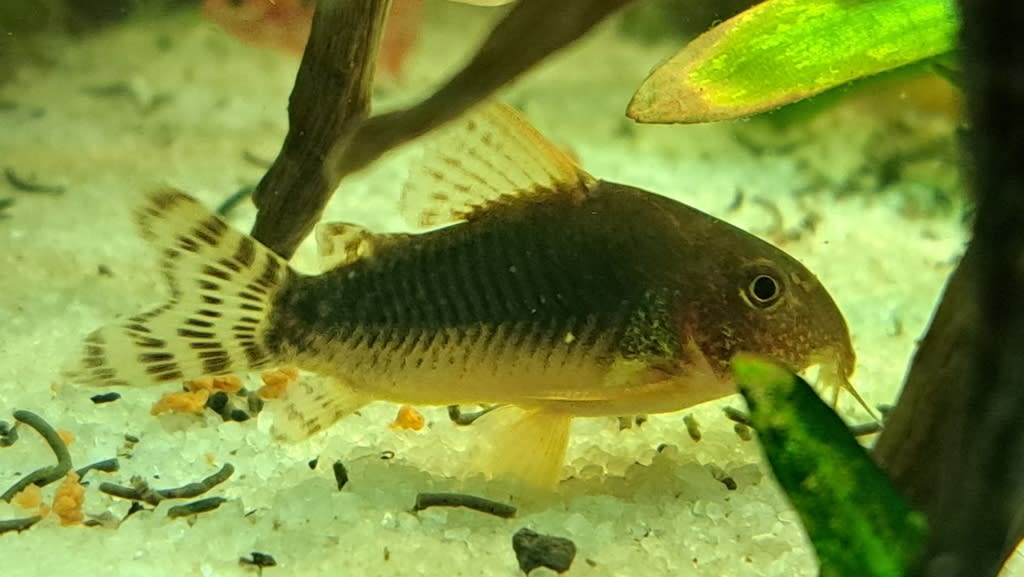
Palespotted corydoras
Hoplisoma gossei
Parameter dashboard
24-28 °C
5.5-7.5
5.5 cm
5 years
Care guide
The Palespotted Cory (Hoplisoma gossei, formerly Corydoras gossei) is a charming armored catfish from the rio Mamoré watershed in Rondônia state, northwestern Brazil, part of the upper Madeira River system within the greater Amazon basin. Named in honor of Dr. J. P. Gosse, who collected the type material, this species reaches a maximum standard length of 50–55 mm and exhibits the characteristic Corydoras body armor of overlapping bony plates along the flanks. It has a dark upper body, paler lower areas and a marked tail; its snout is shorter and rounder than that of the similar-looking C. seussi.
Keep Palespotted cories in peaceful groups of four to six or more. They spend much of their time actively foraging along the bottom, sifting through sand with their sensitive barbels in search of food particles, and their social nature means they are noticeably more confident and active in the company of their own kind. They make ideal inhabitants of a well-maintained community aquarium alongside other peaceful species such as tetras, rasboras, and dwarf cichlids. As foraging omnivores, they eagerly accept sinking dried foods but thrive when offered a varied diet that includes small live and frozen options like bloodworm and Tubifex — they should never be expected to subsist on leftovers from other tank inhabitants.
Native to the soft, acidic waters of the Amazon basin, the Palespotted Cory does best in an aquarium with a fine sand substrate to protect its delicate barbels, along with some cover in the form of driftwood, plants, or caves to provide security. Keep water at 24–28°C and pH 5.5–7.5, with soft to moderately hard water. Breeding follows the typical Corydoras pattern: a large, cool water change often triggers spawning, with eggs deposited on the aquarium glass, among fine-leaved plants, or on spawning mops. Incubation takes 3–4 days, and the fry require excellent water quality and a thin layer of sand for best results. Like all Corydoras, this species is a facultative air breather, periodically rising to the surface to gulp atmospheric oxygen, and its sharp pectoral-fin spines can deliver a painful sting if handled carelessly.
Provide a base of at least 90 × 30 cm. Both the base and suitable group housing matter; the litre figure should not replace the footprint check.
Source
Further reading on identification and aquarium care.
Tankmate compatibility (sample)
Pairwise screening against other species in the database (prioritizing the same family when data is available).
Review first (3)
Caution or avoid from automated rules — confirm before mixing.
| Species | Assessment | Notes |
|---|---|---|
| Hoplo Catfish Megalechis thoracata Caution | Caution | Fish 2x+ larger may eat smaller tankmates · close relatives, and one of them is territorial, so both claim the same kind of space · one is boisterous and the other a much smaller peaceful fish sharing the same floor, where it can be intimidated and outcompeted at feeding time Open pair in Compare → |
| Panda corydoras Corydoras panda Caution | Caution | the two share only a narrow band of temperature, so one of them sits at the edge of its range Open pair in Compare → |
| Schwartz's catfish Corydoras schwartzi Avoid | Avoid | Species with non-overlapping temperature ranges cannot coexist · the two share only a narrow band of temperature, so one of them sits at the edge of its range Open pair in Compare → |
7 species with compatible assessment in this sampleCollapse to hide the list; use “Open pair in Compare” for the full matrix.
| Species | Assessment | Notes |
|---|---|---|
| Adolf's catfish Corydoras adolfoi Compatible | Compatible | No rule-based conflicts detected for this pair. Open pair in Compare → |
| Bronze corydoras Osteogaster aenea Compatible | Compatible | No rule-based conflicts detected for this pair. Open pair in Compare → |
| Leopard corydoras Corydoras julii Compatible | Compatible | No rule-based conflicts detected for this pair. Open pair in Compare → |
| Peppered corydoras Hoplisoma paleatum Compatible | Compatible | No rule-based conflicts detected for this pair. Open pair in Compare → |
| Pygmy corydoras Corydoras pygmaeus Compatible | Compatible | No rule-based conflicts detected for this pair. Open pair in Compare → |
| Sterba's cory Corydoras sterbai Compatible | Compatible | No rule-based conflicts detected for this pair. Open pair in Compare → |
| Twosaddle corydoras Hoplisoma weitzmani Compatible | Compatible | No rule-based conflicts detected for this pair. Open pair in Compare → |
Same rule engine as Compare. Not a substitute for observation, tank size, or acclimation.
Related species
Was this page useful? Spot anything wrong?