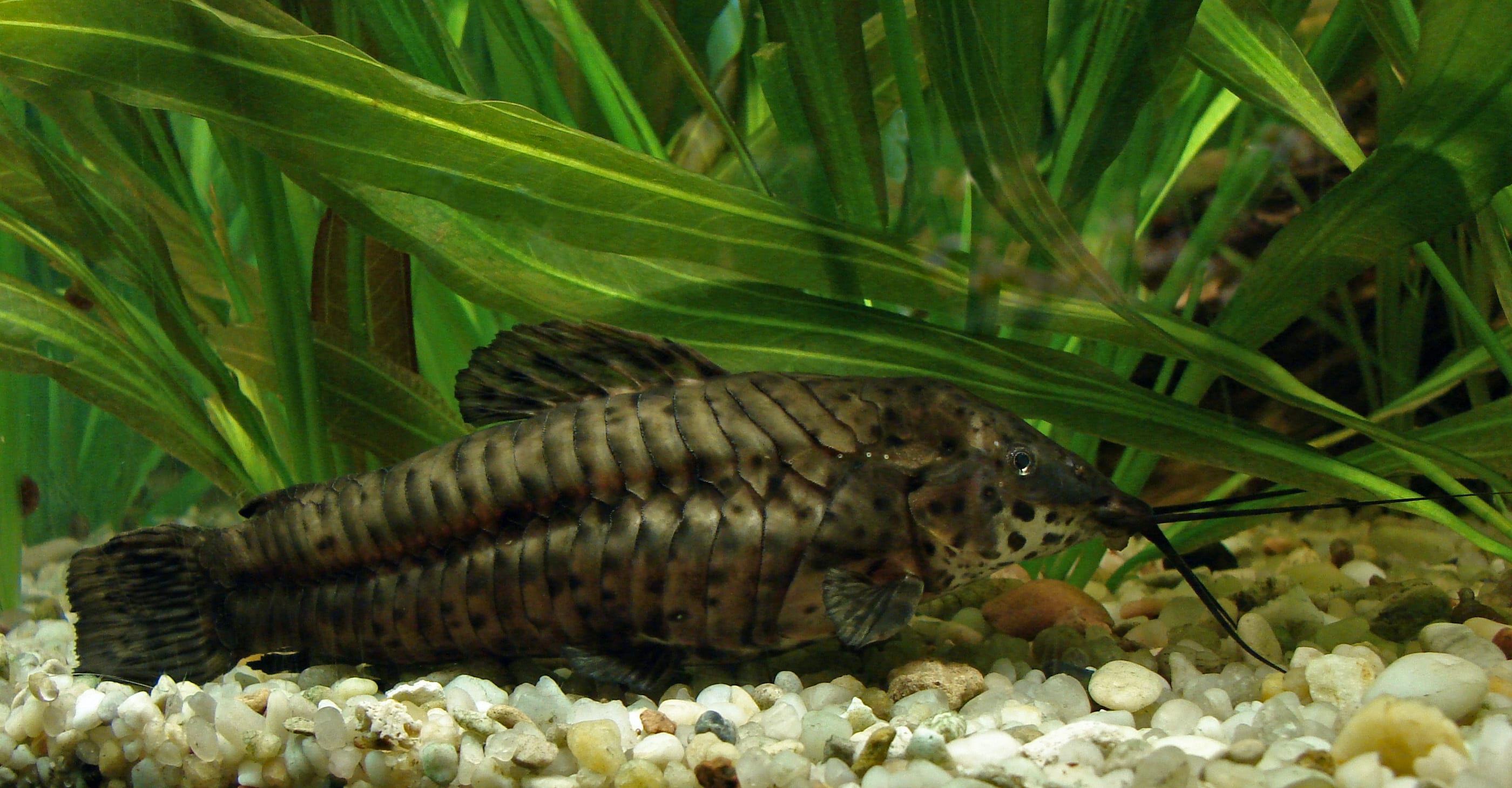
Hoplo Catfish
Megalechis thoracata
Parameter dashboard
18-28 °C
6-8
15.5 cm
8 years
Care guide
The hoplo catfish, also known as the brown hoplo or Cascadura, is a robust armoured catfish from northern South America. Its natural range spans the Amazon, Orinoco, and upper Paraguay River basins, as well as the coastal rivers of the Guianas and northern Brazil. It inhabits slow-moving tributaries, floodplain lakes, and swamps with soft, muddy substrates, often in waters with low dissolved oxygen — an adaptation that has driven the evolution of its ability to breathe atmospheric air through a modified vascularised intestine. Adults reach approximately 15.5 cm in standard length.
Unlike many catfish that are strictly nocturnal, hoplos are active throughout the day, spending much of their time rooting through the substrate in search of food. They are peaceful community fish that mix well with similarly-sized tetras, rasboras, gouramis, and other non-aggressive species. A pair or small group of 3-4 individuals will exhibit more confident, natural behaviour than a single specimen. The minimum tank size is 140 litres with a soft sand substrate — sharp gravel can damage their barbels and underslung mouth. Provide driftwood caves, hardy plants, and areas of surface vegetation to diffuse light.
Water parameters should be 18-28°C, pH 6.0-8.0, with soft to moderately hard water. As obligate air-breathers, hoplos must have unrestricted access to the water surface, and a tightly-fitting lid is essential to prevent escape. The diet is omnivorous: high-quality sinking pellets and wafers should form the staple, supplemented with live and frozen bloodworm, brine shrimp, tubifex, daphnia, and blanched vegetables such as zucchini and cucumber. Hoplo catfish are notable bubble-nest builders — the male constructs a floating nest of bubbles and plant debris under floating leaves, guards the eggs, and tends the fry for the first few days. Their hardy nature, engaging behaviour, and peaceful disposition make them an excellent choice for the South American community aquarium.
Sources
- seriouslyfish.com — https://www.seriouslyfish.com/species/Megalechis-thoracata/
- fishbase.mnhn.fr — https://fishbase.mnhn.fr/summary/46502
Further reading on identification and aquarium care.
Tankmate compatibility (sample)
Pairwise screening against other species in the database (prioritizing the same family when data is available).
Review first (10)
Caution or avoid from automated rules — confirm before mixing.
| Species | Assessment | Notes |
|---|---|---|
| Adolf's catfish Corydoras adolfoi Caution | Caution | Fish 2x+ larger may eat smaller tankmates · close relatives, and one of them is territorial, so both claim the same kind of space · one is boisterous and the other a much smaller peaceful fish sharing the same floor, where it can be intimidated and outcompeted at feeding time Open pair in Compare → |
| Bronze corydoras Osteogaster aenea Caution | Caution | Fish 2x+ larger may eat smaller tankmates · close relatives, and one of them is territorial, so both claim the same kind of space · one is boisterous and the other a much smaller peaceful fish sharing the same floor, where it can be intimidated and outcompeted at feeding time Open pair in Compare → |
| Leopard corydoras Corydoras julii Caution | Caution | Fish 2x+ larger may eat smaller tankmates · close relatives, and one of them is territorial, so both claim the same kind of space · one is boisterous and the other a much smaller peaceful fish sharing the same floor, where it can be intimidated and outcompeted at feeding time Open pair in Compare → |
| Palespotted corydoras Hoplisoma gossei Caution | Caution | Fish 2x+ larger may eat smaller tankmates · close relatives, and one of them is territorial, so both claim the same kind of space · one is boisterous and the other a much smaller peaceful fish sharing the same floor, where it can be intimidated and outcompeted at feeding time Open pair in Compare → |
| Panda corydoras Corydoras panda Caution | Caution | Fish 2x+ larger may eat smaller tankmates · close relatives, and one of them is territorial, so both claim the same kind of space · one is boisterous and the other a much smaller peaceful fish sharing the same floor, where it can be intimidated and outcompeted at feeding time Open pair in Compare → |
| Peppered corydoras Hoplisoma paleatum Caution | Caution | Fish 2x+ larger may eat smaller tankmates · close relatives, and one of them is territorial, so both claim the same kind of space · one is boisterous and the other a much smaller peaceful fish sharing the same floor, where it can be intimidated and outcompeted at feeding time Open pair in Compare → |
| Pygmy corydoras Corydoras pygmaeus Caution | Caution | Fish 2x+ larger may eat smaller tankmates · close relatives, and one of them is territorial, so both claim the same kind of space · one is boisterous and the other a much smaller peaceful fish sharing the same floor, where it can be intimidated and outcompeted at feeding time Open pair in Compare → |
| Schwartz's catfish Corydoras schwartzi Caution | Caution | Fish 2x+ larger may eat smaller tankmates · close relatives, and one of them is territorial, so both claim the same kind of space · one is boisterous and the other a much smaller peaceful fish sharing the same floor, where it can be intimidated and outcompeted at feeding time Open pair in Compare → |
| Sterba's cory Corydoras sterbai Caution | Caution | Fish 2x+ larger may eat smaller tankmates · close relatives, and one of them is territorial, so both claim the same kind of space · one is boisterous and the other a much smaller peaceful fish sharing the same floor, where it can be intimidated and outcompeted at feeding time Open pair in Compare → |
| Twosaddle corydoras Hoplisoma weitzmani Caution | Caution | Fish 2x+ larger may eat smaller tankmates · close relatives, and one of them is territorial, so both claim the same kind of space · one is boisterous and the other a much smaller peaceful fish sharing the same floor, where it can be intimidated and outcompeted at feeding time Open pair in Compare → |
Same rule engine as Compare. Not a substitute for observation, tank size, or acclimation.
Related species
Was this page useful? Spot anything wrong?