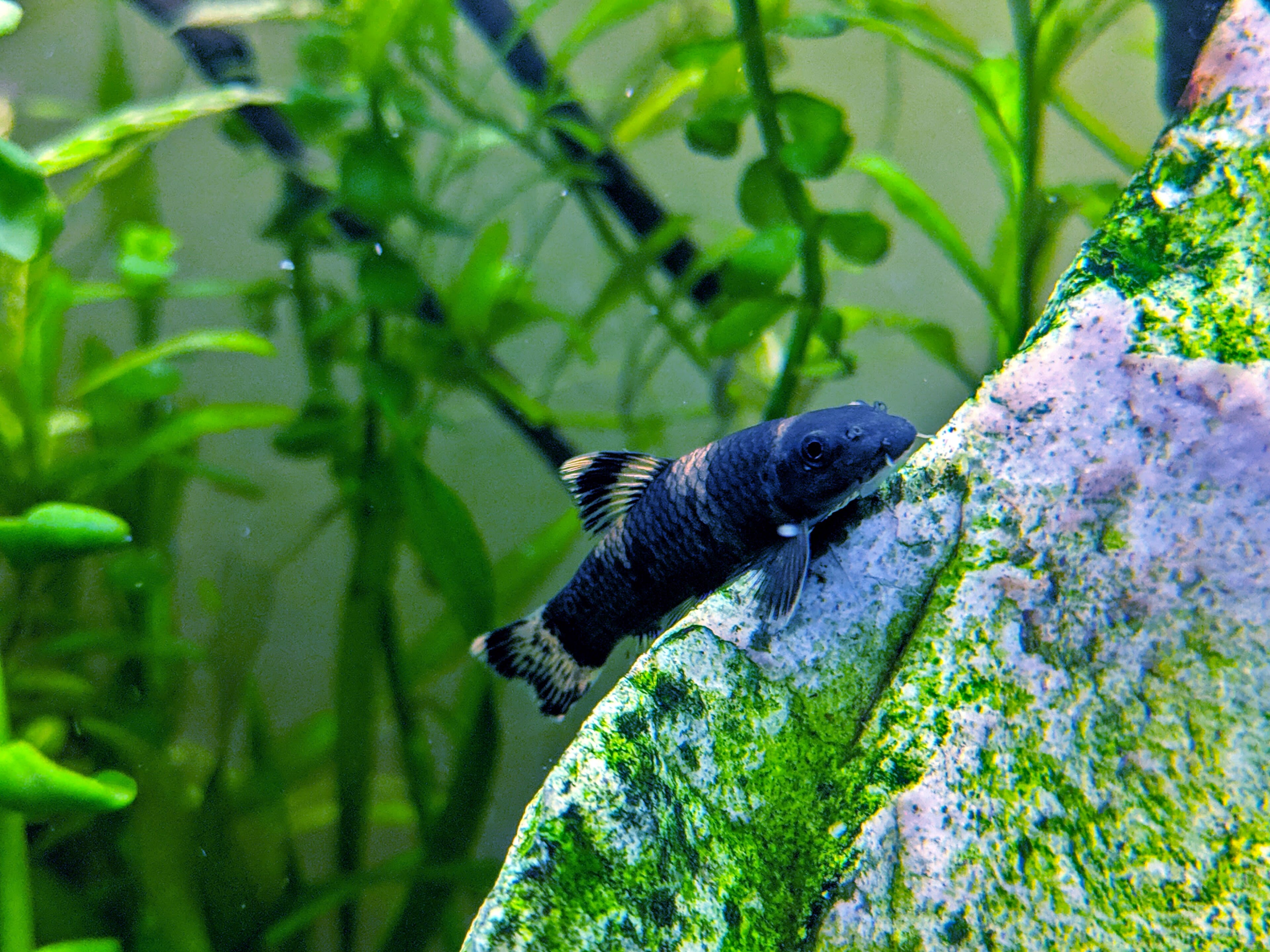
Panda Garra
Garra flavatra
Parameter dashboard
22-27 °C
6.5-7.5
9 cm
5 years
Care guide
The panda garra (Garra flavatra) is a strikingly patterned cyprinid endemic to the Rakhine Yoma mountain range in Rakhine State, western Myanmar. It was scientifically described as recently as 2004 by Kullander and Fang and became available to the aquarium hobby the following year, quickly gaining popularity among enthusiasts. This species inhabits shallow, clear streams and rivers with substrates of gravel, pebbles, and rocks, where seasonal monsoon rains cause significant variation in water levels. It is traded under various names including 'panda garra', 'clown garra', 'banded butterfly garra', and 'rainbow garra', and is sometimes incorrectly referred to as a loach.
Reaching 7–9 cm (2.8–3.5 in) in standard length, the panda garra displays a distinctive colour pattern of alternating black and yellowish-orange bands across the body, resembling that of a panda bear. Males develop noticeable tubercules on the head and along the lateral line when sexually mature and tend to be slimmer in body than females. A minimum tank size of 80 L (21 gal) with base dimensions of at least 90 × 30 cm is recommended. This species appreciates clean, well-oxygenated water with turnover exceeding 10 times per hour, and a tightly-fitting cover is essential as it can literally climb glass.
In the aquarium, the panda garra is relatively peaceful and best maintained in groups of 3–4 or more to spread intra-species aggression, as solitary individuals tend to behave more aggressively toward similarly-shaped tankmates. The diet should include both meaty foods such as live or frozen bloodworm, Artemia, and chopped prawn alongside good quality sinking dried products with vegetable content, plus occasional fresh vegetables. Water temperature should be 22–27°C, pH 6.5–7.5, with hardness of 36–215 ppm. This species has been successfully bred commercially in Myanmar since 2008, spawning during May to July.
Sources
- seriouslyfish.com — https://www.seriouslyfish.com/species/garra-flavatra/
- fishbase.se — https://www.fishbase.se/summary/Garra-flavatra.html
Further reading on identification and aquarium care.
Tankmate compatibility (sample)
Pairwise screening against other species in the database (prioritizing the same family when data is available).
Review first (4)
Caution or avoid from automated rules — confirm before mixing.
| Species | Assessment | Notes |
|---|---|---|
| Red Cherry Rasbora Rasbora lacrimula Caution | Caution | Fish 2x+ larger may eat smaller tankmates Open pair in Compare → |
| Sumatra barb Puntigrus tetrazona Caution | Caution | close relatives, and one of them is territorial, so both claim the same kind of space Open pair in Compare → |
| Tinfoil barb Barbonymus schwanenfeldii Caution | Caution | Fish 2x+ larger may eat smaller tankmates Open pair in Compare → |
| Sawbwa barb Sawbwa resplendens Avoid | Avoid | Fish 2x+ larger may eat smaller tankmates · Species with non-overlapping temperature ranges cannot coexist · the two share only a narrow band of temperature, so one of them sits at the edge of its range Open pair in Compare → |
8 species with compatible assessment in this sampleCollapse to hide the list; use “Open pair in Compare” for the full matrix.
| Species | Assessment | Notes |
|---|---|---|
| Black ruby barb Pethia nigrofasciata Compatible | Compatible | No rule-based conflicts detected for this pair. Open pair in Compare → |
| Cherry barb Puntius titteya Compatible | Compatible | No rule-based conflicts detected for this pair. Open pair in Compare → |
| Chinese barb Barbodes semifasciolatus Compatible | Compatible | No rule-based conflicts detected for this pair. Open pair in Compare → |
| Fiveband barb Desmopuntius pentazona Compatible | Compatible | No rule-based conflicts detected for this pair. Open pair in Compare → |
| Flying fox Epalzeorhynchos kalopterum Compatible | Compatible | No rule-based conflicts detected for this pair. Open pair in Compare → |
| Rosy barb Pethia conchonius Compatible | Compatible | No rule-based conflicts detected for this pair. Open pair in Compare → |
| Ruby barb Pethia padamya Compatible | Compatible | No rule-based conflicts detected for this pair. Open pair in Compare → |
| Three-lined rasbora Rasbora trilineata Compatible | Compatible | No rule-based conflicts detected for this pair. Open pair in Compare → |
Same rule engine as Compare. Not a substitute for observation, tank size, or acclimation.
Related species
Was this page useful? Spot anything wrong?