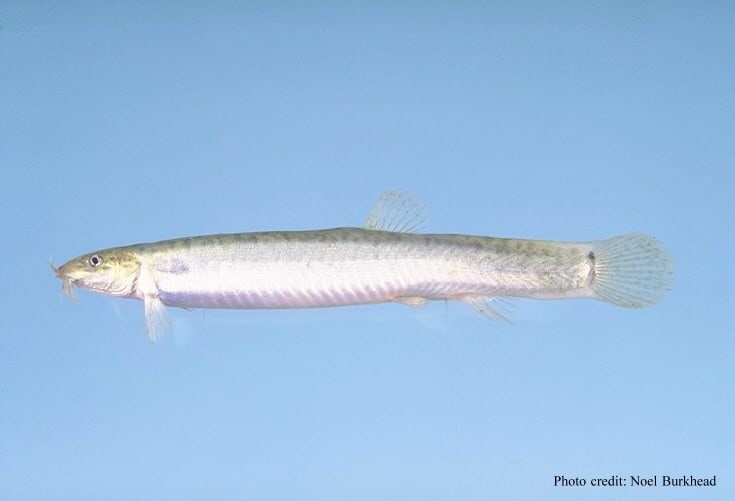
Pond loach
Misgurnus anguillicaudatus
Parameter dashboard
18-23 °C
6.5-8
28 cm
10 years
Care guide
The weather loach or dojo loach (Misgurnus anguillicaudatus) is a remarkably adaptable species native to Siberia, Korea, Japan, China, and northern Vietnam, with introduced populations now established across Europe, North America, and Australia. It inhabits shallow, slow-moving sections of rivers, swamps, oxbows, and paddy fields with soft mud or silt substrates and dense vegetation. Its eel-like body, reaching up to 28 cm in length, is marked with irregular dark spots and blotches over a tan or olive-brown base. The common name "weather loach" derives from its reported sensitivity to barometric pressure changes, which can trigger increased activity before storms. This species possesses intestinal respiration, allowing it to gulp atmospheric air and survive in hypoxic conditions. The aquarium should be at least 120 cm in length with a soft sandy substrate to accommodate its burrowing behaviour — coarse gravel can injure the fish. It appreciates dim lighting, driftwood, and leaf litter. Despite its hardiness, this is not a tropical species; it should be maintained at cooler temperatures between 18 and 23 °C. It is peaceful with medium-to-large tankmates but may prey on very small fish or eggs. Individuals often develop distinct personalities and may become tame enough to hand-feed.
Source
Further reading on identification and aquarium care.
Tankmate compatibility (sample)
Pairwise screening against other species in the database (prioritizing the same family when data is available).
Review first (12)
Caution or avoid from automated rules — confirm before mixing.
| Species | Assessment | Notes |
|---|---|---|
| Borneo Loach Pangio shelfordii Caution | Caution | Fish 2x+ larger may eat smaller tankmates Open pair in Compare → |
| Celebes rainbowfish Marosatherina ladigesi Caution | Caution | Fish 2x+ larger may eat smaller tankmates · the two share only a narrow band of temperature, so one of them sits at the edge of its range Open pair in Compare → |
| Coolie loach Pangio semicincta Caution | Caution | Fish 2x+ larger may eat smaller tankmates · Species with non-overlapping pH ranges may not thrive together Open pair in Compare → |
| Giant kuhli loach Pangio myersi Caution | Caution | Fish 2x+ larger may eat smaller tankmates Open pair in Compare → |
| Harlequin rasbora Trigonostigma heteromorpha Caution | Caution | Fish 2x+ larger may eat smaller tankmates Open pair in Compare → |
| Honey gourami Trichogaster chuna Caution | Caution | Fish 2x+ larger may eat smaller tankmates · the two share only a narrow band of temperature, so one of them sits at the edge of its range Open pair in Compare → |
| Lemon tetra Hyphessobrycon pulchripinnis Caution | Caution | Fish 2x+ larger may eat smaller tankmates Open pair in Compare → |
| Zebra Nerite Vittina natalensis Caution | Caution | Fish 2x+ larger may eat smaller tankmates · the two share only a narrow band of temperature, so one of them sits at the edge of its range Open pair in Compare → |
| Glowlight tetra Hemigrammus erythrozonus Avoid | Avoid | Fish 2x+ larger may eat smaller tankmates · Species with non-overlapping temperature ranges cannot coexist · the two share only a narrow band of temperature, so one of them sits at the edge of its range Open pair in Compare → |
| Gray bichir Polypterus senegalus Avoid | Avoid | Fish 2x+ larger may eat smaller tankmates · Species with non-overlapping temperature ranges cannot coexist · the two share only a narrow band of temperature, so one of them sits at the edge of its range · one is boisterous and the other a much smaller peaceful fish sharing the same floor, where it can be intimidated and outcompeted at feeding time Open pair in Compare → |
| Threespot eartheater Satanoperca daemon Avoid | Avoid | Species with non-overlapping temperature ranges cannot coexist · Species with non-overlapping pH ranges may not thrive together · the two share only a narrow band of temperature, so one of them sits at the edge of its range Open pair in Compare → |
| Zebra pleco Hypancistrus zebra Avoid | Avoid | Fish 2x+ larger may eat smaller tankmates · Species with non-overlapping temperature ranges cannot coexist · the two share only a narrow band of temperature, so one of them sits at the edge of its range Open pair in Compare → |
Same rule engine as Compare. Not a substitute for observation, tank size, or acclimation.
Related species
Was this page useful? Spot anything wrong?