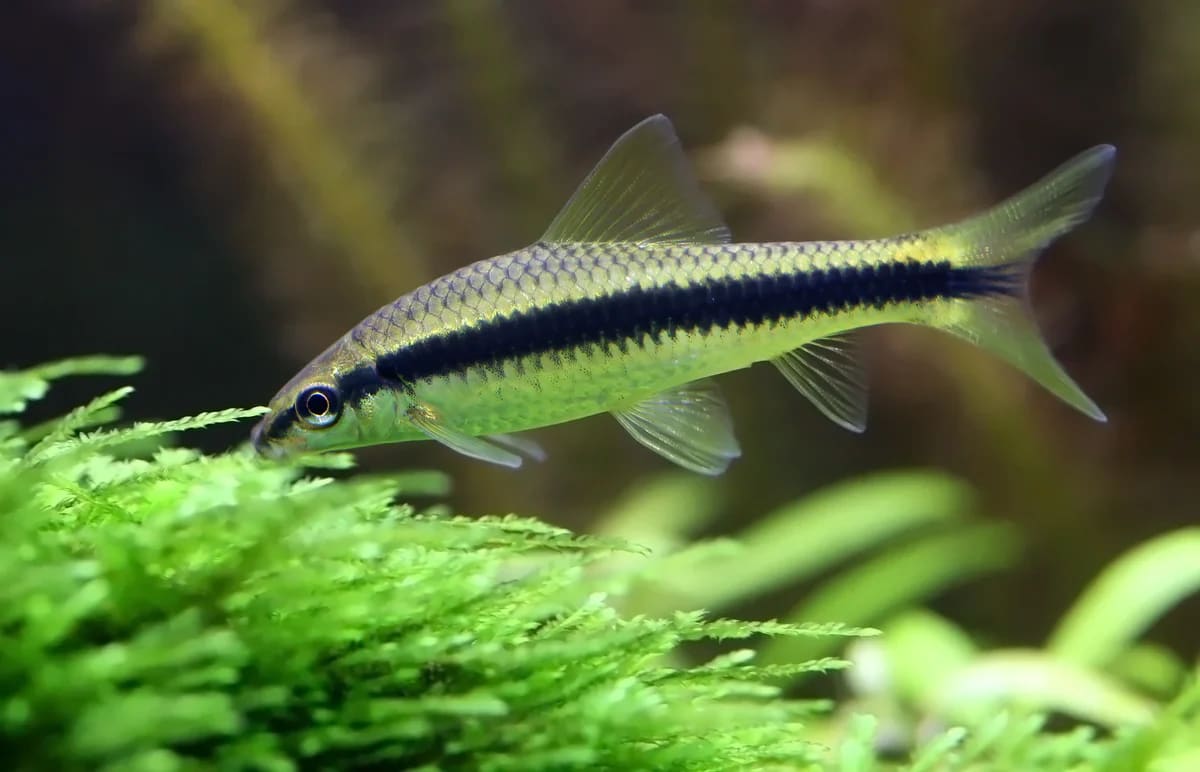
Siamese flying fox
Crossocheilus oblongus
Parameter dashboard
23-27 °C
6-7.5
16 cm
Care guide
The Siamese algae eater, also called the Siamese flying fox, is a tireless forager from the fast-flowing streams and rivers of mainland Southeast Asia — Thailand, Cambodia, Laos, and Malaysia. Its most celebrated feature is an almost single-minded appetite for nuisance algae, particularly black brush algae (BBA) and hair algae that many other fish ignore. Identification is key: the true species has a single bold black stripe running from snout through the entire tail fin, with slightly serrated edges and completely clear, unmarked fins — distinguishing it from lookalikes like the false flying fox or the more aggressive Chinese algae eater.
Siamese algae eaters are active, fast-moving fish that do best in groups of five or more, where they establish a clear hierarchy and spend their days grazing rocks, driftwood, and plant leaves. Kept singly, they can become skittish; kept in pairs, mild squabbling is common. They are peaceful with tankmates of similar size — barbs, danios, rasboras, rainbowfish, and medium tetras all make good companions. Their diet in the wild is primarily algae and biofilm, making them herbivore-leaning omnivores. In the aquarium, they eagerly take algae wafers, spirulina-based sinking pellets, and blanched vegetables such as zucchini or cucumber, supplemented with occasional frozen foods. Overfeeding protein-rich foods makes them lazy and reduces their algae-grazing effectiveness.
Given their active nature and eventual size of up to 16 cm, a minimum tank of 200 litres is recommended for a group, with strong filtration, good water flow, and a secure lid — they are notorious jumpers. Water temperature should be 23 to 27°C with a pH of 6.0 to 7.5. They thrive in mature, well-oxygenated tanks with plenty of smooth rocks, driftwood, and robust plants. Breeding in home aquaria is extremely rare; most specimens are commercially farmed with hormone assistance. They are long-lived, routinely reaching ten years and sometimes fifteen with excellent care. An established group of true SAEs remains one of the most effective natural algae-control solutions available to planted-tank keepers.
Sources
- aquariumcoop.com — https://www.aquariumcoop.com/blogs/aquarium/siamese-algae-eater
- theshrimpfarm.com — https://www.theshrimpfarm.com/posts/true-siamese-algae-eater-care/
Further reading on identification and aquarium care.
Tankmate compatibility (sample)
Pairwise screening against other species in the database (prioritizing the same family when data is available).
Review first (10)
Caution or avoid from automated rules — confirm before mixing.
| Species | Assessment | Notes |
|---|---|---|
| Cherry barb Puntius titteya Caution | Caution | Fish 2x+ larger may eat smaller tankmates Open pair in Compare → |
| Chinese barb Barbodes semifasciolatus Caution | Caution | Fish 2x+ larger may eat smaller tankmates · the two share only a narrow band of temperature, so one of them sits at the edge of its range Open pair in Compare → |
| Dwarf rasbora Boraras maculatus Caution | Caution | Fish 2x+ larger may eat smaller tankmates Open pair in Compare → |
| Melon Barb Haludaria fasciata Caution | Caution | Fish 2x+ larger may eat smaller tankmates Open pair in Compare → |
| Red Cherry Rasbora Rasbora lacrimula Caution | Caution | Fish 2x+ larger may eat smaller tankmates Open pair in Compare → |
| Reticulated Sae Crossocheilus reticulatus Caution | Caution | the two share only a narrow band of temperature, so one of them sits at the edge of its range Open pair in Compare → |
| Rosy barb Pethia conchonius Caution | Caution | the two share only a narrow band of temperature, so one of them sits at the edge of its range Open pair in Compare → |
| Ruby barb Pethia padamya Caution | Caution | Fish 2x+ larger may eat smaller tankmates Open pair in Compare → |
| Sumatra barb Puntigrus tetrazona Caution | Caution | Fish 2x+ larger may eat smaller tankmates · close relatives, and one of them is territorial, so both claim the same kind of space Open pair in Compare → |
| Tinfoil barb Barbonymus schwanenfeldii Caution | Caution | Fish 2x+ larger may eat smaller tankmates Open pair in Compare → |
2 species with compatible assessment in this sampleCollapse to hide the list; use “Open pair in Compare” for the full matrix.
| Species | Assessment | Notes |
|---|---|---|
| Clown rasbora Rasbora kalochroma Compatible | Compatible | No rule-based conflicts detected for this pair. Open pair in Compare → |
| Flying fox Epalzeorhynchos kalopterum Compatible | Compatible | No rule-based conflicts detected for this pair. Open pair in Compare → |
Same rule engine as Compare. Not a substitute for observation, tank size, or acclimation.
Related species
Was this page useful? Spot anything wrong?