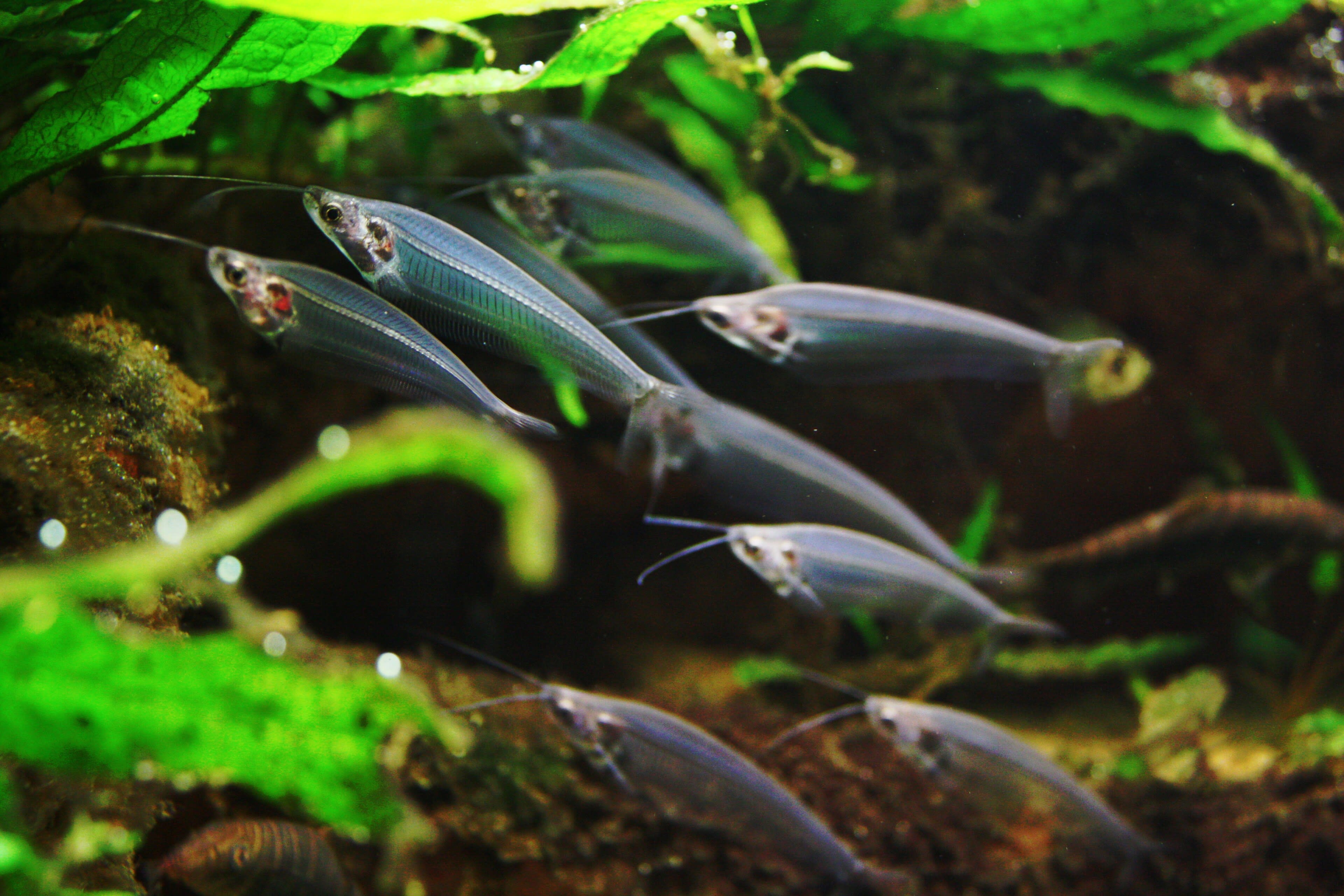
Glass catfish
Kryptopterus vitreolus
Parameter dashboard
20-26 °C
4-7
6.5 cm
7 years
Care guide
The glass catfish (Kryptopterus vitreolus) is one of the most remarkable freshwater aquarium species — its body is almost entirely transparent in life, revealing the spine and internal organs through a translucent musculature and skin. Endemic to coastal river basins of Peninsular Thailand and the Cardamom Mountains in southeastern Thailand, this species was only formally described in 2013 after decades of misidentification as Kryptopterus bicirrhis or K. minor. It reaches a modest 5.5–6.5 cm in standard length and is distinguished by its nearly invisible body, forked caudal fin, and two long sensory barbels extending forward from the snout.
Glass catfish are highly gregarious and must be maintained in groups of six or more to thrive; solitary individuals may become stressed and lose condition. They are peaceful but somewhat timid, making them unsuitable tankmates for boisterous or aggressive species. Ideal companions include small, peaceful Southeast Asian species such as Trigonostigma harlequin rasboras, Boraras micro-rasboras, and various small loaches. In nature they are micropredators feeding on small invertebrates and zooplankton, and in the aquarium they should be offered daily meals of small live or frozen foods such as Artemia nauplii, Moina, and microworm, though they will also accept high-quality dried foods of a suitable size.
Use a mature aquarium with a base of at least 90 × 30 cm and adequate space for the group. They prefer subdued lighting with surface vegetation or floating plants, and the addition of dried leaf litter and alder cones is beneficial for mimicking the blackwater conditions of their natural habitat. Recommended water parameters include a temperature of 20–26°C, pH 4.0–7.0, and hardness of 18–179 ppm. They are sensitive to swings in water chemistry and should never be added to an immature or unstable aquarium.
Source
Further reading on identification and aquarium care.
Tankmate compatibility (sample)
Pairwise screening against other species in the database (prioritizing the same family when data is available).
Review first (7)
Caution or avoid from automated rules — confirm before mixing.
| Species | Assessment | Notes |
|---|---|---|
| Goldspotted snakehead Channa aurantimaculata Caution | Caution | Fish 2x+ larger may eat smaller tankmates Open pair in Compare → |
| Princess of Burundi Neolamprologus brichardi Caution | Caution | Species with non-overlapping pH ranges may not thrive together Open pair in Compare → |
| Strawberry Rasbora Boraras naevus Caution | Caution | Fish 2x+ larger may eat smaller tankmates Open pair in Compare → |
| White Seam Betta Betta albimarginata Caution | Caution | Fish 2x+ larger may eat smaller tankmates Open pair in Compare → |
| Zebra Nerite Vittina natalensis Caution | Caution | Fish 2x+ larger may eat smaller tankmates · Species with non-overlapping pH ranges may not thrive together Open pair in Compare → |
| Electric blue ram Mikrogeophagus ramirezi Avoid | Avoid | Species with non-overlapping temperature ranges cannot coexist · the two share only a narrow band of temperature, so one of them sits at the edge of its range Open pair in Compare → |
| Oxyropsis Oxyropsis carinata Avoid | Avoid | Species with non-overlapping temperature ranges cannot coexist · the two share only a narrow band of temperature, so one of them sits at the edge of its range Open pair in Compare → |
5 species with compatible assessment in this sampleCollapse to hide the list; use “Open pair in Compare” for the full matrix.
| Species | Assessment | Notes |
|---|---|---|
| Black phantom tetra Hyphessobrycon megalopterus Compatible | Compatible | No rule-based conflicts detected for this pair. Open pair in Compare → |
| Clown rasbora Rasbora kalochroma Compatible | Compatible | No rule-based conflicts detected for this pair. Open pair in Compare → |
| Common otocinclus Otocinclus vittatus Compatible | Compatible | No rule-based conflicts detected for this pair. Open pair in Compare → |
| Honey blue eye Pseudomugil mellis Compatible | Compatible | No rule-based conflicts detected for this pair. Open pair in Compare → |
| Reticulated hillstream loach Sewellia lineolata Compatible | Compatible | No rule-based conflicts detected for this pair. Open pair in Compare → |
Same rule engine as Compare. Not a substitute for observation, tank size, or acclimation.
Was this page useful? Spot anything wrong?