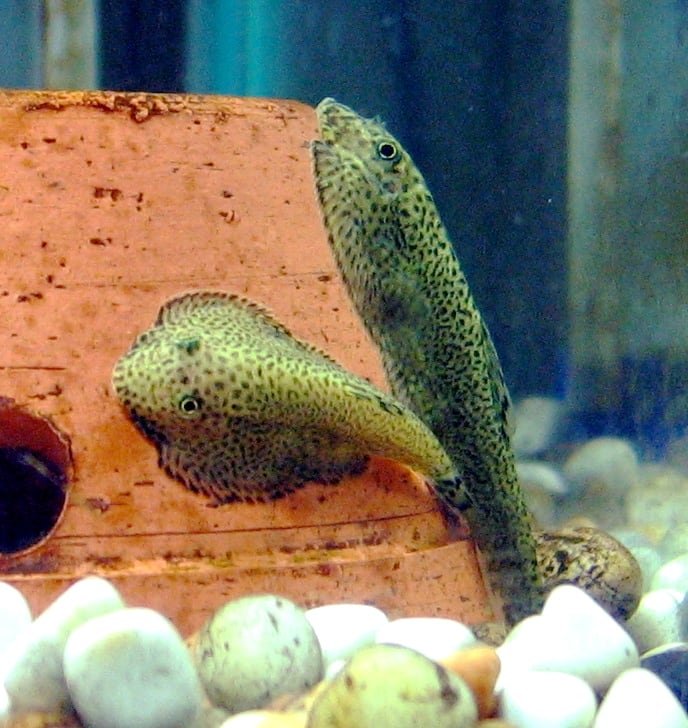
Hillstream loach
Gastromyzon punctulatus
Parameter dashboard
23-25 °C
6.5-7.5
6.5 cm
5 years
Care guide
The hillstream loach (Gastromyzon punctulatus) is a small, specialised loach endemic to the fast-flowing streams of Borneo. It reaches only about 6.5 cm in standard length and possesses a highly flattened body and enlarged pectoral and pelvic fins that form a powerful suction cup, allowing it to cling to rocks in swift currents. Its body is patterned with small, evenly spaced pale spots over a darker base, providing excellent camouflage against the rocky substrates of its native habitat. In the aquarium, this species requires excellent water quality with high dissolved oxygen levels and moderate to strong water flow to replicate its natural torrent-stream environment. A mature tank with abundant algae-covered rocks is ideal, as it grazes on benthic algae and the associated micro-organisms that form the bulk of its diet. Supplementary foods include quality sinking wafers, blanched vegetables, and occasional live or frozen bloodworm, though protein levels should be kept moderate to avoid digestive issues. It is entirely peaceful and can be maintained in groups alongside other small, non-aggressive species that appreciate similar conditions, such as small rasboras or other hillstream loaches. The tank should have a sandy or fine gravel substrate with smooth river stones.
Source
Further reading on identification and aquarium care.
Tankmate compatibility (sample)
Pairwise screening against other species in the database (prioritizing the same family when data is available).
Review first (9)
Caution or avoid from automated rules — confirm before mixing.
| Species | Assessment | Notes |
|---|---|---|
| Assassin Snail Anentome helena Caution | Caution | Fish 2x+ larger may eat smaller tankmates · Species with non-overlapping pH ranges may not thrive together Open pair in Compare → |
| Chili Rasbora Boraras brigittae Caution | Caution | Fish 2x+ larger may eat smaller tankmates Open pair in Compare → |
| Palespotted corydoras Hoplisoma gossei Caution | Caution | the two share only a narrow band of temperature, so one of them sits at the edge of its range Open pair in Compare → |
| Rainbow krib Pelvicachromis pulcher Caution | Caution | the two share only a narrow band of temperature, so one of them sits at the edge of its range Open pair in Compare → |
| Reticulated hillstream loach Sewellia lineolata Caution | Caution | the two share only a narrow band of temperature, so one of them sits at the edge of its range Open pair in Compare → |
| Siamese fighting fish Betta splendens Caution | Caution | one of these species is highly aggressive and is usually best kept on its own Open pair in Compare → |
| Sterba's cory Corydoras sterbai Caution | Caution | the two share only a narrow band of temperature, so one of them sits at the edge of its range Open pair in Compare → |
| Surrufus Stiphodon Stiphodon surrufus Caution | Caution | Fish 2x+ larger may eat smaller tankmates Open pair in Compare → |
| Medusa Pleco Ancistrus ranunculus Avoid | Avoid | Fish 2x+ larger may eat smaller tankmates · Species with non-overlapping temperature ranges cannot coexist · the two share only a narrow band of temperature, so one of them sits at the edge of its range Open pair in Compare → |
3 species with compatible assessment in this sampleCollapse to hide the list; use “Open pair in Compare” for the full matrix.
| Species | Assessment | Notes |
|---|---|---|
| Denison barb Sahyadria denisonii Compatible | Compatible | No rule-based conflicts detected for this pair. Open pair in Compare → |
| Lemon tetra Hyphessobrycon pulchripinnis Compatible | Compatible | No rule-based conflicts detected for this pair. Open pair in Compare → |
| Lizard Loach Homaloptera orthogoniata Compatible | Compatible | No rule-based conflicts detected for this pair. Open pair in Compare → |
Same rule engine as Compare. Not a substitute for observation, tank size, or acclimation.
Related species
Was this page useful? Spot anything wrong?