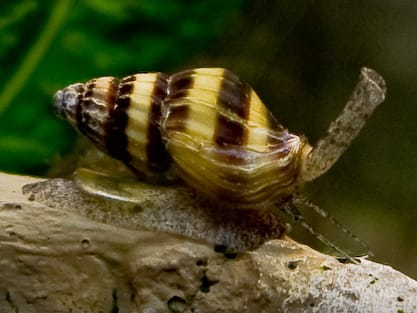
Assassin Snail
Anentome helena
Parameter dashboard
21-27 °C
7.2-8
3 cm
Care guide
Despite the name, the assassin snail (Anentome helena) is a snail, not a fish, and it earns that name by hunting. This small Southeast Asian species, native to Thailand, Malaysia, and Sumatra, grows to around 2.5–3 cm and wears a pointed, bumblebee-striped shell. It spends much of the day buried in sand with only its breathing siphon poking up, sampling the water for the scent of prey. The moment it smells food, it surfaces and goes hunting.
What it hunts is other snails. Assassins eat bladder, ramshorn, and Malaysian trumpet snails, which makes them the go-to fix for a pest-snail outbreak, with no chemicals needed. They will also scavenge carrion, fish eggs, and fry too young to swim away. They ignore plants and leave dwarf shrimp and peaceful fish alone, but they do pick off ornamental snails like nerites and mystery snails, so don't mix them with snails you want to keep. Skip puffers and snail-eating loaches, which turn the hunter into the hunted.
Care is easy. Keep water at 21–27°C and pH 7.2–8.0, with moderate hardness. Soft water pits their shells, so add crushed coral if yours is low in minerals. When the pest snails run out, feed high-protein foods like frozen bloodworms, sinking wafers, or pellets. One quirk sets them apart from most aquarium snails: they have separate sexes and can't clone themselves, so keep six or more to get a breeding pair. Females lay single eggs in tiny, square, translucent capsules stuck to rock or wood. The young emerge as miniature snails, with no free-swimming larval stage, and monitor the population as juveniles develop.
Sources
- en.wikipedia.org — https://en.wikipedia.org/wiki/Anentome_helena
- aquariumcoop.com — https://www.aquariumcoop.com/blogs/aquarium/assassin-snail
- theshrimpfarm.com — https://www.theshrimpfarm.com/posts/assassin-snail-care/
Further reading on identification and aquarium care.
Tankmate compatibility (sample)
Pairwise screening against other species in the database (prioritizing the same family when data is available).
Review first (12)
Caution or avoid from automated rules — confirm before mixing.
| Species | Assessment | Notes |
|---|---|---|
| Clown rasbora Rasbora kalochroma Caution | Caution | Fish 2x+ larger may eat smaller tankmates · Species with non-overlapping pH ranges may not thrive together Open pair in Compare → |
| Colored snakehead Channa pulchra Caution | Caution | Fish 2x+ larger may eat smaller tankmates · Species with non-overlapping pH ranges may not thrive together · one is boisterous and the other a much smaller peaceful fish sharing the same floor, where it can be intimidated and outcompeted at feeding time Open pair in Compare → |
| Convict cichlid Amatitlania nigrofasciata Caution | Caution | Fish 2x+ larger may eat smaller tankmates · one is boisterous and the other a much smaller peaceful fish sharing the same floor, where it can be intimidated and outcompeted at feeding time Open pair in Compare → |
| Coolie loach Pangio semicincta Caution | Caution | Fish 2x+ larger may eat smaller tankmates · Species with non-overlapping pH ranges may not thrive together Open pair in Compare → |
| Finescale tigerfish Datnioides microlepis Caution | Caution | Fish 2x+ larger may eat smaller tankmates · Species with non-overlapping pH ranges may not thrive together Open pair in Compare → |
| Gold Cap Caudopunctatus Neolamprologus caudopunctatus Caution | Caution | Fish 2x+ larger may eat smaller tankmates · one is boisterous and the other a much smaller peaceful fish sharing the same floor, where it can be intimidated and outcompeted at feeding time Open pair in Compare → |
| Hump-head Cyrtocara moorii Caution | Caution | Fish 2x+ larger may eat smaller tankmates · one is boisterous and the other a much smaller peaceful fish sharing the same floor, where it can be intimidated and outcompeted at feeding time Open pair in Compare → |
| Lizard Loach Homaloptera orthogoniata Caution | Caution | Fish 2x+ larger may eat smaller tankmates · Species with non-overlapping pH ranges may not thrive together Open pair in Compare → |
| Oscar Astronotus ocellatus Caution | Caution | Fish 2x+ larger may eat smaller tankmates · Species with non-overlapping pH ranges may not thrive together Open pair in Compare → |
| Rainbow krib Pelvicachromis pulcher Caution | Caution | Fish 2x+ larger may eat smaller tankmates · Species with non-overlapping pH ranges may not thrive together Open pair in Compare → |
| Schwartz's catfish Corydoras schwartzi Caution | Caution | Fish 2x+ larger may eat smaller tankmates · Species with non-overlapping pH ranges may not thrive together Open pair in Compare → |
| Siamese fighting fish Betta splendens Caution | Caution | Fish 2x+ larger may eat smaller tankmates · one of these species is highly aggressive and is usually best kept on its own Open pair in Compare → |
Same rule engine as Compare. Not a substitute for observation, tank size, or acclimation.
Was this page useful? Spot anything wrong?